Trump's 'America first' policy may turn into 'China first'
US president's protectionist stance and climate change pronouncement are giving China a gigantic opportunity to move across Asia into a leadership role.
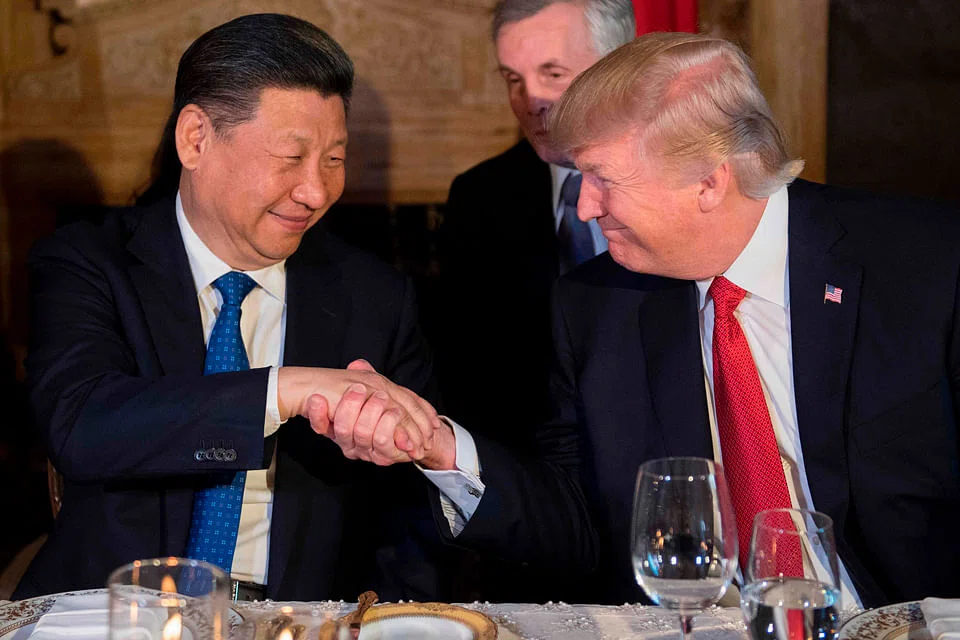
PRESIDENT Donald Trump's relationships with Russia and his sympathies, real and alleged, with President Vladimir Putin have attracted much attention. Another plausible candidate for a "friend of Trump" accolade is President Xi Jinping of China. Many of Mr Trump's actions since his inauguration on Jan 20 are likely, directly or indirectly, to strengthen Beijing's international position.
Mr Trump's decision to pull out of the Paris climate change accord weakens overall momentum behind lowering carbon emissions and quelling global warming. But the US's move to retreat from leadership in this and other spheres such as trade may end up reinforcing China's ability, through a variety of "soft power" measures, to move forward. While advocating "America first", Mr Trump may become instrumental in promoting China to a more effective position on the world stage.
One big problem for Mr Trump is that Asia is now starting to emerge across a variety of fields including defence cooperation - dealing with the many political and security hotspots throughout the region. By apparently ditching long-held American principles in favour of a case by case "transactional approach" in trying to resolve policy dilemmas, Mr Trump may be responding to US domestic pressure for a more hard-nosed attitude towards "free-riding" allies and partners. But he is opening himself to the charge that America cannot be trusted over the longer term - and giving China a gigantic opportunity to move across Asia into a leadership role from which it will not easily be supplanted.
In anti-climate change efforts, China will not be seeking to move overtly to the front. Instead it will be advancing stealthily in broad spheres using traditional multilateral diplomacy backed by grants, credits and technological commitments. As one Beijing official describes it: "There is a vacancy, there is a place. The world has to move forward."
He adds: "Climate change is financially and technically very complex. China cannot simply take over. The US and China have been working together. China alone can't do that. We need Europe, we need emerging markets - we need a set of proper governance measures."
Many commentators and politicians have pointed out that America's step back from a liberal approach to international commerce opens a vacuum that China is trying to fill. On Jan 17 in Davos Mr Xi announced: "We must promote trade and investment, liberalisation and facilitation through opening up - and say No to protectionism."
In contrast, in his inauguration speech three days later, Mr Trump stated: "Protection will lead to great prosperity and strength." Likewise, Mr Trump's withdrawal from the 12-nation Trans-Pacific Partnership has been widely interpreted as giving China a new instrument to forge closer trade ties with countries in its region - and even to supplant the American role in the Pacific Rim.
In a similar way, Mr Trump's climate change pronouncement provides China with additional direct and indirect leverage. One possible route for China is analogous to the multi-dimensional policy it is forging over the "Belt and Road Initiative" - a move to develop infrastructure primarily across Asia and Europe, also spreading to Australasia and East Africa, encompassing around 60 countries.
This goes beyond a giant programme to build continental-scale roads, railways, ports and other trade facilitation structures, involving investment over several decades and from a variety of sources of between US$4 trillion and US$8 trillion. As Chinese officials make clear, the initiative is designed, too, to encourage further international use of the renminbi as an investment, payments and transaction currency that will one day challenge the dollar.
Furthermore, the Chinese effort also aims to build up a Chinese-style financial regulatory and banking system in countries in the "Belt and Road" programme. This meets a threefold objective: to strengthen economic and financial systems; to safeguard Chinese credits and investment across this widespread region, ensuring, for example, that repayments are made on time; and to provide opportunities for Chinese expansion in financial services.
In climate change, China could now take a similar multi-dimensional approach by pushing forward with efforts to harmonise regulatory standards in fields ranging from green bond issuance to solar energy installations. Europe and China have agreed to a "green alliance" to push forward the climate agenda. After meeting Li Keqiang, the Chinese premier, in Brussels, Donald Tusk, president of the European Council, called the Trump decision "a big mistake" and said that the European Union and China would accelerate emission cuts. "Today, China and Europe have demonstrated solidarity with future generations and responsibility for the whole planet," Mr Tusk added.
There is room for China to propel forward a United Nations (UN) commitment to reduce emissions by 26 per cent from 2005 levels by 2025. Michael Bloomberg, the former New York mayor, said after meeting French President Emmanuel Macron on June 2 that US cities, states, universities and businesses would inform the UN that they aimed to honour the US commitment. Jerry Brown, the governor of California, has been in China in the last few days to talk to political and business leaders about coordinating new green technologies being produced by Chinese manufacturers. Mr Brown has joined Andrew Cuomo, the New York governor, and other state governors, pledging continued allegiance to the Paris commitments .
China Investment Corporation, the Chinese sovereign fund, which has been eyeing the vaunted US$1 trillion Trump infrastructure programme as a possibility for enhanced American engagement, is exploring whether Mr Trump's disavowal of the Paris agreement is a possible opportunity for building cooperation in the US at a state and municipal level.
Chinese officials bemoan Mr Trump's climate change withdrawal as a blow for overall progress. But it is not clear how much real change this will provoke in the near term, as Mr Trump had already shown a distinct lack of interest in the area, for example in the May Group of Seven meeting in Sicily of the world's top advanced economies. The US, China, France, and others designed the Paris accord to push forward with a series of processes that are highly flexible - able to adapt to changing circumstances.
What is clear is that China now has a series of valuable channels for enhanced international cooperation bypassing Mr Trump's Washington. Over time, Mr Xi may be very grateful to his opposite number in Washington. "America first" may turn into "China first".