Trump's Saudi dilemma: Realpolitik vs liberal internationalism
With the fate of Washington Post columnist Jamal Khashoggi still unresolved, President Trump finds himself in yet another tight spot.
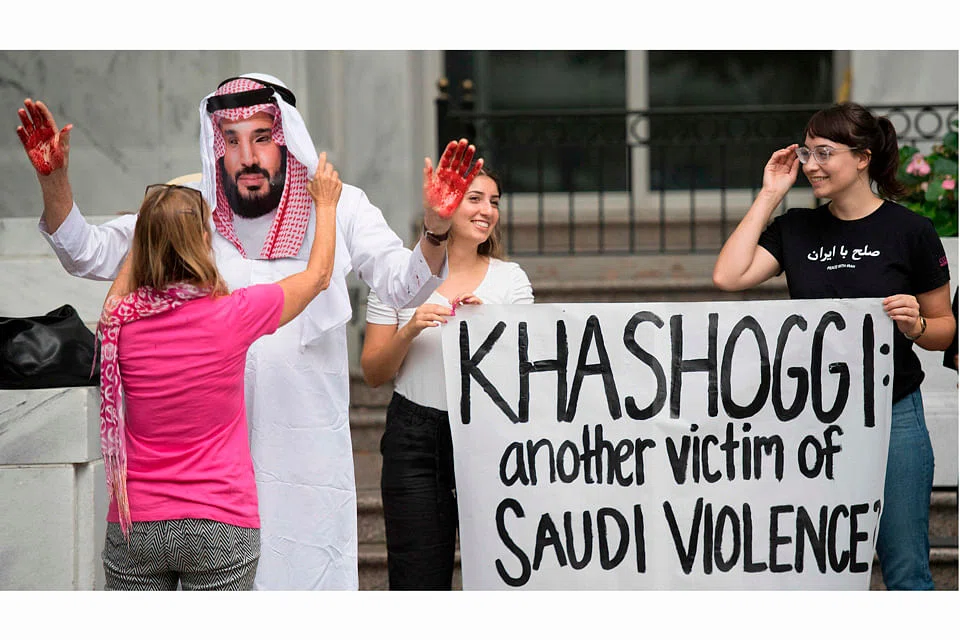
THE continuing international preoccupation with the fate of Saudi Arabian journalist Jamal Khashoggi who entered the Saudi Consulate in Istanbul, Turkey, on Oct 2 to sign documents relating to his divorce and has since not been heard from, should not surprise anyone.
The Turkish government alleges that it has evidence that a Saudi hit team tortured and murdered Mr Khashoggi in the consulate and then dismembered his body and packed the remains in a black suitcase, despatched it in a black van and into a private plane headed for Saudi Arabia.
It was inevitable that the plot - which sounded like a cross between an international spy thriller and a sordid horror film - would capture the imagination of the entire world that is under the spell of the 24/7 news cycle, especially since for several days the Saudis have refused to explain what really happened to the missing reporter. "The whole world is watching," suggested President Donald Trump in an interview with CBS News programme 60 Minutes.
But the interest in the story went beyond its film noir traits. Mr Khashoggi resided in a suburb of Washington, DC, and served as a columnist for The Washington Post, one of America's leading news organisations that was bought a few years ago by the owner of the Silicon Valley's crown jewels, Amazon. Mr Khashoggi was not an international celebrity but a man with political connections and media clout who seemed to be playing the role of a promoter of press freedom and that of a political dissident, and therefore almost by definition has become the hero du jour in the eyes of the Western elite.
According to the narrative constructed by many American pundits, if Mr Khashoggi were the hero, Crown Prince Mohammed bin Salman (aka MBS) who rules the Kingdom of Saudi Arabia, would be the villainous autocrat who regarded the Saudi journalist, a critic of his policies, as a threat to his power and thus targeted him for elimination.
Since coming to power, the young Saudi prince has marketed himself to Americans as a political and economic reformer, allowing women in the Kingdom to drive and removing other restrictions on them, while promoting more economic and cultural ties with the West.
That in turn created a lot of expectations that MBS would emerge as a liberal crusader, and explains why the notion that he had ordered the assassination of his critics came as a major shock to many of his new American buddies in Washington, Wall Street and Silicon Valley, who went on to denounce the Saudi ruler who had suddenly turned from reformer to autocrat.
But then the Good Guy (Mr Khashoggi) vs the Bad Guy (MBS) narrative that evolved after Mr Khashoggi's disappearance seemed to be more of a reflection of the wishful thinking of American politicians and journalists than of the reality of Saudi politics and society.
MBS was not the Saudi version of Mikhail Gorbachev who was seeking to democratise and liberalise the decaying Soviet Union, but could probably be compared to Deng Xiaoping who wanted to reform the Chinese economy and integrate it into the global economy while maintaining control of the Chinese Communist Party and strengthening China's military power.
Hence, MBS wants to modernise Saudi society and economy and to weaken the power of the religious guardians who sustain the Kingdom's conservative Sunni traditions and close it to the outside world.
But the young Saudi prince never pretended to be a "democrat" in the Western sense. In fact, he took steps against his political opponents, including jailing and even executing some of them.
And central to his agenda has been the formation of a military alliance with Egypt and other Arab-Sunni states, creating a so-called Arab Nato, aimed at containing radical Shiite Iran and its regional satellites, most recently through a military campaign against Iran's allies in Yemen which resulted in the death of thousands of Yemenite civilians.
Most significant have been the close personal ties that developed between MBS and President Trump and his son-in-law Jared Kushner. That helped solidify the strategic alliance between Washington and Riyadh as part of a new US policy to strengthen relations with Saudi Arabia and Israel and to deter Iran from pursuing its aggressive moves, including the spread of terrorism in the Middle East.
That Mr Khashoggi has been a vocal critic of these Saudi and American policies does not qualify him as a heroic political dissident or a crusader for press freedom.
In fact, for most of his adult life, Mr Khashoggi, a member of a prominent Saudi family, served the Saudi regime, working for the government-controlled media and cooperating with its intelligence agencies, while at the same time developing ties with anti-American Islamist groups. He interviewed Osama bin Laden and later praised the terrorist leader after he was killed by American commandos.
In recent years, Mr Khashoggi expressed support for the Muslim Brotherhood, a radical Islamist group that seeks to oust the Saudi regime and other Arab-Sunni governments. The organisation is backed by Turkish leader Tayyip Erdogan who is competing with the Saudis and the Iranians for influence in the Muslim Middle East.
From that perspective, the Saudi regime regarded Mr Khashoggi as a political opponent. It was furious about the anti-MBS articles he published in The Washington Post and was worried about the journalist's plans to establish a pro-Muslim Brotherhood group in the Washington area. That may explain why the Saudis wanted to shut up Mr Khashoggi, but that certainly does not justify a plan to kidnap him, a view that is shared by the majority of Americans and their representatives in Washington.
In a way, while the oil-rich Saudi Arabia has been a close strategic ally of the United States since the 1940s, American presidents have never pretended that the two countries shared common values. The Saudi connection was always about oil and not ideals. And it is doubtful that that would have changed even under a moderniser-ruler like MBS.
If anything, President Trump has insisted that he would be pursuing a realpolitik interest-based approach in dealing with authoritarian regimes such as China, Russia or Saudi Arabia, and that he would refrain from delivering to them sermons on the need to protect human rights.
But even the most powerful American president, intent on improving relations with authoritarian governments, would find himself constrained by public opinion and Congress if those regimes engage in murdering their opponents in foreign countries, like in the case of the Saudi Arabian and Russian governments.
This certainly poses a major policy dilemma to President Trump whose entire strategy in the Middle East counted on the cooperation of MBS who - in addition to pursuing the idea of creating a so-called Arab Nato to contain Iran, and assisting Washington in reaching an Israeli-Palestinian peace deal - was buying American military equipment worth more than US$100 billion and in the process helping President Trump create more American jobs.
Under the worst-case-scenario a crisis in the US-Saudi relationship would play directly into the hands of the Ayatollahs in Teheran and could destabilise the global energy markets.
In any case, there is no doubt that the American media and Congress would demand that Washington "punish" the Saudis if the evidence points to their being directly responsible for Mr Khashoggi's death, leaving President Trump no other choice but to cool off his relationship with MBS.
Share with us your feedback on BT's products and services