Truss in trouble amid Tory meltdown
There could well be a new UK PM by the new year. Yet, remarkable as recent weeks have been, they fit a wider pattern of underlying UK political flux since at least the Brexit referendum in 2016.
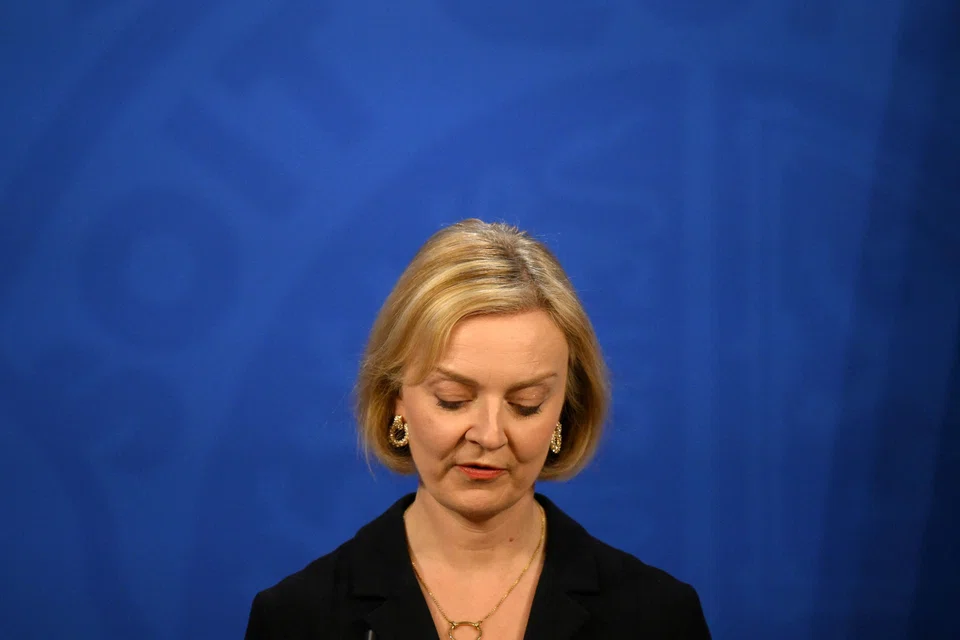
THE English phrase “it never rains but it pours”, which is believed to date back to the 18th century, is a compelling description of UK politics in 2022 with Prime Minister Liz Truss now in very serious political peril.
While the phrase may have originated with references to the weather, it now often refers to the fact that when one negative development happens to someone or something, several bad things can soon follow. This is certainly the feeling of many, if not most, exasperated Conservative MPs in Westminster.
A growing number have reached the conclusion that Truss needs to be replaced before the next general election, potentially before Christmas, although most are keeping their counsel private for now. One of the exceptions to this is former minister Crispin Blunt MP, who said on Sunday (Oct 16) that “the game is up (for her) and it’s now a question as to how the succession is managed... Exactly how it is done and exactly under what mechanism (is unclear)... but it will happen”.
The mood of many MPs was voiced in the slightly more cautious words of former cabinet minister Andrew Mitchell MP who said that “it is now clear that significant errors were made with September’s budget which was a victory of ideology over reality”. He said Truss “will go” unless she can soon convince Conservative MPs and financial markets she is up to the job.
It should be remembered here that Truss is the first Conservative leader for almost a quarter of a century who was selected by party activists, despite not winning the support of most Conservative legislators. So the potential for management problems with MPs in Westminster is obvious.
The best-case scenario for Truss may be that she potentially survives in much weakened form – in office, but not in power. However, with an election around two years away at most, this weak leadership seems unlikely to be one that many Conservatives will want to countenance, hence why former finance minister George Osborne called Truss on Sunday a “Pino” or prime minister in name only, saying he thinks she will be replaced by the new year.
The turmoil surrounding Truss’ leadership has only deepened since Friday’s sensational sacking of her finance minister Kwasi Kwarteng. While he lacked political savvy, making many mistakes during his short period at the Treasury, many voters rightly perceive that he is a scapegoat for Truss.
For the truth is that Kwarteng was no “rogue” colleague, but one who had a joint agenda with her. Indeed, reportage in the UK media over the weekend indicates that it was Truss who pushed Kwarteng to be bolder than he wanted to be in September’s reckless emergency budget, including in the proposal to cut the tax rate for the highest earners which even many Conservatives acknowledge was very badly timed.
Moving away from the deeper details of last month’s emergency budget, it is clear too that the blame must lie at Truss’ door for creating a narrative around the new government’s economic policy that was unwise and unsustainable, especially in the middle of a looming downturn. Thus, she artificially inflated expectations during the leadership election contest over the summer, that she would end what she called a failed UK consensus that has “peddled a particular type of economic policy for 20 years that hasn’t delivered”. It was also naive to launch the emergency budget without economic forecasts from the independent Office for Budget Responsibility.
As if this domestic political humiliation was not enough for Truss, to make the embarrassment worse, US President Joe Biden weighed in over the weekend to call her abandoned budget plan a “mistake”. Biden said it was “predictable” that she was forced last Friday to walk back her plans.
So less than a month and a half after assuming office, after the worst start of any modern prime minister, Truss is therefore trying to pick up the pieces of her premiership. While she faces massive political pressures, it is not inconceivable she could remain in office longer than some Conservative MPs think, if she seeks to completely reset and reaches out to far more supporters of her leadership rival Rishi Sunak who were almost completely removed from the cabinet in September.
While it is not yet clear if she can survive, what is evident is that her economic policy will now be significantly revised by new Finance Minister Jeremy Hunt. The former foreign secretary, who finished second behind Boris Johnson in the Conservatives’ 2019 leadership race, appears to have been given wide discretion by Truss to dismantle last month’s emergency budget, and announced over the weekend, for instance, that the increase in corporate taxation scrapped by Kwarteng will be reinstated.
With MPs and markets now awaiting Hunt’s budget on Oct 31, it is timely to reflect on the ongoing extraordinary events in the United Kingdom since September. At the heart of this was the most negative market reaction to any UK fiscal event in living memory, with Kwarteng’s resignation meaning there have now been four UK finance ministers in four months (Sunak, Nadhim Zahawi, Kwarteng and Hunt).
While Truss will serve more than Kwarteng’s approximately 40 days in office, the political longevity of prime ministers since 2019 has decreased too with three premiers since then (Theresa May, Boris Johnson and Truss). Compare this to before when David Cameron served six years; Gordon Brown three; Tony Blair 10; John Major six; and Margaret Thatcher 11.
Yet, remarkable as the last few weeks have been, they fit a wider pattern of underlying UK political flux, since at least the Brexit referendum in 2016. This is no better documented than the British Election Study which indicates how much voters are increasingly influenced by recent key “shocks”, including potentially the pandemic too, that have seen traditional partisan voting patterns eroding faster than ever, adding to volatility, including in the 2017 and 2019 elections, which saw more people change their vote than ever before in the post-war era.
The chief beneficiary of Truss’s travails will be Labour. Polls released recently have given leads of up to 33 percentage points to the party.
Labour takes nothing for granted, given the volatile political mood. However, there is a growing sense in the country that the Conservatives may be reaching the “endgame” of their current period of office, potentially failing to emerge as the largest party at the next election for the first time since 2005.
Andrew Hammond is an associate at LSE IDEAS at the London School of Economics.