

Two Lefts won't beat a Right
Can the Democratic Party's Elizabeth Warren energise the New Left without antagonising the Old Centre, or can Joe Biden keep the party's two strands together?
SINCE the French Revolution more than two centuries ago, the labels "left" and "right" have been used in reference to two competing political ideologies and the movements representing them - those on the left promoting social justice and economic equality as the engines of progress, and those on the right protecting traditional values and national cohesion as ways of safeguarding the political order.
Through the years those terms have been used and abused by leaders and groups vying for power, and started losing their meaning after the end of the ideological rivalry of the Cold War and against the backdrop of the economic and technological changes of recent decades.
Hence for most of the 19th and 20th centuries we have accepted as a political axiom that the electoral base of left-leaning socialist parties was dominated by members of the working class while the conservative right-wing movements represented the interests of the rich economic elites.
But the head of the Republican Party won the electoral support of blue-collar Americans in 2016. Does that turn President Donald Trump - who rails against the political and economic elites - into the leader of America's workers?
In fact, if you analyse the electoral base of self-proclaimed left-leaning political parties, like America's Democrats, Britain's Labour or the Socialists and the "Greens" in France and Germany, you'd notice that their voters consist of upper-middle class and educated professionals dwelling in large urban centres plus members of ethnic and racial minority groups. The workers on whose behalf the political left is speaking, tend to vote for right-wing parties that bash the moneyed elites and corporate interests.
The sense of confusion that we experience as we try to tag political leaders and parties as either "leftist" or "rightist" is actually not something new when it comes to the Democrats - America's centre-left party that has been the political home of the nation's labour unions and that has won elections by carrying the votes of industrialised workers in the large manufacturing centres.
There has always existed tension between two strands of "left" in the US Democratic Party. Union members gravitated to the Democrats which were seen as committed to strengthening the foundations of the welfare state and to protecting the economic interests of working-class Americans.
But since the 1960s, a New Left seems to have been gaining more power on the Democratic side. Students and educated urban residents working in the advanced service economy have been embracing the agenda of social justice, centred on advancing the rights of women, gays and racial minorities, including African Americans and Hispanics, and highlighting the need to protect the environment.
That the "new" and "old" left did not see eye to eye on many policy issues reflected the economic and social gaps between them. Working class Americans were mostly whites without college education, more traditional and nationalist in terms of their cultural orientation, who believed that the main job of the Democrats was to safeguard their industries and to raise their wages.
The more educated, secular and cosmopolitan new leftists seemed to be more concerned with the problems of marginalised minorities and social issues like feminism and gay rights, and to place more emphasis on saving the environment even if that resulted in the loss of manufacturing jobs.
The strains in the relationship between the two groups became more acute when members of the rising new political elite in the Democratic Party (represented by the likes of presidents Bill Clinton and Barack Obama) took power and tried to strike a balance between the two competing agendas which became even more challenging in the era of globalisation: Should we save the environment or the jobs of coal miners? Can multi-culturalism co-exist with the preservation of American identity? Is trying to guarantee access for minorities to education and employment compatible with interests of white blue-collar workers?
These dilemmas have not been resolved and explains in part why the traditional allies of the old left of the Democratic Party (including members of the labour union) deserted their party and switched in 2016 to the Republican presidential candidate who pledged to defend the economic interests of working class Americans.
In fact, if the United States had a multi-party political system, it is not unlikely that the Democrats would be splitting now into two parties: One would be, say, a Green Party that would become the political home of social justice warriors, environmentalist activists, feminists and advocates for black and Hispanic rights and identity politics represented by New York Representative Alexandria Ocasio-Cortes. The other - what would remain of the Democratic Party - would likely be backed by older voters who support a moderate reformist agenda that focuses on the need to strengthen the welfare state and to expand social-economic programmes, like in healthcare.
But since America has a two-party system, and no one expects the emergence of two Democratic parties anytime soon, the Democrats would have to overcome their divisions if they want to beat Mr Trump next year.
The problem is that if the leader of the old centre-left - former vice-president Joe Biden - is nominated as the Democrats' presidential nominee and wants to ensure that the fans of Ms Ocasio-Cortes do not stay at home on Election Day, he is required to pander to them and proclaim his support for their social-cultural agenda. But doing so would inevitably antagonise those working-class Americans in Pennsylvania, Ohio and Michigan whom the Democrats want to bring back home in 2020.
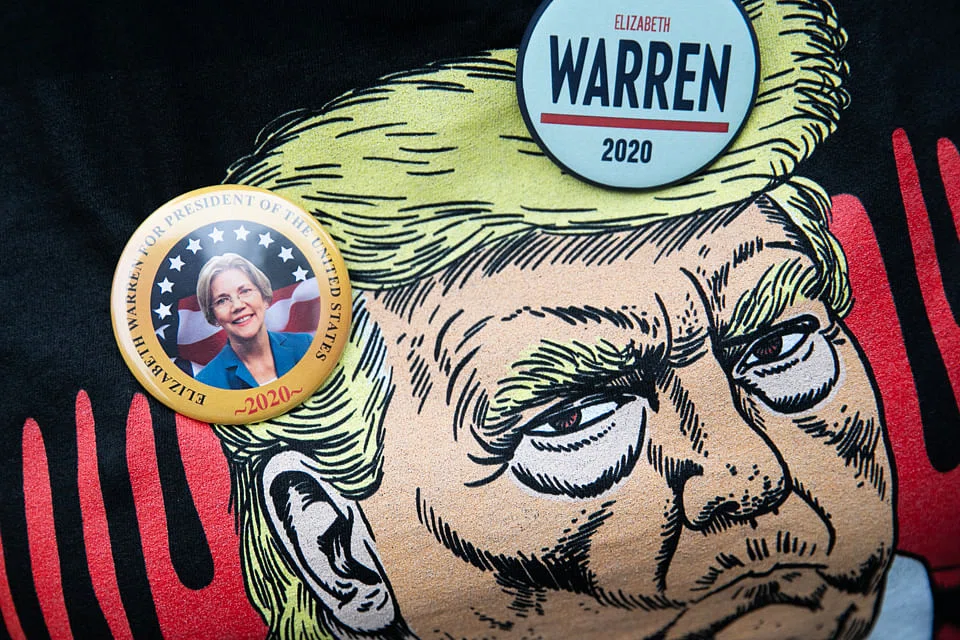
The conventional wisdom until recently has been that the two most left-leaning candidates in the Democratic presidential race, Senator Bernie Sanders (Vermont) and Elizabeth Warren (Massachusetts), are too radical for the political taste of the majority of American voters and that only Mr Biden could beat Mr Trump.
But, in contrast to Senator Sanders who has labelled himself a "socialist", Senator Warren rejects that designation and insists that all she wants is to reform the current capitalist system and protect the interests of American workers, by helping to strengthen the labour unions, providing for an effective national healthcare insurance system, narrowing economic inequality, and by embracing "fair" trade deals.
These could win the backing of the two wings of the party and become a basis for a political message aimed at the blue-collar workers who voted for Mr Trump in 2016 and who may now feel betrayed by the economic nationalist who failed to deliver on his promises.
In order to succeed, Ms Warren would have to start moving to the political centre when it comes to social-cultural issues and not run as an identity-politics crusader and supporter of free immigration, while accentuating the party's "old left" values as the champion of America's workers and of a viable welfare state.
TRENDING NOW

Inside Jensen Huang’s last hours as Nvidia CEO

Higher rates, weaker spending: Is the Philippines entering stagflation?

‘I’ll be buying more’: Singapore investors pour into Nvidia shares on Jensen Huang’s exit

Demand, tech capabilities position Apac and AI as Skyscanner’s next growth frontiers: CEO Bryan Batista

