

US, North Korea talks just first step on long road to peace
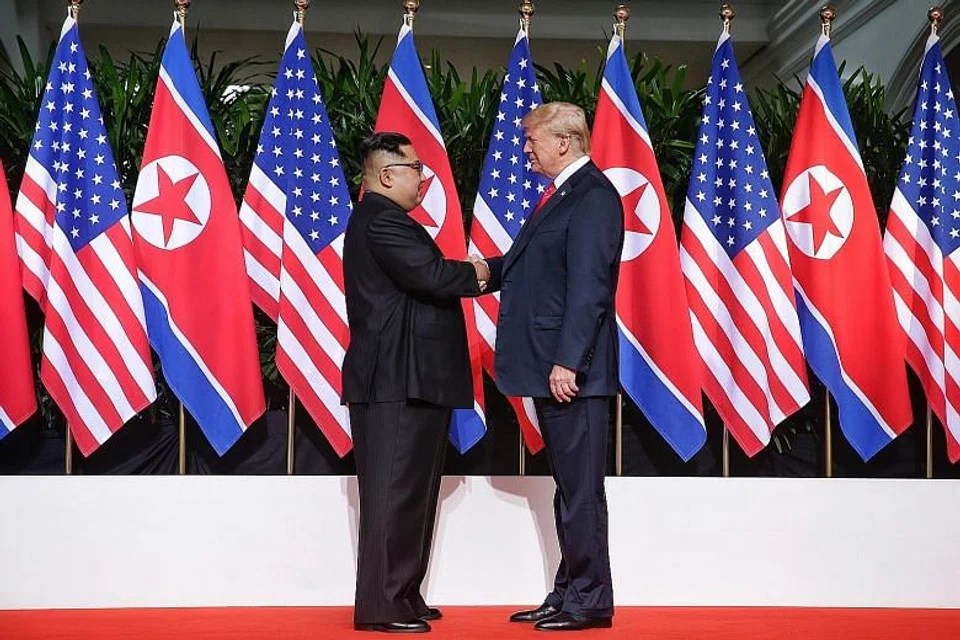
KOREA has been the plaything of the Great Powers for the past 130 years. First it was China, Russia and Japan that competed to dominate the fading Joseon dynasty in the 1880-1895 period, then it was Japan and Russia for the next 15 years, then Japan alone until 1945. Since then, the USSR/China (by the 1970s) and the US have each helped prop up an ally on the divided peninsula.
South Korea's economic transformation since 1961 has made it the world's 11th largest economy. What North Korea lacked in economic power, it compensated with nuclear weapons and the ballistic missiles to deliver them - honed in 2017, with the successful test of intercontinental ballistic missiles (ICBMs) capable of hitting almost every part of the US.
When the conservative successor party of General Park Chung Hee (the dictator responsible for South Korea's economic "Miracle on the Han River") rules in Seoul, inter-Korean relations usually remain hostile.
The democratic stalwart Kim Dae Jung (president from 1998-2003) and his liberal successor Roh Moo Hyun (2003-08) made important overtures to the North that Pyongyang enthusiastically reciprocated.
When Mr Roh's former chief-of-staff, Moon Jae In, was elected South Korea's president in May 2017, a great opportunity presented itself. North Korea took it up at the start of 2018, secure in the effectiveness of its nuclear deterrent.
From the winter Olympics in Pyeongchang to the inter-Korean peace meetings on April 27 and May 27, the Kim-Moon bromance has electrified the peninsula - culminating in the historic Singapore Summit between Kim Jong Un and US President Donald Trump.
Normalising N Korea
That summit ultimately proved to be mainly a confidence-building exercise. It did not result in a peace treaty to end the Korean War, or any other dramatic overture from either side.
All it did was to normalise the former pariah state of North Korea - bringing it in from the cold, locking it into diplomatic negotiations, and initiating a long process that could eventually lead to a permanent peace on the Korean peninsula.
This itself was a remarkable outcome, marking an extraordinary turnaround from the danger of nuclear war that hung over the Korean peninsula right through 2017.
Unsurprisingly, the DPRK did not unilaterally surrender its nuclear weapons, having worked painstakingly over two decades to acquire a credible nuclear deterrent. Mr Kim thus demonstrated just how dexterous a negotiator he is.
Both the DPRK and the US achieved their key summit objectives: The US will not withdraw the sanctions on North Korea - despite prominent calls from China (today) and Russia (last week) to withdraw them.
But North Korea merely agreed to the "complete denuclearisation of the Korean peninsula" in line with the Panmunjom Declaration.
The US has always maintained that sanctions will only be removed when denuclearisation is complete, verifiable and irreversible. Thus, the summit merely laid the groundwork for negotiations, but didn't result in a substantive "deal".
War games
The US did agree to stop the regular "war games" (military exercises) conducted by the US and South Korean militaries - Mr Trump called them "provocative" (echoing Mr Kim) and expensive. Mr Trump also announced that South Korea and Japan would help finance North Korea's denuclearisation process.
The DPRK apparently offered to destroy a missile-engine testing site soon (following-up on its unilateral destruction of its main bomb-testing site).
The Panmunjom Declaration of April 27, 2018, held out the distinct possibility of Korea's gradual economic reunification, but the Singapore Declaration suggests that goal still remains distant.
Mr Trump made it clear that the withdrawal of US troops from South Korea is possible at the end of the negotiation process. Thus, Mr Trump clearly accedes to the idea of a reciprocal set of military concessions - that go well beyond the unilateral "Libya model" that his National Security Adviser John Bolton favours.
Mr Trump was criticised for agreeing to a summit with North Korea - which should normally have been at the end of a long process, not its beginning. But he hasn't given up much by holding the summit: all he has done is kickstart a serious negotiation process that both sides are committed to. The granular details of what constitutes a "complete denuclearisation of the Korean peninsula" will take months, perhaps years, to sort out.
South Korean equities carry a "Korea Discount" because of the near-permanent threat from the North: their price/equity ratios are nearly always lower than those of Asia's 12 other equity markets. That Korea Discount will be diluted, but not entirely eliminated by the outcome of the Singapore Summit. But the longer-term economic and political risks on the Korean Peninsula have been drastically lowered by the extraordinarily transformative events of the past five months.
READ MORE:






