

US war of ideas to have long-term impact
Positions are shifting in trade and security: it seems like the GOP is emerging as pro-free trade and pro-military intervention, and the Dems, more protectionist and isolationist
IT'S become somewhat of a cliché, but, yes, American politics is going through a major transformation. And while we're using clichés, let's add that this transformation is going to have a long-term impact on the US approach to global affairs.
Want some proof? Well, in the same week that finance ministers and central bankers from around the world were gathering in Washington - the symbol of US global military and economic supremacy, a.k.a. the American Empire - for the spring meetings of the International Monetary Fund (IMF) and the World Bank, President Barack Obama and Republicans and Democrats in Congress were engaged in two major legislative and political battles that reflected the evolving war of ideas of the early 21st century over US strategies in the Middle East and East Asia, as well as over American trade and security policies. These fights are forcing the two major political parties and their leaders - President Obama as well as the Democratic and Republican aspirants - to define their positions on those issues in a way that would have a major impact on American global policies in the coming years.
To make some sense of what's taking place now, one needs to recall that in the decade or so following the end of the Cold War, there seemed to be a bipartisan consensus in Washington over national security and trade policies. Both Republican President George H W Bush and Democratic President Bill Clinton were ardent internationalists who shared a clear commitment to maintaining US global strategic supremacy, including in the Middle East, and to leading an effort to liberalise international trade.
It was true that even then, the Democrats were perceived to be less interventionist on military policy and more protectionist on trade issues than the Republicans. But it's important to remember that it was Clinton the Democrat who presided over some of the most significant steps to liberalise US trade policies in the 1990s, including the signing of the historic North American Free Trade Agreement (NAFTA), the normalisation of trade ties with China and the establishment of the World Trade Organisation (WTO), in addition to leading a US military intervention in the Balkans that brought an end of the civil war in the former Yugoslavia.
Pursuing those trade and foreign policies needed reliance on the support of Republicans on Capitol Hill. Hence the controversial free trade accord with Mexico and Canada was passed in November 1993 by 234-200, with the supporters including 132 Republicans and 102 Democrats, and by 61-38 in the Senate, with 34 Republicans and 27 Democrats backing it.
Core Democratic-Party allies - like the labour unions, environmental groups and human rights advocates - have never embraced free-trade principles. But at the same time, a powerful coalition of centrist Democratic lawmakers and economic officials in the Clinton administration - the "Clintonites" like former Treasury Secretaries Robert Rubin and Lawrence Summers - played a central role in successfully promoting President Clinton's ambitious trade agenda.
Similarly, while many Democrats and liberals have been critical of President George W Bush's invasion of Iraq and his unilateralist military policies in the Middle East, the majority of the Democrats in the Senate, including a certain senator from New York (Hillary Clinton), voted in support of authorising the White House to oust Saddam Hussein and of the war in Afghanistan.
What is remarkable about the current congressional debate over President Obama's trade policies, including the proposed Trans-Pacific Partnership (TPP) accord with 11 Pacific Rim nations, is the extent to which almost all the Democrats on Capitol Hill are now opposed to the notion that United States continue playing a leading role in liberalising global trade - an integral principle of the bipartisan internationalist perspective that dominated Washington since the end of World War II.
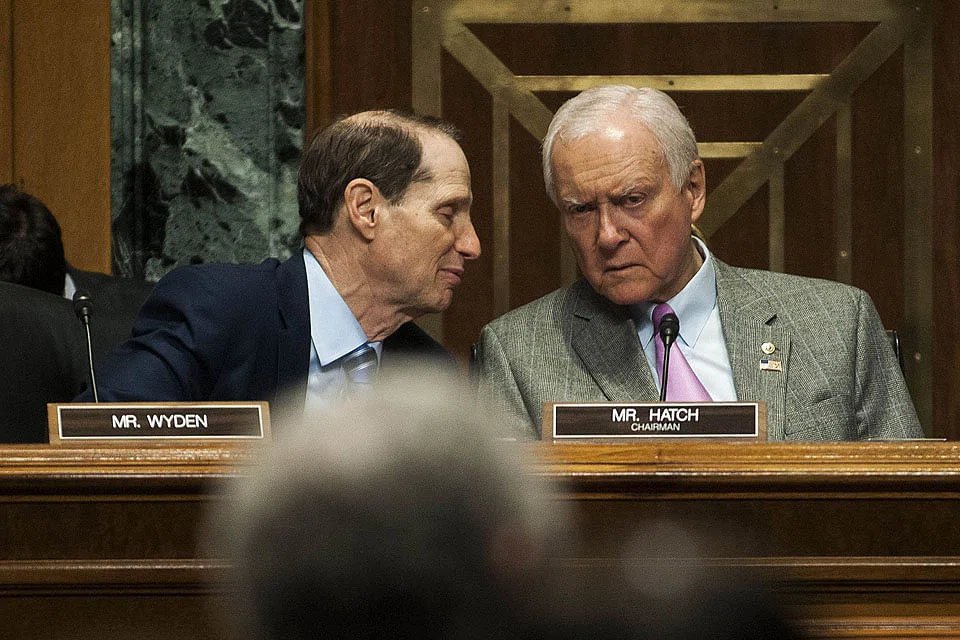
A high-ranking Democratic senator on the Senate Finance Committee, Ron Wyden of Oregon, joined the Republican Chairman Orin Hatch from Utah and Republican Representative Paul Ryan of Wisconsin, Chairman of the House Ways and Means Committee, in drafting a Trade Promotion Authority (TPA), or the "fast track" that would enable President Obama to conclude the negotiations on the TPP and on a similar free-trade agreement with the European Union (EU).
But in a way, Mr Wyden is a member of an endangered political species on Capitol Hill - the centrist pro-free trade Democratic lawmaker - and he happens to represent a north-western state whose economy depends very much on trade and investment ties with the Pacific Rim economies, which explains why Democratic lawmakers from California and Washington states will probably also vote in support of "fast track" and the TPP.
But then, two moderates and internationalist Democrats - Senator Chuck Schumer of New York and Representative Chris Van Hollen of Maryland - the kind of Democratic lawmakers who would have backed NAFTA in the 1990s, have already made it clear that they would be voting against the proposed trade legislation.
Indeed, despite the fact that the TPA bill incorporates and addresses traditional Democratic concerns about labour and environmental rights more than anytime in the past - and allows Congress to rescind the TPA if it concludes that the final TPP deal violates the commitments made by the White House - the leading labour unions and environmental groups have pledged to block the TPP and not to provide the current Democrat occupying the White House with a "fast track" authority.
At the same time, many of the centrist Democratic lawmakers who were allied with President Clinton in the 1990s have retired and are being replaced by members the resurgent progressive wing of the party that have embraced a skeptical, if not hostile, approach to free trade, blaming the passage of NAFTA and the normalisation of trade relationship with China for the loss of American manufacturing jobs and for the stagnant wages of American workers. "Never again," they will pledge, when they are asked to vote in favour of the TPP.
One of the leading opponents of the TPP is Democratic Senator Elizabeth Warren of Massachusetts, who is emerging as the leader of the Democratic progressives and who continues to be under pressure to run for president next year as an alternative to Hillary Clinton who, like her husband, is seen as an ally of Wall Street and a, well, Clintonite, who has yet to state her position on the TPP and other trade issues.
President Obama has called on Congress to provide him with the TPA and to back the TPP. But unlike President Clinton, he has never been a strong proponent of free trade. And his rhetoric and body language have failed to project a lot of enthusiasm about the issue.
And unlike President Clinton, President Obama doesn't have a Robert Rubin or a Lawrence Summers who could serve as an articulate advocate of his trade policies.
The White House seems to be operating under the assumption that the majority of the pro-business Republicans would provide him with the votes needed for the passage of the TPA and TPP. But GOP leaders have warned that a few Republicans who are affiliated with the Tea Party movement may vote against "fast track" and stress that President Obama needs to get the support at least 50 Democratic lawmakers in the House.
The conventional wisdom in Washington is that President Obama would eventually win the day on trade with narrow majorities in the House and the Senate. But even if that happens, it's becoming clear that his political party is moving steadily to the left and like other left-of-centre movements in the West, will embrace more radical, anti-free trade policies in the coming years, making it more difficult for Republican and Democratic presidents to promote new trade initiatives.
At the same time, President Obama's Iran nuclear deal and his opposition to US military intervention in the Middle East does reflect the views of progressive Democrats who, after all, helped foil Hillary's 2008 presidential hopes because of her support for the Iraq War.
The leading Republican presidential candidates, reflecting the sentiments of the party's activists and supporters, are calling for a more muscular military and diplomatic US policy in the Middle East and around the world, suggesting that the GOP is emerging as the pro-free trade and pro-military intervention party - while the Democrats are gradually shifting in a more protectionist and isolationist direction.
So it will be interesting to see how the internationalist and interventionist Hillary Clinton would adjust to this changing political reality. Is she still a Clintonite - or has she also been moving together with her party to the political left?
TRENDING NOW
Simba admits exceeding spectrum limits amid failed M1 deal; parent company Tuas’ full-year profit surges 277%

He built the Vingroup empire. Now South-east Asia’s richest man is handing some key roles to his sons

Ex-execs of CW Group, Allied Tech charged with offences linked to lawyer’s S$76 million misappropriation
Singapore to prioritise high-value AI infrastructure as Asean markets play to their strengths: Tan Kiat How

