

The US's complicated Middle East policy mix
Washington hopes to create a stable balance of power that would not require the deployment of US ground troops in the region and is not looking for a regime change
WHEN his fans claim, and his detractors sometimes agree, that US President Donald Trump is "authentic" and that he "says what everyone thinks", they usually have in mind your standard Archie Bunker applauding The Donald's most recent violation of a political correctness directive.
But then on occasion, Queens' native son who currently occupies the White House pronounces in public - in his own stream-of-consciousness way - what even some members of Washington's political elites only say privately.
Consider, for example, Mr Trump's comments in a recent interview to The Washington Post, discussing American policy in the Middle East, in which he expounded on one of the reasons why the US may consider bidding farewell to that part of the world.
"Oil is becoming less and less of a reason because we're producing more oil now than we've ever produced," he observed. "So, you know, all of a sudden it gets to a point where you don't have to stay there, "there" being what Mr Trump described as a "dangerous, rough part of the world".
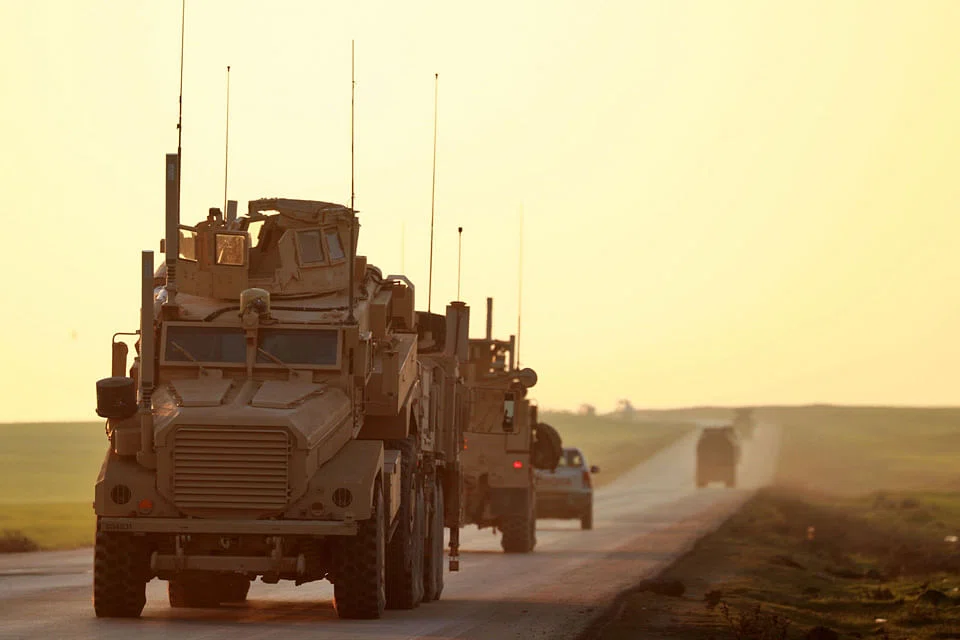
In a way, this kind of deep thoughts about the Middle East and American role provide an explanation to Mr Trump's decision, announced last week that he planned to withdraw all 2,000 American troops from Syria within 30 days.
The announcement not only came as a big surprise to US allies in the Middle East, but it also stunned members of the foreign policy establishment in Washington, including Secretary of Defence Jim Mattis who resigned on Thursday in protest of Mr Trump's Syria decision.
But the decision by the nationalist occupying the White House to start reducing America's military footprint in the Middle East should not have come as a shock to anyone familiar with Mr Trump's long-held criticism of American military intervention in that region of the world and his campaign pledges to reassess that costly strategy.
REALPOLITIK VISION
Americans, in short, are less willing now to pay the high costs of a Middle East strategy that, after all, ended with one disaster after another. Another radical regime coming to power; more acts of anti-American terrorism; one more military fiasco and that Middle East "peace process" that leads to nowhere; not to mention the high costs in American lives and American dollars.
In fact, one of major reasons that Candidate Trump had crushed the neo-conservatives' favourite candidates, Jeb Bush and Mario Rubio, in the Republican primaries - and then went on to win the 2016 presidential election - was his harsh criticism of the decision to go to war in Iraq and his call for reducing American military involvement in the Middle East, which he denounced as a waste of the country's resources that run contrary to US national interests.
And while Mr Trump has bashed his predecessor's foreign policy agenda, including his Middle East policy, President Barack Obama's electoral success exposed a similar public disenchantment with American push for "regime change" and "nation building" in Iraq and in the Arab World.
Like Republican Candidate Trump, Democratic Candidate Obama criticised the decision to oust Iraq's Saddam Hussein, which was backed by both his Democratic rival, Hillary Clinton, and by his Republican challenger, John McCain, and pledged to withdraw US ground troops from Iraq and Afghanistan.
Moreover, notwithstanding some disagreements over how to define US national interest, both the "internationalist" Obama and "nationalist" Trump shared a common Realpolitik vision of an evolving multipolar international system under which Washington needed to shift its strategic focus from the Middle East and the War on Terror to East Asia as part of an effort to contain the rising economic and military power of China. The latter has been the main beneficiary of America's sinking into the quagmires of the region that in Beijing is being referred to as "West Asia".
Going back to the Fall of the Berlin Wall, that was probably the time when US policymakers should have conducted a wide-ranging reassessment of US strategy in the Middle East that reflected Cold War considerations, including the need to contain the Soviet threat in the region and to protect the energy resources in the region on which the industrialised economies, and in particular, America's allies in Europe and Asia, were dependent.
If such a post-Cold War reassessment of US policy in the Middle East would have been conducted and its operative conclusions would have been implemented, one could imagine a "What If?" scenario under which a gradual US disengagement from the Middle East would have provided incentives for its European allies to start paying the costs of maintaining their economic and military interests in what is, for all practical purposes, their strategic backyard.
But that did not happen. Instead, political and bureaucratic inertia in Washington that was welcomed by the pro-American Arab states and by Israel as well as by the Europeans, led to the expansion of the American involvement in the Middle East to a level that did not align with US military, diplomatic and military power, leading to major failures: No democracy in Iraq! No stability in the Middle East! No peace between Israel and the Palestinians! A resurgent Iran and the monstrous ISIS! A richer China and a poorer America. President Obama hoped to square the Middle East circle and to reduce the need for American intervention in the area, and in particular to remove the threat of a military confrontation with Iran, by creating the conditions for the co-option of Teheran into a new and stable regional balance of power system involving Iran and Saudi Arabia. He was also hoping to ally the US with the "forces of change" of the so-called Arab Spring.
BALANCE OF POWER
That did not work too well, so Mr Trump entered office with his own Realpolitik vision that assumed that the combined military power of Saudi Arabia and the Arab Sunni states - as part of a new "Arab Nato" - and that of Israel could succeed in containing Iran's efforts to challenge the status quo, especially after the president and his son-in-law would help achieve the "deal of the century" between the Israelis and the Palestinians.
It also should be noted that when it came to Syria, that Mr Trump, like his predecessor in office, resisted the pressure from members of the foreign policy establishment in Washington to intervene in the civil war in Syria and like President Obama, he was hoping to reach a deal with the Russians over the issue.
His goal has never been a "regime change" in Damascus or for that matter, in Teheran, but the creation of a stable balance of power in the Middle East that would not require the deployment of US ground troops in the region.
Defending the Syria withdrawal, Mr Trump tweeted that the US should not be the "policeman of the Middle East".
His administration fulfilled its commitment to help get rid of the presence of the murderous ISIS terrorists in Syria and Iraq, and now was time for other players in the region, including Turkey, Saudi Arabia and Israel to start take care of their regional interests without picking up the phone to call Washington each time they face a challenge.
For years, any sign of growing tensions in the Middle East would have immediately triggered pressure on Washington to "do something" as soon as possible.
Doing nothing, US officials were warned, could risk a full-blown regional war, outside intervention by global adversaries, oil embargoes, the collapse of pro-American Arab regimes, the survival of Israel, and perhaps even the end of the world as we know it.
As the rest of the nation's international and domestic problems would be placed on the policy backburner, the US president would make urgent phone calls to Middle Eastern leaders, as he and the rest of Washington would consider sending the Marines, dispatching American envoys to the Middle East, launching another "peace process" and perhaps even convening another "peace conference".
This kind of American diplomatic hyperactivity in the Middle East would be followed by the deployment of US peacekeeping troops and the provision of huge financial assistance packages, with the Americans being drawn into never-ending efforts to resolve unresolvable conflicts, continuing to raise the costs of US intervention in the Middle East.
So perhaps, following the US withdrawal from Syria, Americans should be experiencing a certain sense of pleasure, or schadenfreude as they watch the Russians being drawn into what could prove to be a long and costly effort to "do something" in response to what is happening in its protectorate, Syria.
Good luck with that, President Putin!
TRENDING NOW

He built the Vingroup empire. Now South-east Asia’s richest man is handing some key roles to his sons
Seatrium allocates S$200 million for new share buyback programme

32 companies, 6 individuals bag accolades at Singapore Corporate Awards 2026

Stocks to watch: Mapletree Logistics Trust, Seatrium, Keppel DC Reit, Food Empire

