

Wake up the mob . . . at your own risk
To gain the support of President Trump's political base, some members of America's elite jumped on the populist wave to advance their personal political interests.
RENOWNED Irish philosopher and statesman Edmund Burke once wrote: "Anger and madness will destroy us in half an hour, while caution, deliberation and foresight accumulate over a hundred years." This was in his 1790 book Reflections on the French Revolution, which foresaw the terrible events of the revolution that followed the attack on the Bastille.
Burke warned his readers in the British Isles who supported political change, to refrain from adopting the French revolutionary model, which led to chaos and anarchy and created the conditions that provided eventually for the emergence of a terrorist regime.
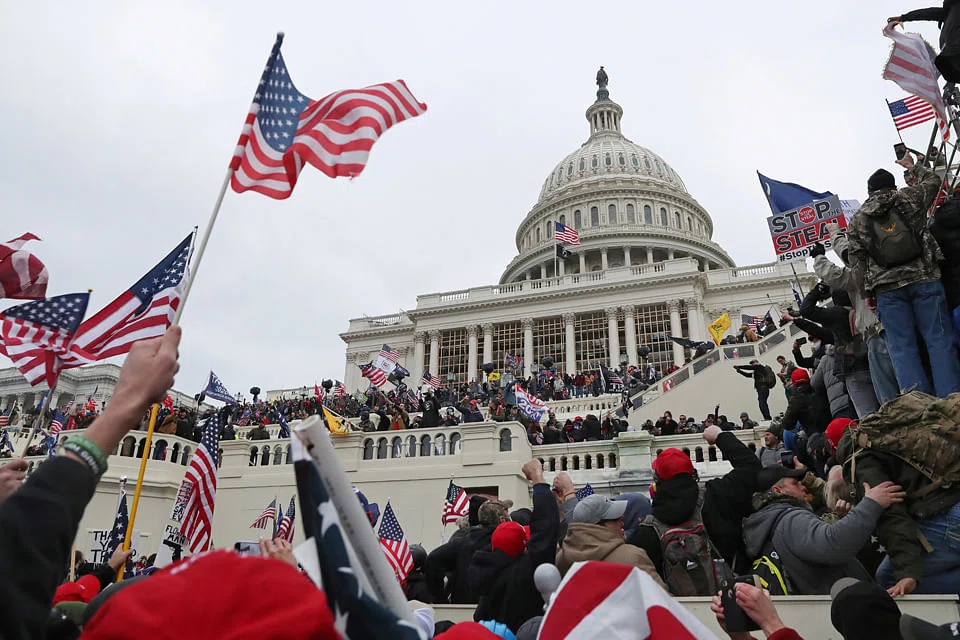
Historically we might be overstating the case by comparing the recent assault on Capitol Hill to the take-over of the Bastille. But the frightening picture of a mob breaking into the US Congress would have reminded Burke of the horror show of his time: Under the banner of democracy and pretending to speak on behalf of the "people", the revolutionaries of then and the populists of today may have had good intentions, but they led their people on the road to political hell.
LIBERAL CONSERVATIVE
Burke is regarded today as the founder of modern political conservatism. But if one considers that he supported the American Revolution, predicted the Irish War of Independence and opposed slavery, one could label him these days as a liberal conservative, or a classical liberal, whose influence went far beyond the European reactionary movements that developed after the French Revolution. In this respect, his impact on the American Revolutionary War and the values on which the Founding Fathers established the new republic was immense, if not decisive.
Some are surprised that the word "democracy" does not appear in the American Declaration of Independence nor in the US Constitution. Although Thomas Jefferson, Thomas Paine and other Founding Fathers came under the influence of the French Revolution, the new republic was formed by a group of men who constituted a political and intellectual elite par excellence.
They adopted the British model of gradual political change, not revolution. Reforms could and should take place through a representative government, or, in today's terms, a representative democracy, in which, as Burke insisted, the power of the people to impose their demands would be limited in various ways.
Ironically, while carrying the populist flag, President Donald Trump and his party have dominated the White House and the Senate for the past four years thanks to an electoral system that used electors - rather than direct popular elections - and to an undemocratic institution that gives a densely populated state like California the same number of representatives in the Senate as to Idaho.
The Founding Fathers, like their British cousins, hated populism even before the concept was even invented. Like the British House of Lords, the US Senate, whose representatives are elected for six years, is supposed to curb the power of the members of the House of Representatives, the People's House, elected directly for two years, and to slow down the legislative process.
The system of checks and balances, in the form of a powerful judiciary, ensures that the elected representatives remain loyal to the constitution. And thanks to the influence of conservative federalists led by Alexander Hamilton, the political independence of the various states is constrained. This is American Politics 101.
Dramatic political changes have occurred in the United States but only when push came to shove, like, in big time. The American Revolution would not have happened if the English king had accepted the modest demands for representation (rather than independence) of the English-speaking colonists. President Abraham Lincoln did not go to war to free black slaves but to prevent a revolt of the Southern states against the central government, and he was in no hurry to issue the Emancipation Proclamation to free the slaves. President Ronald Reagan would not have considered privatising Social Security (in the same way that British Prime Minister Margaret Thatcher did not dare to touch the National Health Service). Yes to Change. No to Revolution.
The Founding Fathers were, however, worried that despite the obstacles they created to block the people's way to power, a demagogue would emerge one day, who would take advantage of a national crisis to overthrow the republic they had established and the constitution they had authored.
From this perspective, the political unrest created by the racial tensions in America this past summer, the demonstrations by organisations such as Black Lives Matter and the violent riots that followed, were rightly seen by Republicans and conservatives as violation of law and order and an attempt to erode the foundations of democracy.
But ironically the serious threat to democracy would be posed by the radicalised Republican Party. Republican lawmakers, who could quote entire sentences from "Reflection on the Revolution" and who keep a copy of the US Constitution in their pockets, and who swore allegiance to a president who did throw them crumbs in the form of deregulation of the economy and the appointment of conservative judges, but who also vowed to break up the power of the "elites" (who apparently did not include billionaires from New York).
This so-called populist agenda, purporting to represent an ideological contra to "globalism" and marketed by intellectual conmen like Steve Bannon, proved to be nothing more than a mishmash of nationalist clichés, attacks on the "other" and a lot of conspiracy theories that exploited the frustration of social-economic victims of automation and the growth in international trade and immigration.
POLITICAL ENIGMA
The bottom line is that President Trump did not return to Pennsylvania or Michigan jobs in the industrial sector, which were allegedly "stolen" by China, and failed to manage the response to the coronavirus plague. He lost the race to the White House and is responsible for the Republicans' loss of control of the Senate.
President Trump still remains a political enigma. Was his bellicose rhetoric designed to mobilise his supporters and strengthen his electoral base? From that perspective, Mr Trump can be seen as a political opportunist.
Or perhaps the president has never read the US Constitution and sincerely believed that he could ignore Congress, the courts and the law, belittle Cabinet members and dismiss guidelines of senior government officials (the "Deep State"), and that no force in the world would stop him on the path to near-total power?
But Republican leaders like Senators Ted Cruz of Texas and Josh Hawley of Missouri are not political enigmas. The two are political opportunists who have embraced and promoted President Trump's book of lies, according to which he had won the election.
In order to gain the support of the president's political base, these respected members of America's elite were willing to encourage the mob that gathered on Capitol Hill and participated in the orgy of destruction and violence in the citadel of American democracy.
They jumped on the populist wave in order to advance their personal political interests. But sooner or later they will discover that when you wake up the mob, don't be surprised that one day it would turn on you.






