

Walls may come up, but keep building doors and bridges
With the TPP's demise and Brexit looming, political solidarity is even more needed now to stand up to protectionism
Singapore
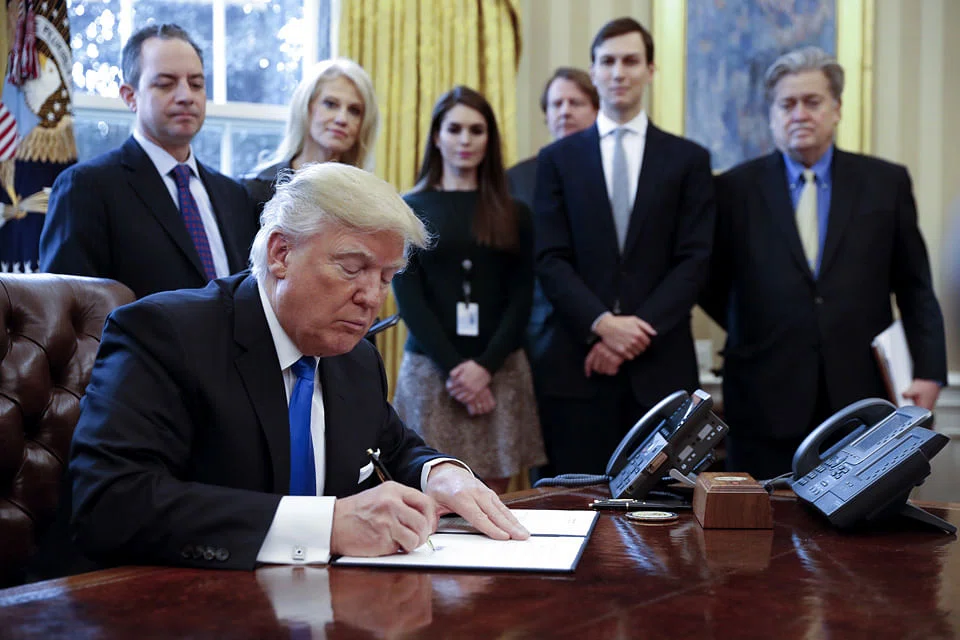
HE really did build a wall - with just the stroke of his pen.
On Monday, the 45th President of the United States Donald Trump signed orders to withdraw the world's largest economy from the Trans-Pacific Partnership (TPP) pact - a 12-member Pacific Rim free-trade agreement (FTA) that would have accounted for almost 40 per cent of the world's gross domestic product.
The America of Mr Trump will thus be shielded from free-trade flows from across the Pacific Ocean. And with the retreat of the US, the TPP as it stands cannot come into being.
Many have expressed dismay, lamenting the lost economic opportunities. Politically, Mr Trump's order left the leaders from some TPP member countries scrambling. Some still wanted to push ahead with a new TPP deal of sorts, others vowed to push through some promises that they made in order to shore up support for the TPP in the early days.
At the other side of the world, a big experiment in a single market is also unravelling with the United Kingdom's exit from the European Union. Singapore's attempt to hammer an FTA with the EU is also put on hold for the moment.
Free trade isn't having a good day, but it is not the time to lament the loss of unrealised opportunities.
With the demise of the TPP, the proposed Free Trade Area of the Asia Pacific (FTAAP) now needs to quickly find a new direction - and counterweight.
The TPP, which excludes China, was often seen complementary to the Asean-led Regional Comprehensive Economic Partnership (RCEP), which includes China but excludes the US.
Together, they would have helped bring the region closer to the FTAAP.
The stakes are high; trade itself has accounted for much of Asia's growth, with China, and the four newly industrialised Asian economies of Singapore, Hong Kong, South Korea and Taiwan as frequently quoted examples. Growing an economy's external pie has sped up development greatly.
Yet, barriers still impede the flow of goods and services. So efforts must still be made to facilitate free trade. States initially focused on constructing international systems and institutions for this purpose, most notably the World Trade Organisation in 1995.
As these negotiations grew more complex, countries turned towards key economic partners to cut new agreements.
In this respect, multilateral FTAs, particularly regional ones, are often seen as a "sweet spot" in the pursuit of free trade.
They bring together neighbouring countries with similar backgrounds and concerns to hammer a deal that is substantial enough.
They bring together politicians, companies, workers and unions to the same table for negotiations, which is immensely useful for confidence-building.
Issues touched on are also more wide-ranging than bilateral ones, yet more palatable than international ones. Regional FTAs are crucial building blocks towards mega-FTAs.
In their entirety, they are a bulwark against protectionism. Built to facilitate trade flows, they help grow economies and foster regional stability.
Yet, for all the economic benefits that FTAs may bring, it would be remiss to disregard the political will needed to cut these deals.
And if countries, or even country groupings, are unable to see eye to eye, any FTA under negotiation may just fall through.
This is especially so when the RCEP is now seen as the key pathway to the FTAAP. In the face of larger economies, the 10 Asean states must muster political will - with the dangling of their combined economic carrot - to push ahead with a pact that is fair and equitable.
Concrete action must be made to continue exploring other avenues to prevent the Asia-Pacific region from being walled in.
The EU and the UK, instead of drawing red lines in the sand, must start exploring a post-Brexit world of new FTAs.
It must be in this same spirit that Singapore's Ministry of Trade and Industry (MTI) sent a strong signal on Tuesday, saying that it is time to move on from the TPP; time to find new ways to integrate.
"The US has indicated that it will pull out of the TPP agreement. Without the participation of the US, the TPP agreement as signed cannot come into effect," it said plainly.
Political will must be mustered to push ahead in the lowering of barriers to trade flows.
And for every wall that is erected to block out such flows, doors and bridges must be constructed to guide them through.
READ MORE: EU-S'pore FTA faces potential legal hurdle that may shape Brexit deal






