We can change - if we truly want to
The Covid-19 crisis can pave the way to sustainability as it has shown that we can muster resources and get organised.
THE global crisis we are currently going through has shown how radically societies and individuals were responding to an immediate threat when health (and finances) were impacted. As a consequence, several nations such as China and other Asia-Pacific countries were able to flatten the curve of the pandemic in a matter of weeks.
What this situation is teaching us is that when fear is triggered, our societies are able to muster resources and get organised to ensure that things go back to normal as soon as possible.
Yet, in such an unprecedented crisis, what can the reaction to this pandemic teach us about how humans respond to other unseen global threats, such as climate change? In that sense, how could Covid-19 lead us to a more sustainable world?
"Things take longer to happen than you think they will, but then they happen much faster than you thought they could." - Al Gore
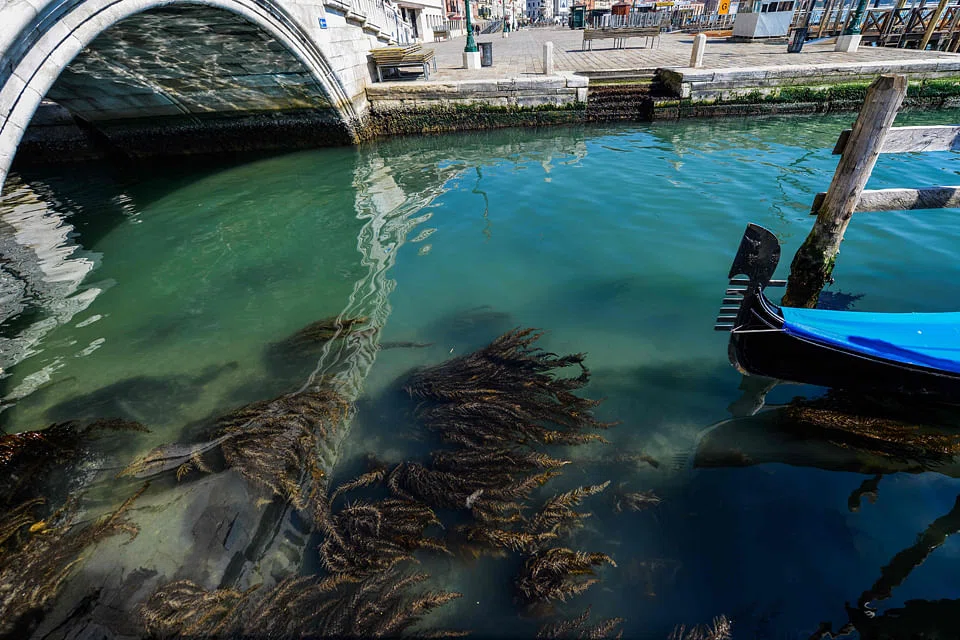
As a result of strict policies all around the world, more than four billion people are currently locked down globally, more than half the world population. One of the most obvious consequences of such drastic policies has been the sudden and tremendous decrease of greenhouse gases, first in China and as the pandemic spread to Europe and the rest of the world. We have not only seen nature claim its rights back in harbours and downtown districts, but also witnessed the drop in pollution in India, Europe and in the USA. Even Los Angeles' infamous smog has disappeared.
In China, pollution kills silently an estimated two to three million people every year. Despite the recent increase in the use of coal, pollution has shrunk by 20-30 percent since the beginning of the year. And even though the virus claimed several thousand lives, how many were saved thanks to the pollution drop?
According to the United Nations Environment Programme (UNEP), global greenhouse gas emissions need to fall by 7.6 per cent each year between 2020 and 2030. Could this crisis take us further on track than we would have imagined just several weeks back?
We tell you why we think so.
1. Politicians are finally starting to listen to scientists
"Hard times create strong men. Strong men create good times. Good times create weak men. And, weak men create hard times." - G Michael Hopf
Despite some rightful criticism, governments have proven their ability to abide by science and take firm commitments, showing they could neglect economic growth vis-a-vis health and safety in a matter of days, if not hours.
In developed countries, these protective measures have been globally well accepted and deemed relatively fair for everyone (young and old, men and women, rich or poor). In France, 93 per cent of the population approve of the lockdown and 85 per cent think it should have been decided earlier.
Thus, in the words of Hopf, these measures might have taken us from good to hard times. Will it make us strong enough to take the measures we need to tackle climate change? Time will tell.
2. Our resources are (almost) limitless
"They didn't know it was impossible, so they did it" - Mark Twain
With the European Central Bank (ECB) putting 870 billion euros (S$1,332 billion) on the table, we have seen that a very high amount of money can be raised almost instantly. In terms of climate change, the European Bank of Investment expects to raise 1,000 billion euros over 10 years to finance projects for the planet. It would be very close to this, but over a much longer time.
On their side, the USA secured US$2,300 billion. So we know that we can have the money - and it seems to be endless. Can the amount be even more for a problem that scientists are already saying will be even bigger?
"Think 'how we will change to get through this' rather than 'how we will get through this'." - Simon Sinek
Just as the Great Depression led to inventions such as discount supermarkets, electric razors and chocolate chip cookies, the previous crises have taught us that the organisations that survive such periods are the ones who are able to adapt their business model and production modes.
As we faced a lack of basic health supplies, some of the biggest companies in the world understood this perfectly and started to adapt their process lines to provide relief to hospitals and the critically ill.
Several companies have begun manufacturing hand disinfectant gel to meet the needs of healthcare workers, and then offered the product on the market. LVMH (luxury goods) and Pernod-Ricard (alcoholic beverages) were among the first movers. Many beauty product companies such as L'Oreal, La Roche-Posay and Firmenich switched their production to hydroalcoholic gels. Sporting goods retailer Decathlon has been working with a Rome-based research institute to use 3D printing to redesign and convert its snorkelling masks into much-needed ventilator alternatives for hospitals. Nike, Under Armour and New Balance, along with many other companies, have also been developing masks to respond to the high demand.
As Simon Sinek says: "We are not in unprecedented times." Why? Because like many companies before, we need to quickly adapt ourselves. When the Internet arrived, many companies had to pivot and pick up the slack. When Uber came on the market, many taxi companies had to change their service. When Netflix scaled up, many video stores closed down, just like how Amazon led to the closing of bookstores. Business models need to evolve, and businesses will need a sense of purpose to make a difference.
Thus, in the mid to long term, this situation is still a precious opportunity for companies and a great time to become leaders in sustainable economies as well as a call for low-carbon models. Now is the moment to think about the changes we will need to implement rather than wait until the crisis is over.
3. Changes might remain after the crisis
"Don't wait. The time will never be just right" - Napoleon Hill
We went, in a matter of days, from good to hard times. We went from freedom to staying home. From going out on weekends to staying in for a movie. From taking time to buy food to rushing before the stocks run out. From looking down while walking on the streets to partying from our balconies. From reaching Godwin's law on social media to laughing at each other's ways to spend time at home.
By taking new habits, by changing our perspective by fear of living this again, several habits won't be the same.
As digital tools become more mainstream, we are also faced with limitations that were not obvious before, when the number of users was much smaller. As working remotely becomes more common and long-lasting, along with increased demand for easy remote work solutions and more diverse options, it is most likely that we see software developers come up with innovative solutions for remote work in a near future.
Since remote work is - by default - the new norm in companies, more employees might still wish to telecommute much more often than before. Business trips might be less frequent or replaced by webinars and online meetings since they are less consuming in time, energy and, of course, money. This would, of course, benefit the climate.
Besides, when we see the astronomic number of layoffs, is employment still the safest way to have a job? Could freelancing or entrepreneurship become the new work safety? And, to that extent, may it become the new norm? Upwork and Freelancers Union believe that the majority of the US workforce will be freelance as soon as 2027.
Most airlines face bankruptcy by the end of May. What solutions will we have then? Do we fund all companies with citizens' money and carry on with business as usual? Nationalise and impose a tax on kerosene? Or leave thousands of people unemployed and airports empty? Airlines have been living in a tax-exemption world on kerosene since the Chicago agreement in 1944. What does it mean?
Is the airline industry somehow responsible for what is happening to them knowing that they have not changed their business model in decades?
Some companies were in the same business-as-usual situation and got kicked out by what was, originally, disruptive players. For example, Amazon introduced the Kindle e-reader in 2007 while the book industry never gave it a thought. Apple launched iTunes in 2001, which is something that the music industry did not want (but consumers did).
Netflix decided to lower the resolution of the videos due to the high emissions and pollution generated. Netflix has done its job right in being accountable for the negative externality it created, and stopped the population in its need for more and more and more. Do we really need to watch a movie, a documentary or series in 4K? May we still have a good time with 2K? No doubt we can.
Then, in a similar way, we are all about to get access to 5G, which is 10 to 20 times faster than 4G, enabling us to download a HD movie in a minute. Are we unhappy with 4G? Are we becoming so obsessed with speed that waiting for 15 minutes before downloading a HD movie becomes hell? By the way, we are only talking about phone connectivity here. Wi-Fi already does the job without our realising it.
4. Post-crisis: Beware of black swans
We are aware that this virus can be controlled but we could be hit by a new, even stronger catastrophe. What would happen if a new heat wave occurs again in Europe this summer? What would happen if this heatwave creates bushfires? And what if rains do not stop and floods appear, will the virus spread all over?
We need to change our ways, change our models, adapt our businesses to stop taking big risks, adapt our businesses to the increasing and endless demand for sustainable actions, sustainable solutions, products that respect our environment. These are things that our customers want, our employees want, and even our shareholders want. Above all, this is what the young generation wants. So let us not be fools. Our societies have all the tools to tackle climate change. It all depends on you, whether you want to heed it or not.
One day, says the legend, there was a huge forest fire. All the terrified animals, aghast, watched the disaster helplessly. Only the little hummingbird was active, fetching a few drops with its beak to throw them on the fire. After a while, the armadillo, annoyed by this ridiculous agitation, said to him: "Hummingbird! Aren't you crazy? You are not going to put out the fire with these drops of water!" And the hummingbird replied: "I know it, but I'm doing my part of the job." - Pierre Rabhi
Let us all be hummingbirds.