What can Singapore do about the haze?
Not much, in terms of tackling the root problem of the burning. But in the meantime, behaviours can be changed to adapt to the unhealthy air.
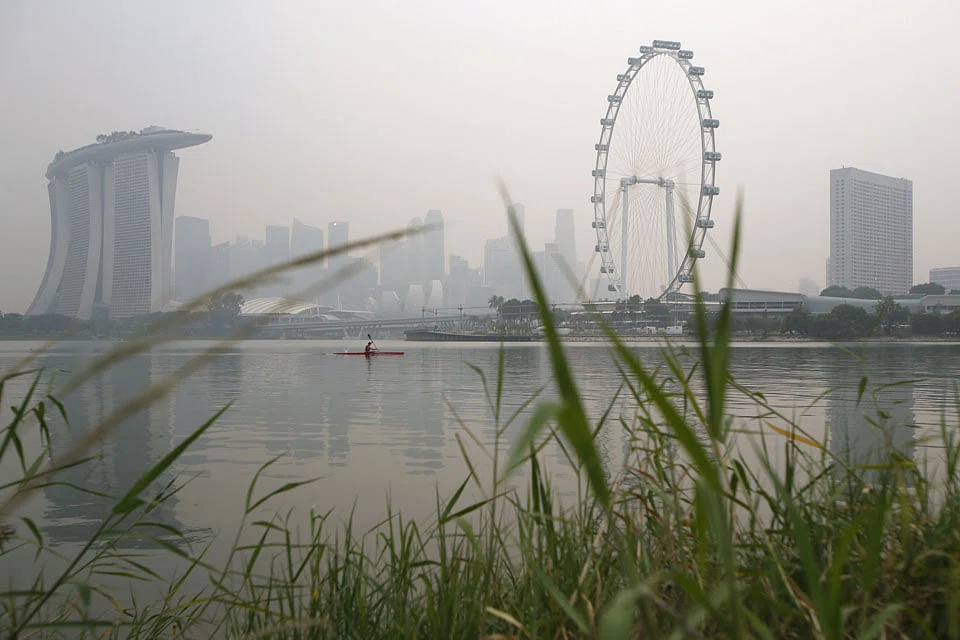
OVER the past two months, the haze has generated a spate of heated responses in Singapore. As we now eagerly await the nearing end to the choking air, we are well aware that the problem is far from its resolution, and we would certainly expect the haze to revisit us in the subsequent years.
Instead of incessantly pointing our fingers at our neighbour, we should focus on how we could possibly escape this recurring conundrum.
It is clear that Singapore has little transnational jurisdiction on the haze culprits apart from Singapore firms, which might or might not be a sizeable proportion of the total number of errant plantations. Holding Singapore firms accountable is justified on both moral and legal grounds, but without disclosures of land ownership from Indonesia, whether this would reach fruition is very much debatable.
Besides, if Indonesia and other countries do not penalise their own culprit firms to an equivalent extent, Singapore firms will bear the burden unfairly in relative terms.
Secondly, a handful of firms in Singapore recently signed a declaration that their products are free of raw materials from suppliers being investigated for the Indonesian fires. There have also been calls for consumers to boycott haze-linked products.
These are applaudable moves, but are unlikely to bring any measure of success in reducing the fires. This is primarily because Singapore's consumption of paper or palm oil products constitutes a small portion of global demand. Additionally, it is unlikely that all local firms and consumers will comply as they can free-ride on others; hence the effect is further reduced.
Unless we can get most local firms and consumers, as well as our neighbouring countries, to practise the boycott, the likely outcome would be higher prices for a seemingly futile attempt. Here is where behavioural economics can lend a hand to change consumers' behaviour. This also warrants a study on the effects of a boycott on the profits of the Indonesian plantations and the suppliers of products linked to these plantations.
Moreover, pressures levied against Indonesian goods might result in trade retaliation.
If these same boycotting measures were to be employed in the major consuming countries (namely China, India and even Indonesia), we could be more hopeful. Nevertheless, would China and India, who are not directly affected by the haze, boycott polluting products at their own expense? Would domestic consumers in Indonesia be willing to pay higher prices for palm oil and paper products in exchange for cleaner air? Such questions are important and require further study.
For all of the above, the facts must first be established. Who are the real perpetrators? The issue of boycotting products from plantations that are being investigated, but subsequently not proven guilty, also arises. As is often the case in law, the accused is not guilty until proven so.
In this regard, Mr Han Fook Kwang, in an Oct 18 commentary in The Sunday Times, suggested shifting the onus of evidence to the companies, meaning that the defendant is presumed to be guilty until proven otherwise. But as with the case before, it is very difficult to prove either way. This idea of the alleged party having to clear its own name may result in too many convicted cases. For small suppliers and plantation owners, it may prejudice their market survivability, paving the way for the market to be dominated by a few suppliers.
Thirdly, Singapore has provided Indonesia with fire-fighting assistance, but both the offer (by Singapore) and acceptance of help (by Indonesia) could have been much quicker.
Another preventive approach would be for Singapore and other victim countries to provide monetary side payments to Indonesia, on the condition that plantations adopt land-clearing practices without the use of fires. The amount of side payment will have to depend on the calculated costs of alternative land-clearing methods. The share in the cost by victim countries, including Indonesia, should be in proportion to the damage suffered.
Given these limited options, there is really not much Singapore can do to touch the root of the problem.
But what Singapore can really do in the meantime, while waiting for mitigation efforts to take place in Indonesia, is to adapt. This is similar to the climate change issue, where adaptation becomes more important than ongoing mitigation, which takes a long time to be realised.
This year, during the school closures in Singapore, some students reportedly still turned up for school. Some among them did not receive the notification; for others, their parents were unable to take time off work to look after them. In this aspect, there is definitely room for improvement in information dissemination, and in designing and encouraging work-from-home and study-from-home arrangements.
On the days where PSI readings have lingered in the "Very Unhealthy" and "Hazardous" ranges, people were spotted on the streets without masks, or wearing surgical masks that are ineffective against fine particles. This calls for improved ways to educate or nudge the general public, which could reduce the incidence of haze-related illnesses and the loss of productivity. The authorities could even impose a mandatory shutdown of outdoor sports facilities when needed, accompanied by a compensation scheme for affected businesses.
It is to be noted that while there has been no shortage of N95 masks, air filters in certain major electrical appliance stores are sold out. On hindsight, since we have expected the severe El Niño episode and the impending haze from international reports, a system of information dissemination could have been set up so that businesses and consumers can take the appropriate action before the arrival of the haze.
To understand the haze problem, we need contributions from multiple disciplines - the business, science and medical, political economy and legal aspects, including estimating the damage costs of the haze for all victim countries in the aggregate as well as sectorally, and in knowing how much people are willing to pay to avoid the polluted air.
Damage costs must necessarily be computed for categories such as loss of life, physiological and psychological health impact in the short and long term, loss of productivity, impact on sectors such as tourism, retail, food and beverages, aviation, conferences and conventions and its mutiplier effect, loss of intangibles (such as scenic views), threats of land subsidence from forest clearing, contribution to global warming, loss of goodwill and reputation.
Losses could also take the form of unwillingness of expats or foreign workers to work in Singapore, which may result in a tighter labour market, especially in the professional sectors. If the haze is a permanent recurring feature, it could also mean that more remuneration would have to be offered to attract future workers. All these may result in higher costs of business, as well as cost of living.
The key is that damage estimates must be continually updated and convincing to all affected countries.
We have seen good progress in Singapore's response to the haze this year, but as long as the problem persists, there is undeniably more to be done.
While there is a lot that Indonesia needs to do on its own, it is perhaps more timely that Singapore focuses on adaptation strategies. For now, it appears that many proposed solutions on the part of Singapore would likely be futile.