

Why Brexit is only getting started 1 year on
Key gaps in bare-bones deal, 12 months of turmoil and poor relations, increasingly negative public opinion, political tensions over UK unity leave it far from being 'done'.
 Add BT as a preferred source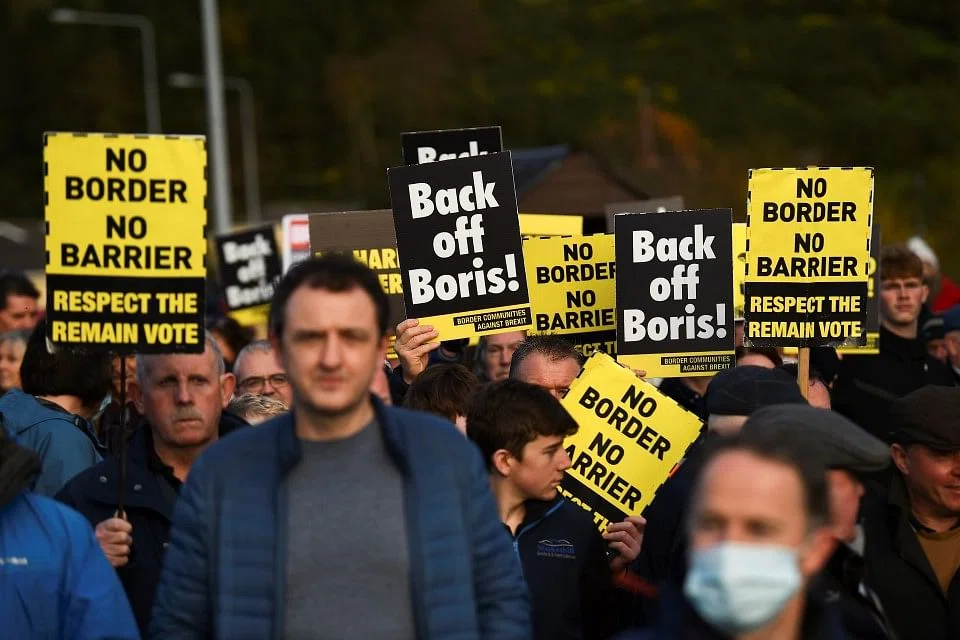
DeeperDive is a beta AI feature. Refer to full articles for the facts.
ON THE 1-year anniversary of the UK-EU trade deal on Dec 30, British Prime Minister Boris Johnson said last week that having "got Brexit done" he is looking in 2022 to secure the "full benefits" of the agreement. Yet, far from ending, the wide-ranging processes unleashed by the United Kingdom's 2016 referendum are only beginning to play out, economically and politically.
The UK-EU agreement is the first trade negotiation in history where barriers went up, rather than down, compared to the status quo, and is only therefore likely to be a partial solution to future UK-EU economic collaboration. For instance, the deal does not cover the services sector which accounts for 80 per cent and 70 per cent respectively of the UK and European Union economies.
As UK businesses try to get to grips with the deal, they are also having to adjust from January 2022 to the introduction of new trade barriers, which mean that importers must make a full customs declaration on goods entering the UK from the EU. So traders are no longer able to delay completing full import customs declarations for up to 175 days, a measure that was introduced to cope with the disruption of Brexit. Remarkably, Philip Rycroft, former permanent secretary at the UK Department for Exiting the European Union between 2017 and 2019, said this may mean some businesses may decide it simply is not worth the hassle of importing.
Part of the challenge with the UK-EU deal is that it was struck in just 8 months, during a pandemic, with a bare-bones agreement the almost inevitable result. So UK negotiations with the EU may therefore need to continue for years to come to fill in key gaps.
Johnson has brushed over this fundamental economic challenge, and pledged that the agreement will lead to a positive reset in political relations between London and the EU-27. However, the deal has so far triggered 12 months of turmoil with relations between the 2 sides rarely so poor - exemplified just 5 months after the agreement was stuck when Royal Navy vessels began shadowing French ships near Jersey in a row over fishing licences.
Little surprise therefore that more than 60 per cent of voters now believe Brexit has gone badly or worse than expected. A recent Opinium survey also found that even 42 per cent of people who voted "Leave" in 2016 now have a negative view of the way things have turned out.
Navigate Asia in
a new global order
Get the insights delivered to your inbox.
Multiple missteps from both sides have led to the current tensions. The UK has threatened to break international law with its Internal Market Bill.
Tensions will continue into 2022
Moreover, less than a month after the deal was agreed, European Commission President Ursula von der Leyen threatened to impose a UK vaccine export ban. Facing delivery shortfalls and suspecting the UK had co-opted EU supplies of the AstraZeneca jab, she ultimately climbed down after much fury.
Tensions will continue into 2022 with the UK government under pressure from the ruling Democratic Unionist Party (DUP) in Northern Ireland to unilaterally override parts of the protocol, risking a trade war with Brussels, ahead of Stormont elections this year likely to be dominated by the dispute. Meanwhile, Europe's leading politician, French President Emmanuel Macron, is running for re-election and is likely to ask the Commission soon to begin legal action against the UK over post-Brexit fishing licences.
Yet, beyond these disputes, other processes are brewing that show how hollow Johnson's slogan is of having "got Brexit done". Indeed, the UK-EU trade talks are, in fact, only 1 subset of much broader, forward-looking debates in 4 areas: between the EU and the UK; within the UK; within the EU; and also between the UK, EU and the rest of the world.
The net impact of these huge, wide-ranging processes unleashed by the UK's 2016 referendum are playing out in ways that could have contrasting implications for the EU and UK. For whereas the next few years may result in a stronger, centralised union of EU states (despite significant continuing disagreements between these same nations), the opposite may be true across England, Scotland, Wales and Northern Ireland.
Brexit has exacerbated tensions over the UK's unity, including putting Northern Ireland at the forefront of UK politics in a way it had not been for a generation. Johnson's decision to allow a new border between Northern Ireland and the rest of the UK has angered much of the unionist community, especially the DUP, and there are growing questions as to whether a referendum might be held on Irish reunification.
The possibility of such a vote, let alone the outcome, remains far from certain. While London remains committed to the unity of the UK and Dublin to the cause of Irish reunification, there are challenges for both sides.
While Northern Ireland was relatively muted as an issue during the 2016 referendum, the prospect of Brexit leading to Scottish independence was actively debated. The Scottish National Party (SNP)'s continued political strength means either a new independence referendum or growing tensions with the rest of the UK are likely, particularly given that the SNP has asked Johnson to agree to a new independence vote.
Out of the club
By contrast, how the EU changes because of Brexit could be the most important, but often overlooked, outcome of the UK's vote to leave. And with the UK no longer in the Brussels-based club, the EU-27 has already made in 2020 and 2021 some significant steps towards greater federalism.
One example is the new 750 billion euro coronavirus recovery fund, a major political milestone in the post-war history of European integration, which saw the continent's presidents and prime ministers commit for the first time to the principle of jointly issued debt as a funding tool. This potentially paves the way for greater future EU supranational powers of taxation.
A broader range of EU policy could change, post-Brexit, altering the political economy of the union. London, for instance, largely succeeded in pushing for an enlarged union where deregulation and free-market economics are the norm. Further attempts to move away from this, for example in tax harmonisation, could take further steps forward now without the UK "blocker".
Taken together, this is why the implications of Brexit could be significantly different for Brussels and London. While both unions are under major stress, the 2020s could see an increasingly federal EU while the UK may become significantly more decentralised or even broken up given the threat to its territorial integrity.
- The writer is an associate at LSE IDEAS at the London School of Economics.
Decoding Asia newsletter: your guide to navigating Asia in a new global order. Sign up here to get Decoding Asia newsletter. Delivered to your inbox. Free.
Share with us your feedback on BT's products and services
TRENDING NOW
Air India asks Tata, Singapore Airlines for funds after US$2.4 billion loss

Beijing’s calculated silence on the Iran war

China pips the US if Asean is forced to choose, but analysts warn against reading it like a sports result

Richard Eu on how core values, customers keep Singapore’s TCM chain Eu Yan Sang relevant

