

Why can't America make enough masks or ventilators?
President Donald Trump has promoted himself as a champion of US manufacturing, but now he avoids addressing its shortcomings.
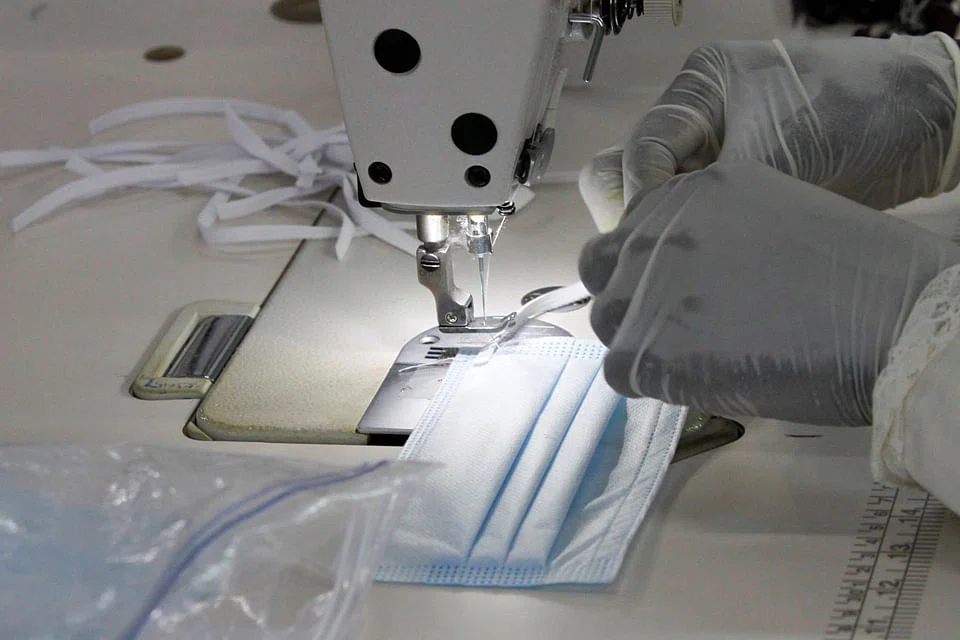
HUNDREDS of companies across the United States are reinventing themselves to make equipment that is desperately needed to treat the Covid-19 outbreak. That so many American manufacturers are rising to meet this pandemic with little coordination from the federal government reveals a deep altruism in our national character.
It also reveals something else: The United States is unable to meet an immediate need for critical medical supplies and personal protective equipment in the face of a crisis. The absence of adequate domestic production capacity for things like face shields and respirators, coupled with the frailty of on-demand global supply chains and our utter reliance on them - for everything from the ingredients in our medications to parts of breathing machines - has left us dangerously exposed during an international health emergency.
Mohawk Fine Papers and its United Steelworkers employees are shifting to medical gown and mask production. American Giant and other garment manufacturers are scaling up the production of medical-grade masks. Companies from Budweiser to Ford are churning out hand sanitisers and ventilators. These instances of private sector action are inspiring, but they would not be enough.
Our policymaking is still behind the curve. US President Donald Trump is starting to selectively use the Defence Production Act, a law from the Korean War era that allows the president not only to order businesses to prioritise the manufacture of items deemed crucial to national security, but also to subsidise them. This is something he should have done many weeks ago, and even now he is mostly invoking it haphazardly with companies that draw his ire.
White House officials have floated for a few months an executive order meant to encourage domestic production of pharmaceuticals. But the hint of such an order generated a lobbying blitz from drug makers, including one spokesperson who told CNBC that "in times of crisis, a diverse supply chain is more important than ever".
This is a blasé way of saying they would rather protect their yawning profit margins than contribute to the country's medicinal security. But many of our national political leaders are not ready to talk about this either. The president has promoted himself as a champion of American manufacturing, but now he avoids addressing its shortcomings.
The Democratic challenger, Joe Biden, only recently began speaking about these supply issues, and mainly in response to Mr Trump's scattered use of the Defence Production Act. Congress had a huge opportunity to encourage the domestic manufacture of critical supplies and avoided it. It attached no strings to force manufacturing repatriation to the US$500 billion it made available to big businesses about to be damaged by the economy's collapse.
The bipartisan tendency of our politicians to salute workers and visit factories during campaign season, and then do little of substance to help factories expand and increase hiring, must end. This pandemic has most Americans rightfully concerned about their personal well-being - everything from their health, their job security to their ability to pay the rent or a mortgage is on the line.
But Americans are also now concerned with their national well-being. And one of the questions they are asking is this: How did it come to pass that we cannot make enough respirator masks or ventilators when we need them most?
The answer is not a blunt call for autarky. No serious person wants the economy to revert to closed borders and walls around our nation. But while globalising supply chains may make sense in textbooks, the outsourcing we have encouraged by decades of this trade policy and corporate profit-seeking clearly has its limitations. And manufacturing critical supplies domestically will require significant policy shifts.
Whenever Congress and the administration decide on the next steps for our national well-being, they must move beyond bromides for the working class and put into place a sensible industrial policy, one that combines the power of American ingenuity with the capabilities of public investment.
"BUY AMERICA"
Such a policy should incentivise re-industrialisation via the tax code. It should encourage it with its traditional power of the purse - which means expanding "Buy America" provisions that prioritise domestic manufacturers in federal contracting bids to virtually all spending.
Companies that dip into the huge fund Congress almost unanimously made available to the Treasury Department in the recent US$2 trillion stimulus package should be expected, when applicable, to bring more of their manufacturing operations back into the country, and to devote far more resources to skills training to prepare for their workforce needs.
Trade enforcement should be more stringent. While critics are right to question the specifics behind some of President Trump's tariffs, these tariffs should not be removed until we see quantifiable and reciprocal change on the part of China and other international competitors - many of which banned exports of medical supplies at a critical time.
And lastly, a national effort should be made to identify and then prioritise the industries where a lack of a domestic manufacturing ecosystem leaves the country extremely vulnerable. We have known about an overdependence on imports in supply chains for pharmaceuticals and medical equipment for years, though it was easier to ignore when our nation was not in crisis.
The Defence Production Act is being invoked to call out and force individual companies to make these supplies. That may be a successful short-term bludgeon, but expanding the Act's use to organise a national manufacturing strategy to meet this moment would be much better, compared to the current piecemeal approach to producing the millions of items healthcare workers need to handle a surge of sick Americans.
The next national emergency could be an attack on our power grid or water supply or a natural disaster that brings global supply chains to a screeching halt. Do we have the battery production capacity to turn the lights back on immediately? Can we produce turbines to keep our dams operating? In a crisis, could we make a smartphone in the United States to ensure that Americans can continue to communicate?
The United States is going to have to weather the coronavirus crisis with a manufacturing sector that is not constructed to meet it. We must address that shortcoming before the next crisis arrives, and we should start now. It is time for a 21st century Arsenal of Democracy: One that will both see us through future crises and revitalise an economy that desperately needs rejuvenation. NYTIMES
Decoding Asia newsletter: your guide to navigating Asia in a new global order. Sign up here to get Decoding Asia newsletter. Delivered to your inbox. Free.
Share with us your feedback on BT's products and services
TRENDING NOW
Easy to rent out, hard to sell: Are buyers losing interest in Singapore’s one-bedroom condos?
GovTech retrenches another 38 staff in second round of layoffs

Stocks to watch: Seatrium, CapitaLand Investment, Keppel DC Reit, Suntec Reit, CLCT, TSH Resources

World’s largest offshore wind platform by Seatrium consortium on track to be completed by 2028

