Why closing Yale-NUS is bad for business

EVEN amid forced restrictions due to a pandemic, rivalry between global powers, and the rising tide of nationalism, our policymakers have steadfastly emphasised a principle that is existential to Singapore: openness.
During the recent National Day Rally, Prime Minister Lee Hsien Loong said that Singapore cannot give the impression that it is hostile to foreigners.
"It would gravely damage our reputation as an international hub. It would cost us investments, jobs and opportunities. It would be disastrous for us and most of all, it is not who we aspire to be," he said.
And just last month, Health Minister Ong Ye Kung reassured members of the European Chamber of Commerce in Singapore of the Republic's continued commitment to staying open, calling it a fundamental value. He noted worrying signs of anti-foreigner sentiment, citing attempts to use free trade to "seed xenophobia in society".
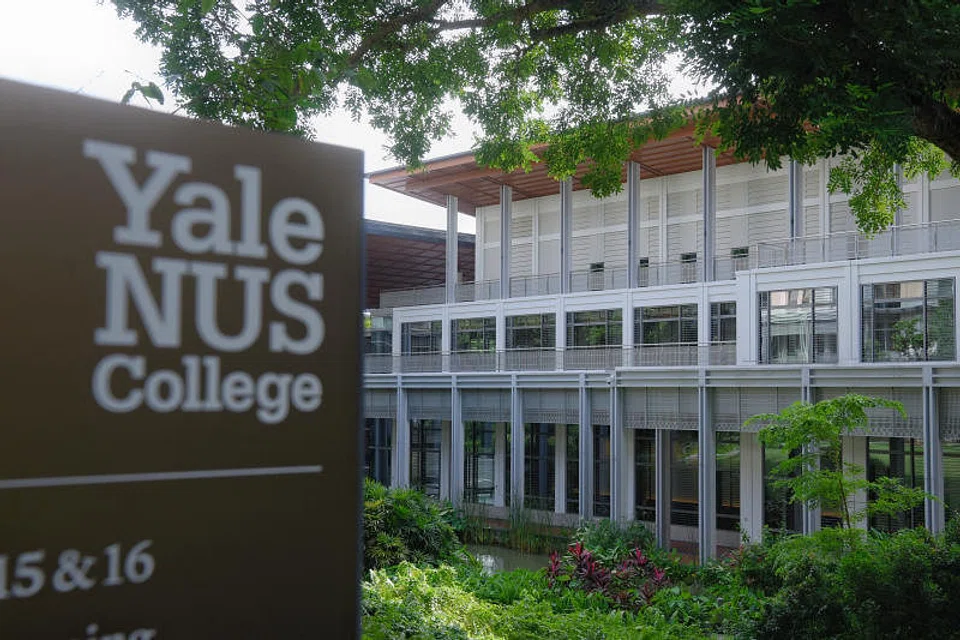
But a shock announcement last Friday (Aug 27) struck directly at the heart of this vital principle of openness. The National University of Singapore (NUS) announced a decision that would in effect shut down Singapore's inaugural and only liberal arts institution: Yale-NUS College.
This however, runs counter to Singapore's spirit of openness - with deleterious effects for the country's economic vision and its reputation as a destination for international innovation and partnership.
Demand for the value of a Yale-NUS graduate
The closure of Yale-NUS is not just the loss of one school, but will effectively end an entire system of education.
One of the key traits of a liberal arts college is the intimacy and coherence of its community, with small class sizes and direct relationships to professors. Students do not just study, but also live, eat, play, research, bond, and create in the same community, breathing in an intense environment centred around debate and discussion.
Perhaps more unique to Yale-NUS is the fact that over 40 per cent of its students are international, and come from over 40 locations worldwide. International programmes built into the Yale-NUS model also guarantee Singaporean students multiple opportunities for selective internships and research stints typically unavailable to undergraduate students.
Together, this has created learning beyond what can be gleaned from just classes and books. Locally educated yet internationally informed, their adaptable mindsets are particularly important for Singapore's growth in new sectors such as the tech ecosystem.
It is this environment that creates graduates armed with a level of mental agility, creative problem solving, and critical thinking that employers find attractive. In a 2017 speech, then Education Minister Ong Ye Kung said: "We all know the saying about not giving a man fish, but teaching him how to fish. In that sense, a liberal arts education is the ultimate fishing rod."
The "New College" that will result from the "merger" of Yale-NUS and the University Scholars Programme will likely retain little of that close-knit environment of asynchronous learning or cosmopolitan outlook. If the traditional residential programme at NUS serves as any guidance, the international population will likely be kept at around 25 per cent.
Enough has and will continue to be said about the critical thinkers that a liberal arts system produces. But the proof, as they say, is in the pudding.
Despite a challenging final semester spent amid a global pandemic, nine in 10 Yale-NUS graduates last year secured jobs within six months of finishing their final exams, commanding a median gross monthly salary of S$4,038 - well above the national median of S$3,700.
Graduates have also won the internationally competitive Rhodes, Fulbright and Schwarzman scholarships, and some have gone to pursue postgraduate studies at top institutions such as Stanford, Oxford, Tsinghua, Yale, Johns Hopkins, and yes, NUS.
And despite the inherent disadvantages of being in a new institution, alumni have gone on to secure positions in some of the world's top employers, including Google, Facebook, Goldman Sachs, Oliver Wyman and locally, Temasek, GIC, and the Singapore public service. Some have even started their own companies.
Yet all this proven value and demand seems to have gone ignored.
Whither the 'global schoolhouse'?
Our policymakers have long recognised that the same openness which characterises our economy must also be extended to the education landscape. Indeed, the longevity and future of the former depends on the latter.
Almost 20 years ago, Singapore announced to great fanfare its ambition to become a "Global Schoolhouse". The key thrusts? To bring in good foreign institutions as partners and attract "large numbers of international students" to Singapore, then minister for Trade and Industry George Yeo said at the project's launch in August 2003.
The hope was that they would bring fresh ideas, talent, rejuvenate the economy, and also place Singapore on the world map as an education hub. The partnerships and relationships built would strengthen Singapore's economic and international network, while having the added benefit of preventing a "brain drain"; a greater (and more affordable) selection at home would keep Singaporean talent in Singapore.
More than a decade later, at the inauguration of Yale-NUS in 2015, PM Lee similarly highlighted Singapore's efforts to diversify the education landscape with international partnerships - pointing to Duke-NUS Graduate Medical School, and collaborations with Johns Hopkins University and Imperial College London.
In many ways, Yale-NUS is the ultimate expression of Singapore's Global Schoolhouse. It draws on the lineage and resources of two great universities, one in the US and one in Asia. Its core mission emphasises its unique location "in Asia, for the world". Mr Lee also pointed out the benefits the partnership brings to both Yale and Singapore in a fast-changing world - a foothold in a rapidly-developing region for the former, and a unique value-add to the latter's education landscape.
One might think this joint venture would last a little longer, given these mutual benefits, the demonstrated success of the college, and the reputations of several important parties at stake - especially that of a certain small and open country highly dependent on international partnerships.
Yet this is not Singapore's first failed education partnership (a comparison international commentators are already making). In 2007, the University of New South Wales departed Singapore barely three months after the first cohort started classes. New York University's Tisch School of the Arts Asia pulled out in 2012. In 2013, the University of Chicago's Booth School of Business moved to Hong Kong. The reasons for these prior failed partnerships ranged from financial difficulties to more competitive bids by other regions.
Yale-NUS could have been the exception to this trend, but if nothing changes, it will join this ignominious legacy. But the reason for its closure is the worst yet: a unilateral, top-down decision characterised by a lack of any consultation.
Yale-NUS president Tan Tai Yong said the decision came to him as a fait accompli, and told student-run publication The Octant that he was "gobsmacked and flabbergasted". Yale has made it clear that this was not their decision, and that they had been prepared to continue even past the year 2030.
Senior administration, tenured faculty, and even major donors were all shocked by the decision. Already, a petition by NUS and Yale-NUS students protesting this and similar "mergers" named "#NoMoreTopDown" has garnered over 12,600 signatures.
The effects of a global schoolhouse extend beyond simply the physical confines of the school - a fact that Mr Yeo certainly understood. He said: "These students when they return home will expand our international network. We must make sure that they have a good experience in Singapore. Then they will always feel fondly for us."
It seems difficult to believe that international students, their parents, and global donors will now "feel fondly" for us.
The moral of the lesson for potential investors, donors and partners to NUS or even more broadly to Singapore seems to be: beware. Things can change without prior notice, partnerships dissolved overnight, and your opinions will not matter.
If the very people paying for the product cannot be guaranteed any accountability, then one might think twice before buying anything it sells in the future. Already, Singapore's critics are reviving past arguments as to why the Republic was a bad place to start such a partnership in the first place.
Quoting the Irish poet WB Yeats, Mr Yeo said in 2002: "Education is not filling a pail; it is about lighting a fire." He noted that Singapore's success has inspired other nations, and its education can be a model to light similar fires in Asia.
There is still a chance for this ambition to come true. Singapore's policymakers can demonstrate the long-term vision and planning this country is known for, show strength in sticking to our core value of openness, and intervene in a rash, uninformed unilateral decision that has effects on Singapore's reputation.
If not, it would confirm fears that the doors are shut, minds in Singapore are closed - and the fire has gone out.
Timeline
- September 2010 - Yale and NUS ink memorandum of understanding to jointly create a liberal arts college in Singapore.
- April 2011 - Name of new offshoot given as Yale-NUS College, plans finalised.
- August 2013 - Yale-NUS takes in its first batch of 157 students selected from about 11,400 across 130 countries.
- July 2015 - Yale-NUS moves from temporary to its own new campus at 16 College Avenue West.
- August 2017 - After the first batch graduated, college takes in record 250 students for Class of 2021, meeting targets.
- February 2018 - More than nine in 10 of the first batch find work within six months of final exams.
- August 2021 - NUS announces "merger" of Yale-NUS with University Scholars Programme, effectively closing the college.
The author is an alumnus of Yale-NUS College.