
Why Le Pen could win French presidential poll
The far right, pro-Russia Le Pen and rival Eric Zemmour, just won around 33% of support between them and most of Zemmour's voters will likely opt for Le Pen.
 Add BT as a preferred source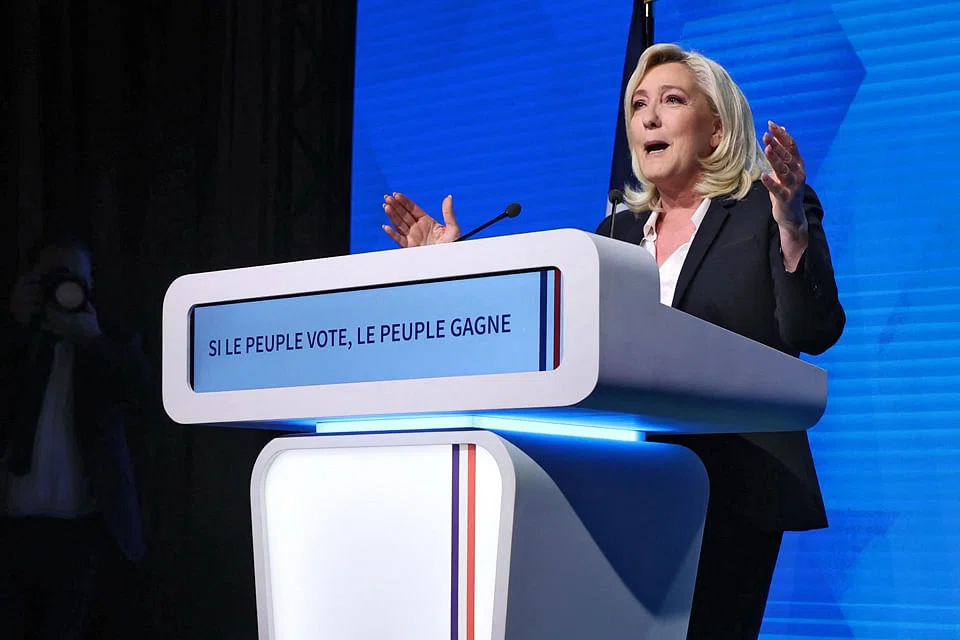
Far right, pro-Russia and anti-Nato leader Marine Le Pen emerged in a strong second place on Sunday (Apr 10) and will face off against incumbent Emmanuel Macron for the French presidency on Apr 24 in what could be a nail-biter.
While Macron emerged in first place on Sunday with around 28 per cent, it wasn't the overwhelming victory that polls as late as last month projected. Le Pen scored her highest percentage of the vote of any of the 3 presidential campaigns she has been involved in, with approximately 23.5 per cent.
It is almost certain that Macron won't win close to the 66 per cent of the second round vote he secured in 2017. Indeed, a poll on Sunday night from Ifop Fiducial indicated that the second round ballot could be a nail-biter with a 51 per cent-49 per cent win for Macron. This is similar to a Harris poll last week which put Macron on 51.5 per cent to Le Pen's 48.5 per cent.
To be sure, Macron remains the favourite to beat her in the second-round, 2-way run-off, and become the first re-elected president for some 2 decades. But French politics is volatile, not least with the impact of the Ukraine conflict.
Support for the far right
Support for the far right in Sunday's first round was at its highest point yet: Le Pen and her extreme-right rival Eric Zemmour, a former talk show pundit, won around 33 per cent of support between them. It seems likely that most of Zemmour's voters will opt for Le Pen in 2 weeks.
Navigate Asia in
a new global order
Get the insights delivered to your inbox.
Macron has been endorsed by the centre-left Socialists, who secured a historic low of 2 per cent on Sunday, and the centre-right Republicans who won only 5 per cent too.
What will now help determine the outcome of the Apr 24 ballot is where the supporters of hard-leftist Jean-Luc Melenchon go. He secured around 20 per cent of the vote and, while he has urged his supporters not to vote for Le Pen, he stopped short of endorsing Macron.
So, while Macron may appear in the home-strait, French politics may still have a surprise or 2 in store in the 2 weeks to come. The unusual political times are highlighted by the fact that, with Macron and Le Pen facing off against each other, this is only the second time in the country's modern history that neither of the parties of mainstream centre-right, Republicans, or centre-left, Socialists, that have governed for almost all of the post-war era have qualified for the final round.
So further unexpected twists and turns cannot be ruled out, especially in a context of distrust of the political class, and of economic pain for many. Small wonder that financial markets have been jittery.
So with Europe in its most volatile period in years, if not decades, post-Ukraine invasion, Macron is by no means guaranteed re-election. So far, he has only partially succeeded in his goal of reducing the unemployment rate and re-industrialising France through innovation-led policies.
There remains widespread anti-establishment discontent, including the so-called yellow-shirt protests, fuelled by economic pain which could now be intensified following the sanctions against Russia, and significantly higher gas, electricity and food prices are likely.
French voters have for months already cited the cost of living and purchasing power as their No. 1 concern ahead of the elections, as inflation surges on the back of rising commodity prices and tight supply chains.
And this despite the fact that the government estimates gross disposable income, which economists use as a gauge of purchasing power, grew twice as fast under Macron's presidency as under that of his 2 predecessors.
Le Pen will seek to double down now on tapping into this economic pain, including by proposing cutting taxes on fuel, presenting herself as an anti-globalisation champion, including opposition to international trade and Nato. Her wider platform is centred on an anti-immigration project to prioritise native French people over non-French for housing, jobs and benefits, and to ban the Muslim headscarf from all public spaces, despite the fact that this is against the French constitution.
The fact that she did so well on Sunday will dismay many in France - as well as internationally too. Should she pull off a victory in 2 weeks, it would be a severe blow for Brussels given her euroscepticism and France's eurozone membership, and the fact that, alongside Germany, the country has traditionally been the 'twin-engine' of EU integration.
Macron will hope to recapture the mood of last month when he was surging in the polls, styling himself as a wartime leader following Russia's invasion of Ukraine. The fact that he slipped in opinion surveys since then has been attributed to him devoting so much time to diplomatic talks with world leaders and coordination with European and other Western allies.
Aware of this critique, he is going after Le Pen hard in the last phase of the campaign, including on Russia, and she has had to distance herself from President Vladimir Putin. Campaign leaflets that showed Le Pen shaking Putin's hand, of which over 1 million copies media claim had been printed, have reportedly been withdrawn by her campaign team.
Macron's main goal
His main goal, now he has filled the vacuum of power in the political centre ground created by the collapse in support for the Socialists and Republicans, will be to make a pitch for the 26 per cent of voters who abstained, plus other non-mainstream voters, especially the approximately 20 per cent who voted for Melenchon. His pitch is that, despite his faults, he is the best choice for the left and indeed centre-right than Le Pen.
Nevertheless, markets will continue to be on edge for another 2 weeks as Macron and Le Pen seek to build a broader coalition of voters in a 1-on-1 standoff. The yield on France's 10-year bonds rose to a 7-year high last week on concerns that Le Pen, with longstanding sympathies for Russia, may take power in the middle of the Ukraine war.
Taken together, this may make for a highly unpredictable finish to the campaign. While Macron has an edge, his lead is not insurmountable in what is a shifting sands socio-economic context.
Andrew Hammond is an associate at LSE IDEAS at the London School of Economics
Decoding Asia newsletter: your guide to navigating Asia in a new global order. Sign up here to get Decoding Asia newsletter. Delivered to your inbox. Free.
Share with us your feedback on BT's products and services

