

Why Qatar faces World Cup-sized reputational challenge
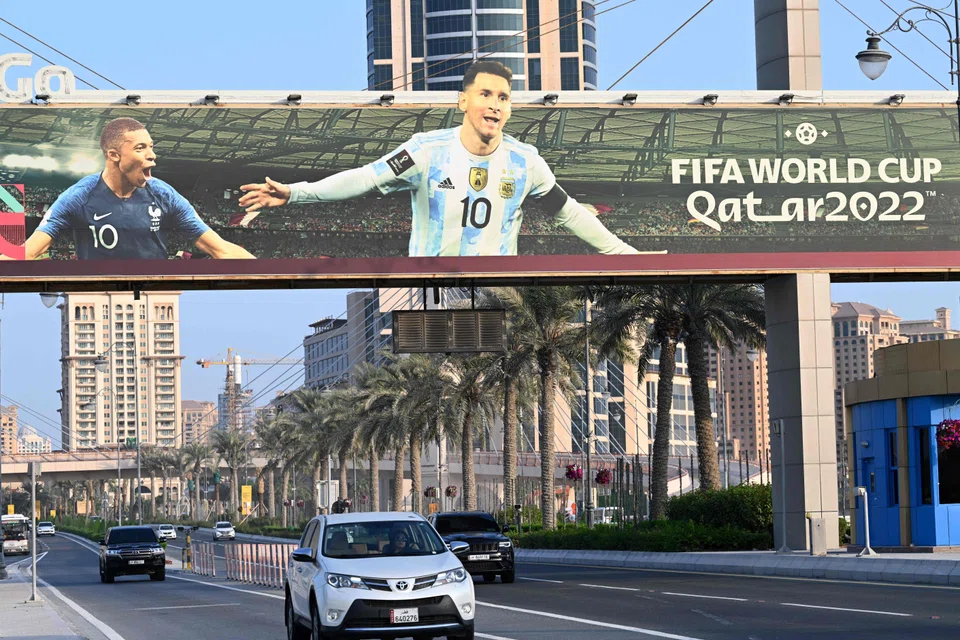
MANY governments still perceive that hosting major sporting contests command significant prestige, yet that will be tested this month and next with the reputational challenges facing the football World Cup in Qatar which kicks off on Sunday (Nov 20).
While Qatar is rightly taking pride in the fact that it is the first Arab Muslim nation to host the tournament, the event has become only the latest sporting contest to be plagued by political plus wider reputational risks and controversies. This is not least because of issues including treatment of migrant workers, anti-LGBTQ+ laws, and restrictions on freedom of speech in the country.
Numerous Western capitals have sought to de-emphasise the event. London has declared that it will not host public screenings of matches, as has Paris and several other French cities such as Lille whose mayor described the Qatar tournament as “nonsense in terms of human rights, the environment and sport”.
Despite these challenges, Qatar wants to portray to the world an image in the next few weeks as a modernising, economically dynamic state building from its energy powerbase. It produces 77 million tonnes of liquefied natural gas a year, about a quarter of the world’s production, making it as big a player as the United States and Australia, with that figure increasing to a forecast 126 million tonnes by 2026-27.
The challenges facing the Qatar event come hot on the heels of those facing China with the winter Olympics earlier this year. There was a Western diplomatic boycott by multiple countries, including the United States, United Kingdom, and Australia over concerns about human rights in Xinjiang.
While the challenges facing the Qatar and Chinese events may be the largest of any sporting tournaments of modern times, they are by no means unique. Last year’s Japan Olympics, postponed for a full year from the original date in 2020, for instance saw a state of emergency in Tokyo and nine other regions for weeks beforehand to try to control the pandemic. Meanwhile, overseas fans were barred from attending.
The Brazil 2016 summer Olympics offer another stark example of the pitfalls of hosting major sporting events. When Rio won in 2009 the right to host the games, the national economy was booming and the country was enjoying significantly enhanced international prestige as a leading emerging market within the so-called BRICS group of nations.
In 2016, however, Brazil was mired in a political crisis surrounding the impeachment of then-president Dilma Roussef, and the then-worst recession in decades which forced significant spending cuts to the Olympic budget. Further, more than 100 prominent doctors and professors wrote to the World Health Organisation asking for the Games to be postponed or moved from Brazil “in the name of public health” in light of the-then widening Zika outbreak which, prior to the coronavirus pandemic, was the worst health crisis facing Brazil since at least 1918.
Previous football tournaments have not emerged unscathed either. Take the European football championships (Euro 2016), awarded to France to great fanfare in 2010 by UEFA, but which took place in a country operating under an official state of emergency following the tragic terrorist attacks in Paris in 2015.
The US State Department issued a warning that the event could be a target for further terrorist atrocities, only the third time in some 20 years that such cautionary advice has been issued by the US government for European travel. With this tournament, and also the Tour de France cycling event, potential targets, French authorities had to deploy some 90,000 police, soldiers and security guards for Euro 2016 alone.
The cost of this security underlines how hosting such sporting contests also incurs massive expenses. In addition to the policing cost for Euro 2016, the total investment in modernising new stadiums was some 1.6 billion euros which, by itself, was larger than the reported target of 1.4 billion euros for broadcast rights and sponsorship income.
The mismatch between revenue and expenditure is, if anything, even starker with some of the Olympics. In 2016, Brazil spent at least US$10 billion on the event, and probably much more in practice, in excess of any revenue the Games could generate, especially with many tourists put off from travelling to the country because of the Zika virus.
Another example of the huge costs of staging the Olympics is represented by Athens 2004 which occurred just before Greece’s slide into economic turmoil a generation ago. Those Games, at that stage the most expensive Olympics ever, are estimated to have cost around US$12 billion but only generated about US$3 billion in income.
Athens 2004 became a symbol for the period of profligate public spending and unsustainable borrowing in the country at the turn of the millennium, and within days of the Olympic closing ceremony, the Greek government warned Brussels that the nation’s public debt and deficit would be significantly worse than anticipated. And in 2005 the country became the first Eurozone country to be placed under fiscal monitoring by EU authorities.
So despite the fact that hosting major sporting events continues to be seen as a source of national pride, growing evidence indicates that such tournaments do not generally provide a substantial economic boost to national economies from stimuli like capital investment and tourism. For instance, many of the visitors tend to come from the host country whose spending often simply displaces that on other domestic leisure services.
Moreover, the legacy value can be limited too. In the case of the Olympics, for instance, newly built facilities are often too large for most conventional sporting uses, and have significant maintenance costs, often leading to these facilities being dismantled after the Games.
Despite all these pitfalls, however, there was no shortage of cities wanting to host the 2028 Olympics, which will follow up on the 2024 Paris-hosted Games, and which was eventually awarded to Los Angeles, US. Meanwhile, numerous countries have already expressed firm intent to host the 2028 European football championships which follow the 2024 event in Germany.
Moreover, there is also a long list of states which have also expressed interest in bidding for the 2030 football World Cup, which will follow the 2026 event jointly hosted by Canada, Mexico, and the United States. What this collectively underlines is that, in the short to medium term at least, the perception that hosting such events is a major symbol of national prestige will continue to supersede the huge headaches that can come with them.
Andrew Hammond is an associate at LSE IDEAS at the London School of Economics
TRENDING NOW

First Resources blames El Nino, outside fires for Kalimantan hotspots amid haze scrutiny

High Court rules against Julius Baer’s Singapore trust arm in US$50 million family trust dispute
Singapore key exports jump by higher-than-expected 68.4% in September, led by non-electronics

MSCI proposes downgrading Indonesia to standalone market status

