

Will the next startup capital to rival Silicon Valley please rise?
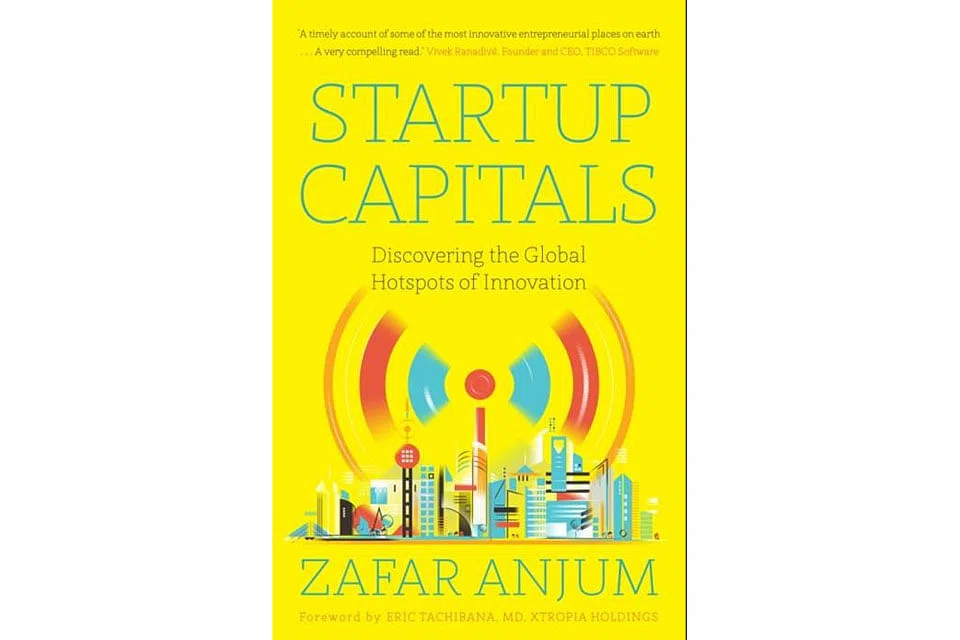
Startup Capitals: Discovering the Global Hotspots of Innovation
by Zafar Anjum
Hardcover: 320 pages
Publisher: Random House India
ISBN-10: 8184005946
Rating : B+
QUIETLY, almost unnoticed amid the euphoria of technology startups, a curious digital race has broken out among cities dotted across the globe. The prize: the accolade of being the next startup capital to rival Silicon Valley.
That honour brings with it riches beyond bragging rights as the hotbed to incubate the next Apple or Facebook. The stakes are high for governments, municipalities and universities. The winners will suck up engineering and marketing talent from across the globe, in turn fuelling economic growth for their communities.
Talented - and sometimes desperate - individuals have for decades, if not centuries, shifted loyalties from native countries and societies to foreign cities for better economic opportunities. Singapore is itself a city made up mostly of descendants whose forefathers sailed here for better jobs. In an increasingly borderless world in the digital age, the pace has accelerated as these havens provide not just jobs but also the buzz of a community of creative and engineering talent who truly believes that the widget or "app" they are working on will truly change the world.
Technology writer Zafar Anjum, a tech writer originally from India who now lives in Singapore, has brought to the surface critical issues facing governments and policymakers.
In Startup Capitals, published recently by Random House India, he examines the world's top 10 startup cities and explores the necessary conditions as well as the hurdles which will decide which city will succeed or fail in this quest. In the heady, sometimes illogical, growth of a startup community, great physical infrastructure and even vast population is no guarantee of success.
Backed by research, first-hand interviews with technopreneurs from various cities and written with the incisive analysis of an experienced tech writer, he lays bare the challenges of failing to attract talent and create jobs. Cities and entire societies which were ahead of others in affluence and wealth until recently can decay and fall rapidly behind if they don't innovate constantly.
Anjum does not only compare which cities fare better or worse in this race, but poses critical questions for municipal councils and governments at state and national levels. Some of these questions tear up the script of what has long been established as the best ways to build and grow cities.
The writer has used data from the Startup Genome project, which tracks start-up ecosystems in 141 countries. The Startup Genome Index ranks Silicon Valley in the US at the top of its 2012 startup ecosystem index, followed by Tel Aviv. Singapore is at number 17, followed by Melbourne and Bangalore.
The book examines why Tel Aviv is ahead of Bangalore, the outsourcing capital of the world, or Tokyo and Singapore - two of Asia's most advanced and innovation-driven cities. The Singapore chapter, for example, tries to explain how the city-state has some of the key infrastructure and policies in place for a startup ecosystem but is still 17th in the global ranking. This is so because, he argues, the city exhibits lower risk aversion, lacks in better role models and self-promotion skills, and needs to have stronger access to key markets such as China, Japan, India, and Indonesia.
The book teems with some surprising data, too: for example, Singaporean startups employ 43 per cent fewer people per stage as compared to Silicon Valley startups. Similarly, startups in Bangalore have 39 per cent fewer mentors per company compared to startups in Silicon Valley.
This publication not only takes you to places like Silicon Valley, Tel Aviv, New York, London, Berlin, Beijing, Tokyo and Sao Paulo for a ringside view but also brings you face to face with some of the brightest brains that are driving the innovation ecosystems there.
Despite the abundance of data, the book is an easy read and is recommended reading for anyone who is in interested in exploring the world of startups and innovation.
TRENDING NOW

Nvidia reinstates Jensen Huang as CEO; Trump says move poses no national security risk

Indonesia’s coal tycoon Low Tuck Kwong replaced as Bayan Resources president-director

Nvidia surges 33% after reinstating Jensen Huang, reviving AI trade; stocks soar in US and Europe

Consider lowering homeownership barriers for some non-resident foreigners

