

World can't wait till COP27 to tackle climate change
Even if all the commitments announced last week are implemented in full - a huge 'if' - global temperatures could be limited to just under 2 deg C.
 Add BT as a preferred source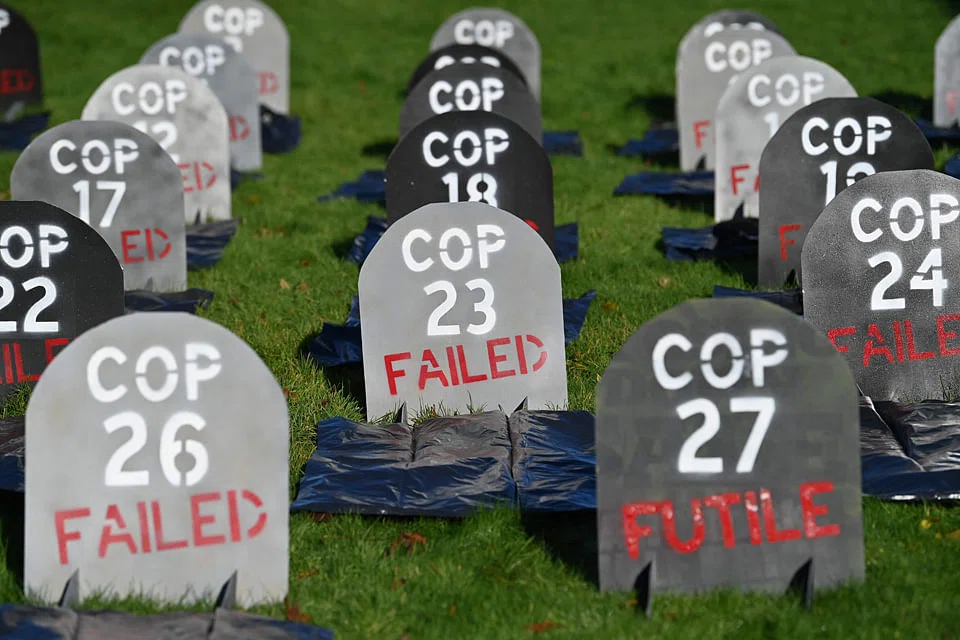
DESPITE 2 years of huge advance in diplomacy, and some 2 weeks of intensive negotiation, Glasgow's COP26 summit is unlikely to be seen as a decisive moment, such as Paris in 2015, in the 21/2 decades journey of United Nations-led climate change negotiations.
Sure, positive steps have been made, and the negotiations didn't collapse - a real threat at some previous key COPs, including Copenhagen in 2009. Moreover, the mood in Glasgow was lifted by the surprise United States-China cooperation agreement which, while short of specifics and lacking the ambition of Washington and Beijing's pre-Paris agreement in 2015, helped create more political space for a deal in Glasgow.
Whether the world goes further and faster on the global warming agenda in the 2020s could well now rest on this climate cooperation and an early signal of that could come on Tuesday morning Beijing time when Chinese and US Presidents Xi Jinping and Joe Biden meet for a virtual summit.
Tackling global warming is a key political priority of both, and it is sometimes forgotten that a key precursor for the Paris deal in 2015 was a bilateral agreement in this area brokered by then-US president Barack Obama and Xi.
Yet, even optimistic interpretations of the event must acknowledge that it lacked the ambition needed to fulfil the promise of Paris which set a cap on global warming of 1.5 degrees Celsius above pre-industrial levels. Several key bodies, including the International Energy Agency, have said that if all the commitments announced last week are implemented in full - a huge 'if' - global temperatures could be limited to just under 2 deg C.
Yet, Selwin Hart, the UN Assistant Secretary-General for climate change, has challenged such forecasts and asserted that the world is still on a 'catastrophic pathway' of well over 2 deg C. He highlighted at Glasgow a gloomy UN assessment of the 2030 picture, which indicates global emissions are on track to rise by 13.7 per cent, a huge bridge to gap between today's policies and action and optimistic long-term ambitions, and warned 'we cannot celebrate before we've done the job'.
Navigate Asia in
a new global order
Get the insights delivered to your inbox.
This confusing picture of mixed messages is why it is likely that, post-Glasgow, there will be divergent views of its achievements. The only certainty is that there is no room for complacency, and the best that can probably be said for the event is that it helped bring greater definition to the roadmap now needed to keep 1.5 deg C 'alive', as the COP presidency baton is handed over to Egypt in 2022, and the United Arab Emirates in 2023.
A fundamental question now is what needs to change to get even more traction, with the clock ticking towards what scientists warn are dangerous levels of climate change on the horizon. After all, Egypt will not be able to mobilise the diplomatic resources for COP27 next year that the United Kingdom, despite the uneven commitment of Boris Johnson's government, has brought to bear in 2020 and 2021.
The answer is complex, but an increasing number in the international community perceive that there may now be a 3-year window of opportunity, while Biden remains in office, to act in what he has called a 'decisive decade'. For, after January 2025, when his current term ends, the election of a Republican climate-sceptic president - possibly even Donald Trump - cannot be ruled out.
Post-Glasgow, there is much now needed to try to build insurmountable momentum in future talks. This includes high levels of business engagement which was one of the key themes of COP26.
Last Friday, for instance, the 2021 Global Investor Statement to Governments on the Climate Crisis saw 733 major institutional investors worth more than US$52 trillion, more than half all the assets under management globally, calling on countries to go further with negotiating texts, including ending fossil fuel subsidies, phasing out coal, and make climate risk disclosure mandatory.
Signatories include some of the world's largest investors, including State Street Global Advisors, Pimco, Amundi, Legal & General Investment Management, Franklin Templeton Investments, UBS Asset Management, Aegon NX, Insight Investment AXA Investment Managers, DWS Group, Schroders, Sumitomo Mitsui Trust Asset Management, Aberdeen Standard Investments, AllianceBernstein, Fidelity International, Aviva, BNP Paribas Asset Management, MFS Investment Management, and Allianz Global Investors. These investors argue that better policies would unlock the trillions of dollars of investment needed in solutions to the climate crisis. This includes policy signals in line with efforts to limit temperature rise to no more than 1.5 deg C, including significantly stronger 2030 nationally determined contributions, credible commitments to net-zero greenhouse gas emissions by mid-century, and the development of just transition plans for affected workers and communities.
This underlines that, ultimately, the world's future success in tackling climate change will rest on deep, collaborative partnerships across the public and private sectors, plus wider society. This is why clarity on the post-Glasgow roadmap is now needed so that actions can hopefully be taken, decisively and immediately.
This, in turn, highlights the critical importance now of implementation after what is sometimes seen as a half dozen 'lost' years of delivery after Paris. One of the key lessons of that period is that implementation of climate deals is best achieved through national laws. So the country 'commitments' put forward so far will be most credible - and durable - if they are backed up by legislation.
In the US, part of the reason Trump was able to unravel Obama's Paris ratification so relatively straightforwardly is that it was, politically, impossible to get the treaty approved in Congress. Obama therefore embedded the agreement through executive order, which Trump rescinded, before Biden reinstated it this year.
Compared to executive orders and other regulatory devices, legislation is more difficult to roll back. And this is especially so when supported - as in a significant number of countries - by well informed, cross-party lawmakers who can put in place a credible set of policies and measures to ensure effective implementation.
While worldwide climate pledges made are not yet close to meeting 1.5 deg C, these domestic legal frameworks are potentially crucial building blocks to measure, report, verify and manage emissions.
In the future, and as the COP process heads to Egypt in 2022 and then the UAE in 2023, the ambition must be that they are replicated in even more countries, and progressively ratcheted up, helping create a key global sustainability framework for billions across the world in the years to come.
- The writer is an associate at LSE IDEAS at the London School of Economics
Decoding Asia newsletter: your guide to navigating Asia in a new global order. Sign up here to get Decoding Asia newsletter. Delivered to your inbox. Free.
Share with us your feedback on BT's products and services
TRENDING NOW
Middle East-linked energy supply shocks put Asean Power Grid back in focus
Strengthening Asean’s economic resilience through RCEP’s 2027 review
How China’s young workers are securing their future even as AI disrupts job market, triggers pay cuts

US-China rivalry and the Kindleberger Trap: Why inaction – not escalation – is the biggest risk

