

World watching as 'freedom day' flops in England
Country is heading into what is forecast to be the biggest recorded wave of infections since the pandemic began.
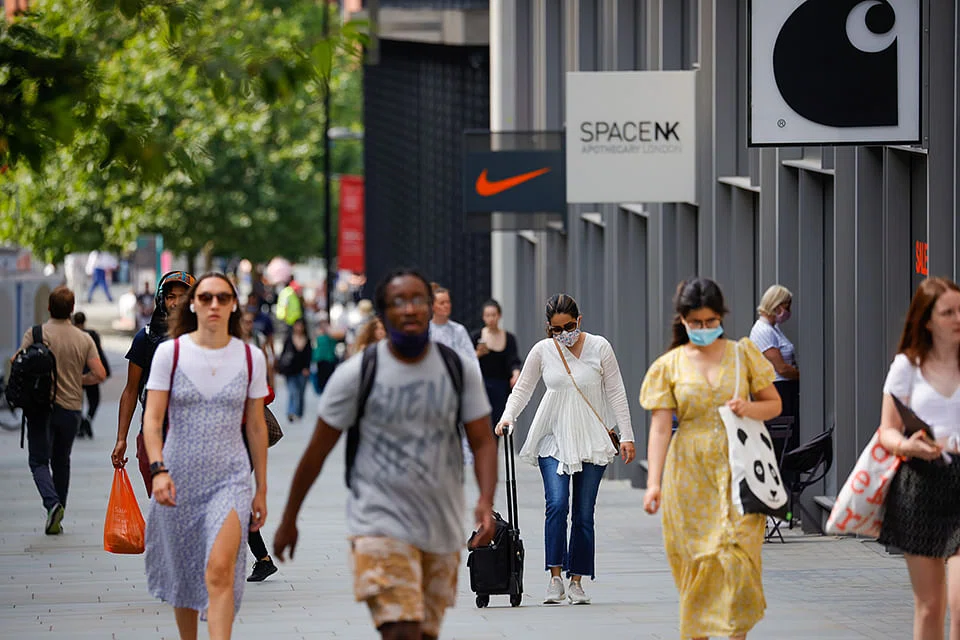
AS England cast aside this week almost all its remaining Covid restrictions, the world is watching the experiment to see whether it shows a pathway back towards "normality", or a new warning that even heavily vaccinated countries are not out of the crisis.
England's Chief Medical Officer Chris Whitty warned last week of a potential new lockdown as soon as next month. Yet, the UK government nonetheless cast aside the nation's remaining legal coronavirus framework while heading into what is forecast to be the biggest recorded wave of infections since the pandemic began in coming weeks.
The decision has been a very tough one to make for Prime Minister Boris Johnson who is himself in coronavirus self-isolation this week. While many businesses have welcomed the move away from legal restrictions to allow people to make their own decisions about how to manage the virus, some have been critical of the government's decision to end the mandatory requirement to use face coverings in places like shops and hospitality venues like pubs.
Outside of the business community, there has been much more concern expressed with hundreds of scientists warning that a complete reopening is dangerous. Specifically, it is charged that it risks creating a whole generation with chronic illnesses such as long-Covid, plus a growing threat of new variants that can break through the present vaccine protection.
MIXED MESSAGES
While pandemic-related deaths are generally occurring at a much reduced rate, the United Kingdom nonetheless reported its worst daily morbidity toll on Tuesday since March. A further 96 people died within 28 days of testing positive, and it is estimated 10,000-20,000 more people could die during the current wave this summer and autumn.
Controversial as the unlocking was for the government, what has left it in disarray this week is sloppy, undisciplined messaging. A good case study here is the mixed messages from ministers about whether it is mandatory to self-isolate when the National Health Service (NHS) pandemic app tells people to do so because of their previous proximity to someone subsequently testing positive for the virus.
Mr Johnson insists it is "crucial" to isolate when pinged in this way, even those who are already double vaccinated, much to the frustration of many people and firms across the country. Yet, several Conservative politicians, including Business Ministers Paul Scully and Lord Grimstone, have suggested it is acceptable for people to ignore a request from the NHS Covid app to isolate.
If Mr Johnson avoids further lockdowns, the political pressure on him may not reach boiling point in coming weeks. However, he could be facing much more trouble if there are further lockdowns after his prior commitment to the "irreversibility" of the easing of restrictions.
Already, on what Mr Johnson previously said was "freedom day" on Monday, he announced a plan to actively curtail liberties that only became available that same day. He said he was proposing, for nightclubs, mandatory Covid status certification that was seen as discriminatory when the idea was first discussed by his government, and also u-turned further by refusing to rule out mandating these passports for a much wider range of venues.
The prime minister knows that another series of regional or England-wide lockdowns, which he has previously insisted won't be needed, would be another body blow for his political credibility and authority. So much so that there would be increased doubt in Westminster if he can survive in office until the next election.
To be sure, the decisions that Mr Johnson has had to make during the Covid crisis have been very hard, and any alternative leader would have made mistakes. Yet his approach to tackling the crisis has too often been chaotic and incoherent, reflecting the fact that his skillset ("big picture" and not details-focused) and style (flamboyant and colourful) is less suited to the demands of the pandemic era than previous times.
When Mr Johnson scored his huge election win in 2019, it was widely expected at the time that he could remain in office for much of the 2020s. Yet the rollercoaster ride that his premiership is proving to be means his term could end far sooner. This is not just because of Mr Johnson's stumbling political performance during the pandemic.
In addition to this are the problems that come from his gambling-style approach to governing the nation. From the very start of his premiership he deliberately took a more adversarial, "scorched-earth" approach to Brexit than predecessor Theresa May. The culmination of this saw him suspend Parliament in 2019, illegally, in a decision that was ultimately over-ruled by the Supreme Court, causing embarrassment to the Queen, who had to formally approve Mr Johnson's suspension request.
One of the biggest risks Mr Johnson is playing right now is over the post-Brexit Northern Ireland Protocol. Despite having signed up to the deal only in December, his government has now described it as unsustainable.
HIGH WIRE APPROACH
To be sure, some of Mr Johnson's gambles have paid off for him, especially in 2019. He took a major risk for instance in pushing for a pre-Christmas election, the first December ballot for a century, at a time of high political volatility, and it paid off.
Since the turn of 2020, however, the prime minister's "high wire approach to governance has generally backfired. In February and March last year, he originally opted for an "outlier" pandemic strategy, styled by some as a "herd immunity" approach, which was out of kilter with many countries in much of the rest of the world that imposed restrictive measures faster and/or utilised much wider "mass" testing.
Fast forward several months to today and, despite many u-turns from Mr Johnson, the United Kingdom will end up with one of the highest number of deaths per capita of many countries with the Office for National Statistics highlighting this week there have been 154,000 UK deaths where coronavirus was mentioned on the death certificate. And the nation may be the hardest hit, economically, of any G-20 country to boot.
While Mr Johnson previously had much goodwill from the nation after his own brush with death from the pandemic in 2020, and is still riding high in the polls, public support will not be sustained indefinitely. Despite his hold on power seeming unassailable a few weeks ago, his premature departure from office in potentially ignominious circumstances cannot be ruled out in the unprecedented context of the continuing Covid crisis.
- The writer is an associate at LSE IDEAS at the London School of Economics
TRENDING NOW
Despite the de-dollarisation debate, demand for dollar liquidity in Asia is growing
URA to review guidelines on floor space to give developers more design flexibility: Chee Hong Tat

He built the Vingroup empire. Now South-east Asia’s richest man is handing some key roles to his sons

Can a first-time homebuyer couple earning S$18,000 a month afford a new EC unit?

