

Company-level gains aside, work-from-home options reduce strain on public infrastructure too
Drastic peak and troughs are a sign of inefficiency. Work-from-home options can smooth out commuter flow issues

SINGAPORE may have enshrined the right of employees to request flexible work arrangements – under tripartite guidelines that kicked in late last year – but the return-to-office wave shows no sign of letting up.
Earlier this month, the National University of Singapore made headlines for bringing all its full-time staff back to the office for five days a week. It is just one of many employers, in Singapore and across the world, that seem keen to forget how the Covid-19 pandemic proved the feasibility of remote work.
The post-Covid era has seen no shortage of studies and think-pieces on the benefits and detriments of remote, hybrid and fully back-to-office arrangements.
Collaboration is often cited as a key benefit of returning to the office, though its proponents tend to sidestep the question of why this cannot be achieved with a hybrid model.
Arguments in favour of remote and hybrid work, meanwhile, tend to focus more on worker welfare and may thus fail to sway hard-headed employers.
These well-trodden arguments tend to focus on workplace-level consequences. Setting them aside, one might instead consider wider societal effects.
Peak capacity
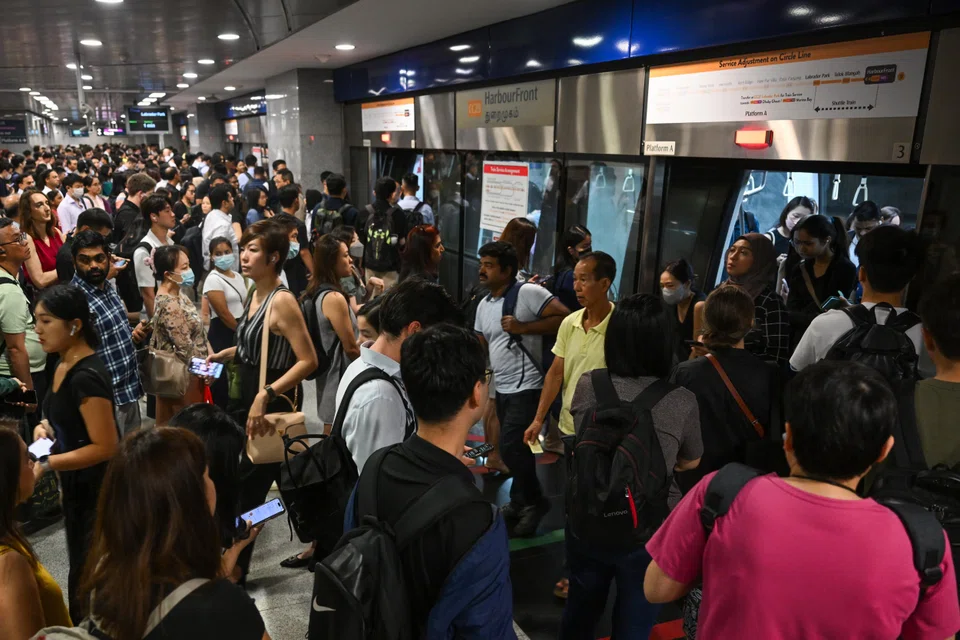
Rush-hour crowds continue to test the limits of the public transport system, even as the MRT network is being expanded and staggered commuting hours are being encouraged.
Eateries in the Central Business District once faced existential worries about the lack of crowds; now, at least anecdotally, they are back to bursting at the seams.
This is even as some employers continue to preserve hybrid work options, with employees allowed to work from home for at least one or two days a week.
If complete work-from-office mandates continue to gain ground, these pressures will only intensify.
Having significant peaks and troughs in capacity is generally seen as inefficient. Smoothening these out, such that a smaller peak capacity is required, is an efficiency gain.
Granted, the office model appears to have its own efficiency gains. If an office is going to be fully lit and air-conditioned regardless, having more workers present – and thus not consuming such electricity at home – may seem better for the environment.
However, this needs to be set against the environmental impact of commuting, not least given that not all commuters use public transport. Singapore is aiming to become a car-lite nation; allowing employees to stay home is one way of reducing the need for cars on the road.
In the absence of rigorous accounting for the environmental impact of commuting versus remote work, one might turn to a simpler measure: workers’ own residential utility bills.
As Covid’s work-from-home era demonstrated, workers may save money by going to the office instead of working from home, if their transport outlays are not too high.
But this is precisely why employers should stop and ponder: Why might some workers be willing to take the financial hit instead of enjoying office facilities?
This willingness points to the welfare benefits of working from home, something that deserves more attention in the national context of addressing mental health issues.
No one is arguing for a return to full remote work; the environmental inefficiencies, in such a scenario, would likely grow too great. But preserving hybrid work options can help to reduce the stress on public facilities – and, of course, on workers too.
TRENDING NOW

MSCI proposes standalone status for Indonesia; Jakarta stocks plunge 8%

Palm oil stocks slide after Singapore begins looking into which firms responsible for haze
High Court rules against Julius Baer’s Singapore trust arm in US$50 million family trust dispute

Why is the haze so bad in South-east Asia this year?

