

DBS, OCBC surge on strong H1 results but don’t overlook the potential of underdog UOB
Dividend yields have compressed but they are still attractive

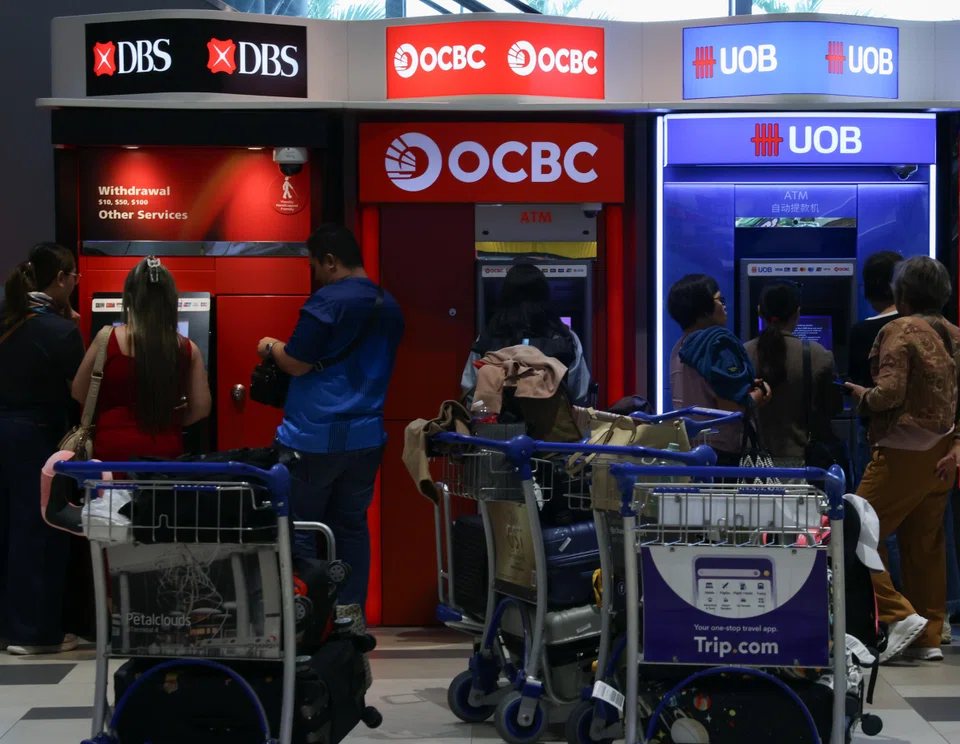
[SINGAPORE] There was a lot riding on the financial results of DBS, OCBC and UOB last week – with some analysts calculating that the three stocks had accounted for nearly 89 per cent of the Straits Times Index’s gain since the beginning of the year, up to Jul 30.
Fortunately, the three banks delivered sufficiently strong numbers to staunch most of the nervousness about their increasingly rich valuations – with their wealth management activities and asset growth compensating for further normalisation of their net interest margins.
Notably, DBS reported a 3 per cent rise in total income to just more than S$12 billion for the first half of 2026, as net interest income fell 3 per cent to S$7.1 billion while non-interest income rose 15 per cent to nearly S$5 billion. Its net profit for the six-month period rose 5 per cent to just over S$6 billion.
OCBC reported an even stronger 11 per cent rise in total income to S$8 billion in H1. Net interest income was down 3 per cent at S$4.5 billion, but non-interest income surged 36 per cent to S$3.5 billion, lifted by record levels of fee, trading and insurance income. The group’s net profit increased 13 per cent to S$4.2 billion.
UOB’s performance was less robust, though. Total income declined 1 per cent in H1 to S$7 billion, as net interest income fell 3 per cent to S$4.6 billion, net fee income eased 2 per cent to S$1.3 billion, and other non-interest income rose 4 per cent to S$1.1 billion.
UOB reported S$902 million in new non-performing assets (NPAs) in Q2 2026, up from S$341 million in Q1 2026, which it attributed to a “closely monitored” real estate account in greater China.
Yet, the group reported a 27 per cent decline in total allowances for NPAs in H1 2026 to S$414 million, as a reversal of general allowances more than offset the specific allowance for the troubled account. UOB’s net profit for the six-month period was up 3 per cent at more than S$2.9 billion.
Reflecting this lukewarm performance, UOB shares ended last week 0.2 per cent lower at S$43.30. DBS ended the week 3.1 per cent higher at S$76.33 and OCBC climbed 4 per cent to S$30.30. The STI was up 1.2 per cent for the week.
Higher ROEs, P/NAV valuations
On the face of it, the market’s reaction to the banks’ H1 2026 financial reports was quite rational.
With non-interest income more than offsetting softer net interest income at DBS and OCBC, both banks reported higher annualised return on equity (ROE) in H1 2026 versus H1 2025 – which would logically justify higher price-to-book valuations for their shares.
DBS reported an annualised ROE of 17.5 per cent for H1 2026 versus 17 per cent in H1 2025, and is currently trading at 3.1 times its net asset value (NAV). OCBC is trading at 2.2 times NAV, against a H1 2026 ROE of 13.7 per cent, up from 12.6 per cent in H1 2025.
In contrast, UOB reported an ROE of 11.6 per cent H1 2026, down from 11.7 per cent in the year-ago period. Its shares are currently trading at 1.4 times NAV.
But are DBS’ and OCBC’s relatively strong ROEs and revenue momentum worth their higher valuations? Or does UOB offer better value? Is it time to get out of the banks altogether?
First of all, it may be worth pointing out that the three banks have themselves displayed varying appetite for their own shares recently.
During the first seven months of 2026, OCBC and UOB spent S$220.1 million and S$216.4 million, respectively, repurchasing their shares from the market, according to data compiled by the Singapore Exchange.
Only two other companies with primary listings in Singapore were bigger buyers of their own shares – and neither of them was DBS. Singtel spent S$893 million on share buybacks during the seven-month period, while Keppel spent S$246.7 million.
In fact, DBS has not repurchased shares from the market since July 2025, when it bought 350,000 shares at prices ranging from S$45.79 to S$46.33 apiece – or as much as 40 per cent below its current market price
Meanwhile, OCBC last bought back its own shares in May this year, when it scooped up 447,300 shares at S$22.86 each – nearly 25 per cent below its current price.
UOB has repurchased shares as recently as last month, when it reported several transactions, some at prices exceeding its current share price.
For instance, on Jul 16, it bought 60,800 shares at prices ranging from S$43.42 to S$44.59. The day before that, it bought the same number of shares at prices in the range of S$44.42 to S$45.11.
Attractive dividend potential
For many investors, the price to NAV multiples at which the banks trade is much less relevant than their dividend yields. While these yields have compressed, they are still quite attractive.
For instance, DBS said last week that it will pay an ordinary dividend of S$0.66 per share and a capital return dividend of S$0.15 per share for Q2 2026, matching its Q1 payout.
If DBS pays the same amount for the last two quarters of the year, its dividend yield for 2026 will amount to 4.3 per cent, based on its current share price.
RHB said in a report last week that DBS may pay higher dividends next year, as its share buybacks appear to have been curtailed.
OCBC and UOB are currently trading at yields of 3.1 per cent and 4.1 per cent, respectively, based on their annualised H1 2026 dividends.
The way I see it, the generally strong H1 performance of the three banks, and their potential to continue paying attractive dividends, could support the recent momentum behind their share prices.
Yet, with their key earnings driver having shifted from net interest income immediately after the pandemic to non-interest income now, forecasting their forward numbers has become somewhat tougher – and their elevated valuations could mean heightened volatility when their results deviate from expectations.
It may also be wise for investors to not assume that UOB is the only local bank susceptible to asset quality issues, as an accumulation of global trade and energy supply disruptions bite in the months ahead.
Against this backdrop, my inclination is to eschew chasing the banks, and to rotate towards the laggard within the sector. While UOB’s H1 2026 performance was disappointing compared to that of its peers, the group is working to catch up.
Last week, UOB said it will sell its asset management arm to Allianz Global Investors (AGI) for S$555 million. As part of the deal, UOB will form a long-term strategic distribution partnership with AGI in order to be able to provide its customers with a broader range of investment solutions.
With high expectations across the banking sector, it may be the underdog that offers the most potential at this point.






