DBS, OCBC, UOB are weighing down the STI
Weaker economic activity and peaking interest rates could reverse the big profitability gains charted by the three banks

Ben Paul
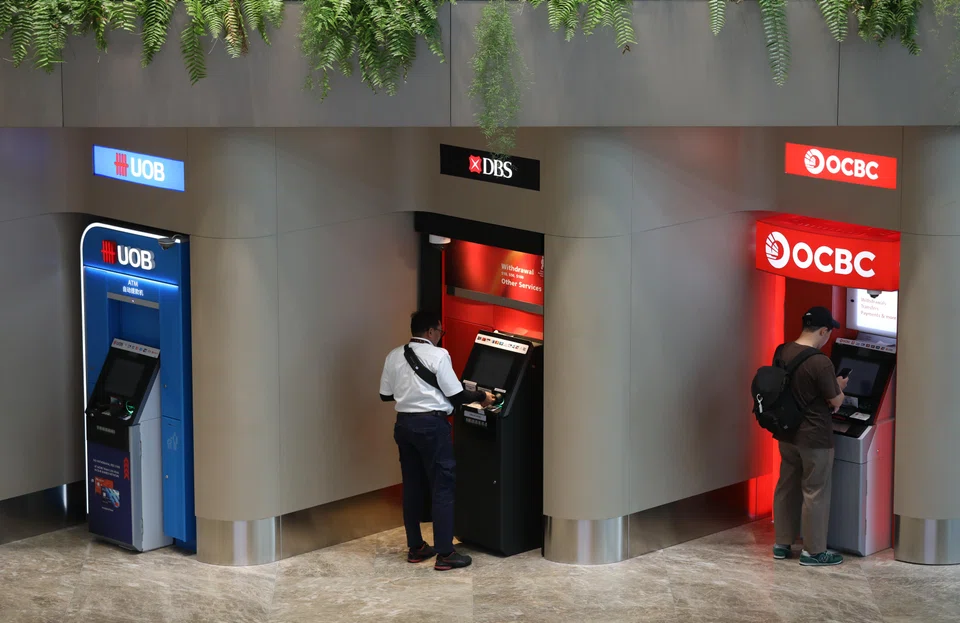
IT HAS been a pretty good few weeks for stocks. The S&P 500 index has bounced 11.8 per cent from its Oct 27 low, thanks in part to a significant pullback in 10-year US Treasury bond yields from a peak of 5 per cent.
The Straits Times Index (STI), however, is up only 1.9 per cent from its Oct 23 low – no thanks to the three Singapore banks, which account for nearly half the local benchmark index.
DBS has fallen 4.3 per cent since Oct 23, making it the worst-performing component of the STI during the nearly seven-week period. OCBC and UOB have slipped 0.5 per cent and 0.1 per cent, respectively.
Only three other components of the 30-stock STI fell during the same period: City Developments, Seatrium and Thai Beverage.
At the other end of the spectrum, many real estate investment trusts (Reits) have outperformed the STI since Oct 23. All six Reits that are components of the STI were among its 10 best performers.
One explanation for DBS, OCBC and UOB lagging the STI recently is that major central banks are expected to begin cutting interest rates in 2024 as growth and inflation ease.
Against this backdrop, net interest margins (NIMs) at the three banks are likely to begin normalising while provisions for bad loans may rise.
This could be a useful reminder to investors positioning themselves for a loosening of monetary policy that the STI will probably not deliver particularly strong returns.
Nevertheless, long-term investors pursuing a dollar-cost averaging strategy might appreciate the ballast the three banks will likely provide to the STI in the event of a shift in consensus on the timing and pace of rate cuts by the Fed and other central banks.
Given the tendency for stocks to overshoot to the upside as well as the downside amid shifting investor sentiment, there could also be opportunities in 2024 for bargain hunters to accumulate what are arguably some of the best quality stocks in the Singapore market.
Sweet spot
The three Singapore banks have clearly been in a sweet spot over the last couple of years.
As interest rates climbed quickly, the banks were able to reprice their assets at a faster pace than the rise in their cost of funds. DBS reported NIMs of 1.45 per cent for 2021, 1.75 per cent for 2022, and 2.16 per cent for the first nine months of 2023.
Similarly, OCBC achieved NIMs of 1.54 per cent for 2021, 1.91 per cent for 2022, and 2.28 per cent for the first nine months of 2023.
UOB reported NIMs of 1.56 per cent for 2021, 1.86 per cent for 2022, and 2.12 per cent for the first nine months of 2023.
The result was record-breaking earnings at all three banks, and a surge in their return on equity (ROE). OCBC reported a rise in its ROE from 9.6 per cent in 2021, to 11.1 per cent in 2022, and to 14.2 per cent for the first nine months of 2023.
UOB’s ROE climbed from 10.2 per cent in 2021 to 11.9 per cent in 2022, and to 14.3 per cent for the first nine months of this year.
DBS reported ROE of 12.5 per cent for 2021, 15 per cent for 2022, and 18.6 per for the first nine months of 2023.
Of the three banks, UOB had the lowest common equity tier-1 (CET1) capital adequacy ratio at the end of Q3 2023 of 13 per cent. DBS and OCBC ended Q3 2023 with CET1 ratios of 14.1 per cent and 14.8 per cent, respectively.
When interest rates plateau and begin falling, it seems very likely that the sharply improved profitability at the three banks will reverse. Net interest income accounts for more than two-thirds of their total income.
Valuations not excessive
The big question is when exactly these rate cuts will happen, and whether they will be accompanied by a “soft landing” for the global economy.
For now, there appears to be a lot of confidence that inflation will be contained without too much pain.
On Friday (Dec 8) morning, the US Bureau of Labor Statistics said total non-farm payroll employment increased by 199,000 in November. The unemployment rate edged down to 3.7 per cent, from 3.9 per cent the previous month.
This sparked an uptick in the 10-year US Treasury bond yields, but the S&P 500 still rose 0.4 per cent to close at 4,604.37 – its highest close for 2023.
The Federal Open Market Committee is due to hold its final meeting for 2023 this week, and issue its latest Summary of Economic Projections. It held the federal funds rate steady at 5.25 to 5.5 per cent at its last two meetings.
My own view is that the cumulative impact of the rapid tightening of monetary policy since early 2022 is still working its way through the global economy and financial system.
Even if the Fed does not raise rates further, or even if it cuts rates slightly ahead of the US presidential election in 2024, markets are going to be generally less exuberant.
What does all this mean for Singapore’s three banks? Weaker economic activity and falling interest rates look set to weigh on their profitability. Indeed, the relative weakness of their shares since October could be a sign of things to come.
The good news is the banks are not excessively priced. UOB is trading less than 11 per cent above its NAV of S$24.89 per share, while OCBC is trading at a 12 per cent premium to its NAV of S$11.28 per share.
DBS is trading at a significantly higher 42 per cent premium to its NAV of S$22.51 per share, perhaps reflecting its superior ROE.
As a long-term investor, I would be a buyer of all three stocks if they sank towards their respective book values.
The writer owns shares in OCBC.