Dear UOL board: don’t stay a crouching tiger, unleash the hidden dragon in the stock
The property player must urgently address its yawning market discount to book value

PROPERTY developer UOL Group has been making astute investments and executing well on various fronts of late. However, this good work may be wasted as the market marks down the value of assets that the group holds. As at Oct 16, UOL traded at a 59 per cent discount to end-June’s net asset value (NAV) per share of S$13.19.
With lower interest rates, UOL should seize the opportunity to optimise its balance sheet, drive higher return on equity (ROE) and grow in fund management. The group can actively embrace capital-efficient ways of holding its investment properties and hospitality assets. This could possibly be through listed real estate investment trusts (Reits) and business trusts, or private funds.
While the Urban Redevelopment Authority’s flash estimate of private-home prices in the third quarter showed a quarterly decline, there is demand for the right projects, even in the prime segment which is reeling from the high taxes that apply to foreigners, who are not permanent residents, buying homes here.
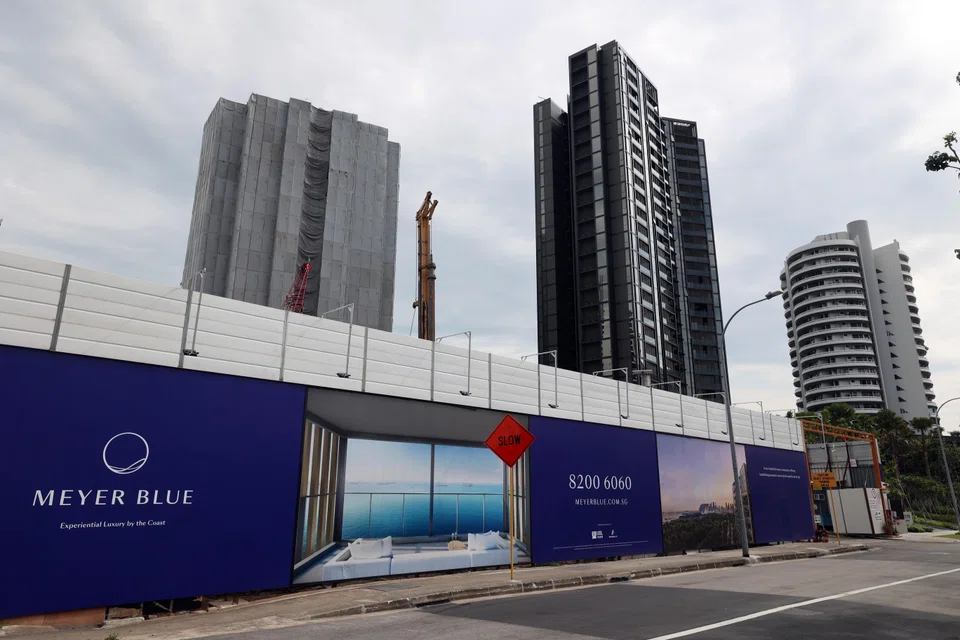
Early this month, freehold condominium Meyer Blue in District 15, which is being developed by UOL and its listed subsidiary Singapore Land Group , sold over half of its 226 units during its launch weekend at an average of S$3,260 per square foot. Meyer Blue’s positive take-up follows strong sales at the launch of another prime condominium project, Watten House. The District 11 project was launched by UOL and Singapore Land last November.
Overseas expansion and Singapore development pipeline
On Oct 11, UOL and Singapore Land announced their joint purchase of a 50 per cent stake in 388 George Street, a freehold property in Sydney, Australia, for a consideration of A$460 million (S$405 million). Located in the heart of the central business district, the refurbished building has a net lettable area of 37,444 square metres (sq m) in office space and 3,654 sq m in retail space.
UOL and Singapore Land appear to be making a good buy. According to media reports, their entry price is at an estimated capitalisation rate of 6.2 per cent. This contrasts with the estimated 4.5 per cent cap rate for Hong Kong-listed Link Reit’s purchase of a 25 per cent stake in 388 George Street in 2022.
In the income capitalisation method, a property’s value is derived by dividing the assumed net property income by its cap rate. The property’s value is inversely related to the cap rate used.
Assuming that the net property income remains constant, the price of a property with a 6.2 per cent cap rate is around 27 per cent lower than that with a 4.5 per cent cap rate.
UOL’s latest Sydney foray will pay off if there is further momentum in workers returning to physical offices in Sydney, and interest rates continue to decline. Such trends could drive rental and capital value growth.
Meanwhile, should lower interest rates and Singapore’s stability amid rising geopolitical tensions buoy the private-homes market, UOL could chalk up more successes in the Republic.
Working with partners, UOL is launching residential developments in 2025 that include projects in prime sites in Orchard Boulevard and Holland Drive.
UOL, together with Singapore Land and CapitaLand Development, will also be launching Parktown Residence, with 1,195 condominium units, likely early next year. This is part of an integrated development with a mall, a bus interchange, a community club, a hawker centre, and direct connectivity to the upcoming Tampines North MRT station. Homebuyers typically flock to integrated developments with good public transport and other amenities.
In addition, UOL is actively growing its hospitality segment.
New properties, which the group owns, that opened this year include Pan Pacific Jakarta and Parkroyal Serviced Suites Jakarta in Indonesia. Between 2025 and 2027, the group will expand its Asian hospitality footprint in Cambodia, China, Indonesia, Japan, Singapore, Thailand and Vietnam.
With rising income in Asia and strong demand for travel, UOL’s hospitality segment should enjoy positive tailwinds. Moreover, an emphasis on biophilia at UOL’s hotels here such as Pan Pacific Orchard, Parkroyal Collection Pickering and Parkroyal Collection Marina Bay helps to burnish the group’s green credentials and build customer loyalty.
Singapore Land, which is a major local office-property owner, is also busy rejuvenating its assets. It is carrying out major asset enhancement works in its flagship Singapore Land Tower in Raffles Place.
Embrace property funds
All the hard work in investments and operations will go to waste unless UOL’s board urgently addresses the share price discount to book value, especially as the NAV is conservative and the balance sheet is healthy. For example, the NAV does not capture potential profit from housing development projects or the upside from marking to market the value of hotel properties carried under property, plant and equipment.
UOL should look to own investment properties and hospitality assets through listed or unlisted property funds. Capital can be freed up by reducing the group’s ownership stake in assets, while ROE may be helped by earning fund management fee income.
Leading Reit CapitaLand Integrated Commercial Trust , which has substantial exposure to Singapore office buildings, malls and integrated developments, traded at close to its end-June NAV based on its unit price as at Oct 16.
UOL will create tremendous shareholder value through owning assets via vehicles that trade at much narrower book value discounts than UOL. Perhaps, UOL can start by working with Singapore Land to inject commercial properties in Australia and the United Kingdom into, say, a Reit, before tackling its substantially larger Singapore investment property and global hospitality portfolios.
UOL has ownership interests in prime London properties 110 High Holborn and 120 Holborn Island, as well as 72 Christie Street in Sydney. Completion of the 388 George Street purchase is expected within the first half of 2025.
UOL turned 60 last year. Earlier this year, Wee Ee Lim succeeded his late father Wee Cho Yaw, who was chairman for over 50 years until his death, as the group’s chairman.
Hopefully, UOL will boldly write a new chapter for its business in funds management. After all, a great property and hotel group needs to excel in buying assets, project execution, operations and owning assets.
The writer owns shares in UOL