

The death of the Trump trade
Investor backlash against US markets appears to be real
[NEW YORK] US President Donald Trump’s trade is dead. Long live the anti-Trump trade. Wherever you look in financial markets, you see signs that global investors are going out of their way to avoid Trump’s America.
Fund managers are not feeling miserable – far from it. Levels of general enthusiasm for riskier assets are roughly the same now as they were immediately after the president won re-election at the end of 2024, judging from investor surveys.
But the source of that enthusiasm, and how it manifests in markets, has flipped.
Back then, it was an outbreak of chest-thumping about a new US administration willing to deregulate and stimulate its way to unstoppable dominance in the global economy and markets.
It was seen as on track to suck economic growth out of the bones of the rest of the developed world, pumping up the US dollar and opening up a gap – between sunny US stocks and a dreary picture elsewhere.
As we stretch into year two of Trump’s second term, however, we see something quite different. The bullishness is still there, but it is showing up in completely different places.
The easiest measure of this is in the stock market performance.
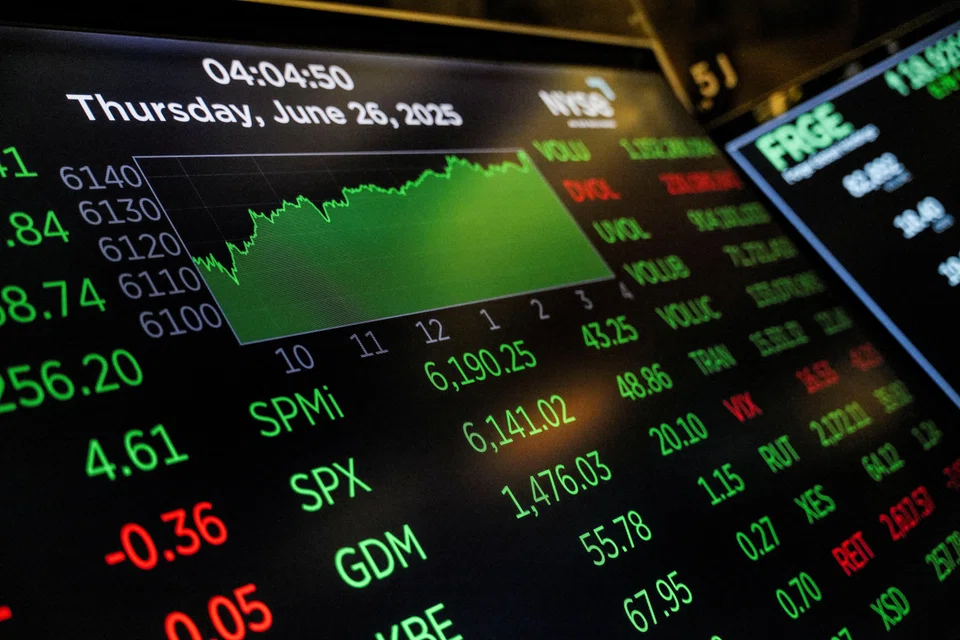
The US’ benchmark S&P 500 index is now slightly negative on the year, bobbing tediously higher and lower in an unusually tight range since late December 2025.
Normally, this would reflect a global outbreak of nerves. This time, however, it is focused squarely on the US, due to the stress in its prized tech sector and policy dysfunction. European and Asian markets are mostly doing just fine.
Global stocks, measured in the widely tracked MSCI World Index and skewed heavily towards the US, are up by 2 per cent so far in 2026. That is decent. But if you strip out the US, you are up a much rosier 9 per cent.
The fact is, it has paid to give US markets a swerve right now. So far this year, they have been a dud.
This is shaping up to be the worst year for US stocks compared with the rest of the world since at least 1995.
It is not yet clear the extent to which the recent pullback in stocks related to artificial intelligence (AI) will turn out to be meaningful.
Tilting the balance
The wave of nausea over the impact of AI on the wider tech sector, however, is certainly helping to tilt the balance further from the US, and towards Europe.
In 2025, the great normalisation of global investors’ reliance on the US – the bedrock of most portfolios for the past few decades – was more of a concept than a reality.
Now, though, regular surveys of investors, carried out by the Bank of America, reflect the biggest positive allocation to euro assets on record in an impressive global rebalancing.
The bank’s European survey showed that more than a third now hold a higher allocation to European Union stocks than benchmarks would usually suggest, up from only 9 per cent three months ago.
A net 22 per cent also say they hold a lower-than-benchmark allocation to the US, from just 6 per cent at the end of 2025. The backlash appears to be real.
Money is not pouring out of US markets, but bankers and investors say the new money pouring into the financial system is seeking out new homes.
In this context, it is notable that even when Trump had his wings clipped, as he did over tariffs on Feb 21, US markets did not spring back. The world is moving on, slowly but surely.
Europe is not the only beneficiary, but it is right up there.
French asset manager Carmignac likens this to the awakening of “Sleeping Beauty”, with a host of both structural and economic factors all helping “the so-called old continent”.
Record-breaking sums are heading into funds of European stocks from investors looking to diversify away from tech, and shield themselves from homegrown US political risks.
Investors and analysts are daring to think the German economy is finally turning the corner as it delivers on its plans for huge additional fiscal spending, which has been largely on ice since it was announced in 2025.
Eurozone business surveys are not sparkling but encouraging. The US economy, meanwhile, is growing much more slowly than previously thought – at a tepid, European-like annual pace of 1.4 per cent, fresh data showed on Feb 20.
The huge reliance on tech outperformance has been essential to the US investment miracle of the past decade or so.
Now, it is stumbling – and at the same time, US economic data is under strain and its politics lurches from one crisis to the next.
Investors are voting with their wallets. The big reset, so often dismissed by money managers in the US, is very clearly happening – whether they like it or not. FINANCIAL TIMES
TRENDING NOW

Britain’s mansion tax shows the difficulty of targeting wealth

Once staunchly pro-China, Malaysian Chinese businesses are now distancing themselves from Beijing

The only common thing in S-E Asia is that we all eat rice: Cisco’s Asean president

Singapore data centre operator DayOne opts for US IPO at likely US$20 billion valuation

