From defence to dividends: The best performing STI components are riding big global currents
Betting that laggards will quickly catch up with the leaders could be a mistake in the current thematic, growth-oriented market environment

[SINGAPORE] There was no shortage of worrying news headlines on the geopolitical front last week – from Poland shooting down Russian drones, to Israel attacking Hamas in Qatar.
Yet, there was little sign of fear or pessimism in global financial markets. In fact, the possibility of a wider military conflict in Europe just seemed to stoke enthusiasm for hot defence stocks.
BAE Systems, Rheinmetall and Rolls-Royce were up last week by 11.3 per cent, 8.7 per cent and 5.4 per cent, respectively. The Stoxx Europe 600 index ended last week more than 1 per cent higher.
One possible reason for the stubborn optimism is that the US Federal Open Market Committee is widely expected to deliver a rate cut this week.
The 10-year US Treasury bond yield ended last week at 4.07 per cent, down about 20 basis points since Fed chairman Jerome Powell telegraphed the likely shift in US monetary policy at the Jackson Hole symposium three weeks ago.
Meanwhile, the rising risks to US employment that has the Fed poised to cut rates despite elevated inflation do not appear to be having much adverse effect on sentiment in the corporate sector. In July and August, analysts actually raised their Q3 2025 earnings per share (EPS) forecasts for S&P 500 companies by 0.5 per cent, according to financial data provider FactSet.
Analysts have historically reduced their EPS estimates during the first two months of a typical quarter, FactSet said. Over the past 10 years, the average decline in EPS forecasts for S&P 500 companies during the first two months of each quarter was 2.5 per cent.
AI boom buoying sentiment
One major theme that is buoying the US corporate sector is artificial intelligence (AI). FactSet said earlier this month that the term “AI” was mentioned in 287 earnings calls conducted by S&P 500 companies from Jun 15 to Sep 5 – the highest number over the past 10 years.
The number of companies mentioning AI during their earnings calls has been rising rapidly since Q4 2022, when OpenAI’s ChatGPT was released.
The previous high was set during the Q4 2024 earnings season, when 247 companies mentioned the term “AI” during their earnings calls, according to FactSet. For Q1 2025, the number of S&P 500 companies that mentioned “AI” dipped to 218.
While some commentators are already raising concerns about whether the billions of dollars flowing into the AI space are being invested productively, there is little sign of the boom coming to an end.
On the contrary, the AI theme was reinforced last week when Oracle surprised the market with a very aggressive guidance for its cloud infrastructure business, sending its shares rocketing.
Oracle was up 25.5 per cent last week, while the S&P 500 was 1.6 per cent higher.
Global currents, local trends
These global currents seem to be shaping trends in the Singapore market, with stocks that fit certain themes being swept higher.
The excitement about global defence stocks, for instance, has kept ST Engineering on the radar of investors. Even after a big-sell off last month, the stock is still the best performing component of the Straits Times Index (STI) this year.
ST Engineering was up 2.9 per cent last week, versus the STI’s gain of 0.9 per cent. Since the beginning of the year, ST Engineering was up 74.9 per cent while the STI was up 14.7 per cent.
Yield-oriented plays in the Singapore market have also rallied strongly on the back of softening interest rates. Notably, all eight real estate investment trusts (Reits) within the STI have risen by more than the benchmark index since Powell’s Jackson Hole speech last month.
Over the past week alone, CapitaLand Integrated Commercial Trust surged more than 3.5 per cent, CapitaLand Ascendas Reit rose more than 2.5 per cent, and Mapletree Logistics Trust climbed more than 2.4 per cent.
DBS is also attracting strong interest, thanks to confidence among analysts and investors that it will deliver higher dividend payouts over the next few years, even as falling interest rates squeeze its net interest margins.
Its shares were up 1.9 per cent last week, and 18.5 per cent higher since the beginning of the year. In contrast, OCBC ended last week unchanged while UOB fell 1.5 per cent. Since the beginning of the year, OCBC was up less than 1 per cent while UOB was down 2.8 per cent.
Then, there is Singtel. The fourth largest component of the STI has been drawing investors with value-unlocking initiatives and improving profitability at its core businesses. While its shares were down 1.1 per cent last week, they have increased 40.9 per cent since the beginning of the year.
The way I see it, Singtel has the potential to latch itself to the AI theme by communicating the opportunities it plans to seize in the burgeoning field, and accelerating the expansion of its data centre business.
Laggards should take action
As a value investor, the current thematic, growth-oriented market environment makes me rather uncomfortable. When stocks I own garner relatively high market valuations, my inclination is to take some money off the table, or rotate into more attractively priced alternatives.
Yet, with interest rates falling in the midst of a bull market, companies with the best growth potential may well see their premium valuations continue expanding. Betting that laggards will quickly catch up with the leaders could be a mistake.
Take the three Singapore banks: After its strong run, DBS currently trades at about 2.2 times its net asset value (NAV) as at Jun 30. Even against its superior return on equity (ROE) in H1 2025 of 17 per cent, that seems a bit high.
OCBC had an ROE of 12.6 per cent in H1 2025, and trades at 1.3 times NAV. UOB had an ROE of 11.7 per cent, and trades at 1.2 times NAV.
As interest rates soften, all three banks are likely to suffer narrower net interest margins and lower ROEs. Yet, DBS would probably still have the highest ROE among the three banks, and the strongest potential to deliver steadily higher dividend payouts going forward.
Unless OCBC and UOB formulate and communicate credible strategies to drive their ROEs higher over time, their valuations may continue to trail behind DBS’, especially if the market keeps rising.
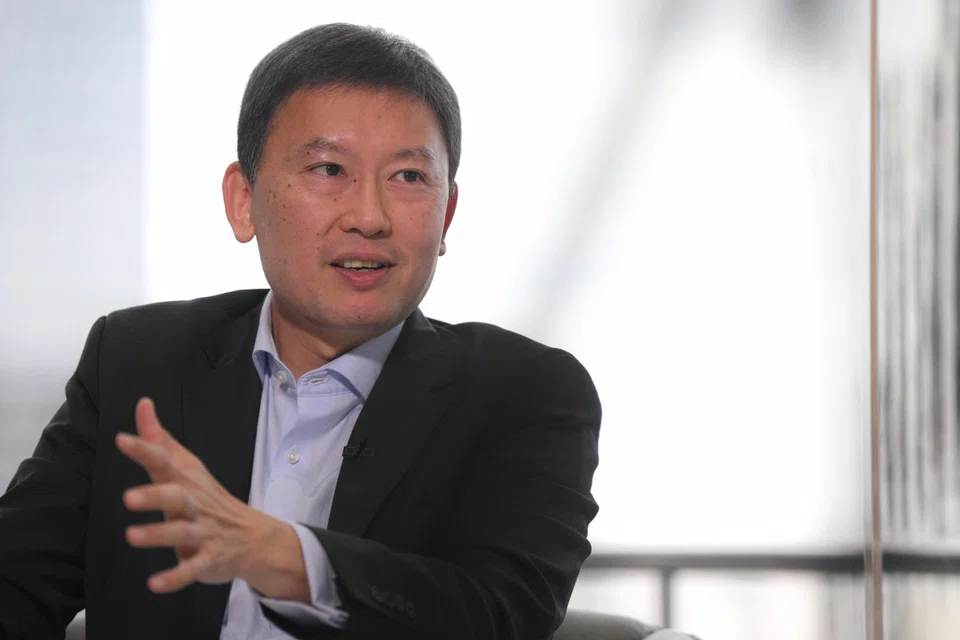
Chee Hong Tat, deputy chairman of the Monetary Authority of Singapore, called on corporate boards last week to do more to deliver shareholder value, and communicate better with investors. “To capture their attention, companies must go beyond standard financial reporting. They must present a compelling narrative of how today’s actions will translate into tomorrow’s success,” he said, in a speech at a conference.
He added: “When companies combine strategic value creation with effective communication, they create the conditions for investor confidence.”
For all the Singapore-listed companies currently lagging the STI, it could be time to raise their game and renew their relevance to investors.