HOCK LOCK SIEW

Does foreign ownership matter? Marina Bay Sands’ success benefits Singapore greatly

It’s Singapore’s time to shine in drawing premium visitors, as tourism mega hits drive economic growth and create jobs

Summarise
Leslie Yee
Published Tue, Mar 24, 2026 · 01:58 PM
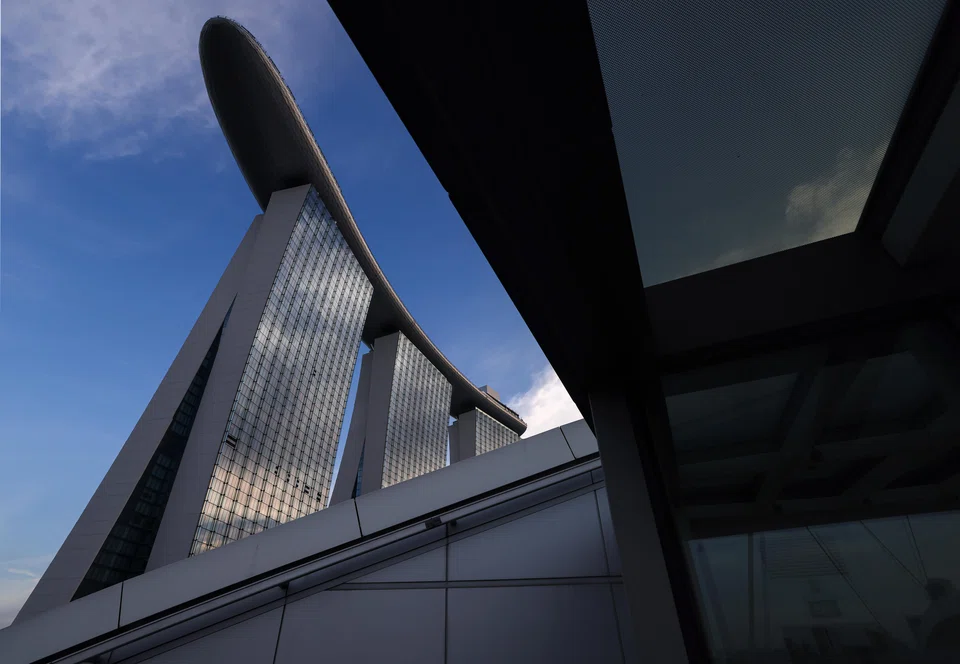
    • MBS has helped in branding Singapore. The Moshe Safdie-designed integrated resort is a widely recognised landmark of the Republic globally.
    • MBS has helped in branding Singapore. The Moshe Safdie-designed integrated resort is a widely recognised landmark of the Republic globally. PHOTO: YEN MENG JIIN, BT

    SINGAPORE’S Marina Bay Sands (MBS) has hit the jackpot. The integrated resort (IR) delivered “simply the greatest quarter in the history of casino hotels”, said Las Vegas Sands (LVS) then chairman and chief executive officer Rob Goldstein in an earnings call on LVS’ fourth-quarter 2025 results.

    Goldstein has since been succeeded in the two roles by Patrick Dumont.

    LVS-owned MBS’ adjusted property earnings before interest, taxes, depreciation and amortisation (Ebitda) soared 50.1 per cent year on year to a new high of US$806 million in Q4 2025. Adjusted property Ebitda margin was 50.3 per cent in the latest quarter.


    In Q4 2025, MBS easily outperformed LVS’ Macau operations which posted adjusted property Ebitda of US$608 million and adjusted property Ebitda margin of 29.5 per cent. LVS’ Macau operations include The Venetian Macao, The Londoner Macao, The Parisian Macao, The Plaza Macao and Four Seasons Hotel Macao, and Sands Macao. 

    Compared with Q4 2024, MBS saw revenue growth in Q4 2025 of 52 per cent to US$1.2 billion for casino, 22 per cent to US$152 million for rooms, 20 per cent to US$114 million for food and beverage, 6 per cent to US$87 million for mall, and 7 per cent to US$46 million for convention, retail and others.

    For Q4 2025, MBS achieved average daily room rate of US$978 and occupancy rate of 95 per cent – highly enviable figures in the Singapore luxury hotel segment.  

    Is it a pity that MBS’ stellar profits are flowing to a New York Stock Exchange listed company which is closely associated with the late US casino tycoon Sheldon Adelson and not a local company?

    For one, City Developments Ltd may rue withdrawing from being an equity partner of LVS in the tender process for building an integrated resort in the Republic. 

    As countries grow more assertive in pushing their self-interest, many governments are keen to see local ownership of large businesses that generate mega profits from operating within their jurisdiction.

    National security is also increasingly used to carve out certain business activities for domestic ownership.

    Nonetheless, on reflection, I think there should be no complaints over the wildly successful MBS being foreign-owned.

    Employer of choice

    LVS’ success with MBS not only generates sound returns for its shareholders, but also creates enormous economic benefits for Singaporeans.  

    MBS employs many locals and is widely regarded as an employer of choice. It also procures goods and services from numerous local small and medium enterprises.

    Meanwhile, the government receives sizeable tax contributions from the spending by MBS’ patrons while having much say over the conduct of gambling operations in Singapore. After assessing that MBS has fulfilled various requirements, the Gambling Regulatory Authority renewed MBS’ casino licence for another three years with effect from Apr 26, 2025.

    Very importantly, MBS has helped in branding Singapore. The Moshe Safdie-designed MBS is a widely recognised landmark of the Republic globally. 

    MBS has helped make Singapore a cool destination, draw high-end visitors here and enhance the city-state’s appeal as a meetings, incentives, conferences and exhibitions (Mice) destination.

    And LVS is spending US$8 billion on the MBS expansion project which will boost Singapore’s appeal to high-value leisure and business visitors. The project will introduce a new hotel experience, a 15,000-seat arena, additional Mice capacity and entertainment offerings including premium gaming areas.

    MBS’ expansion is taking place against a backdrop of huge economic uncertainties and high geopolitical tensions. The project may also face cost pressures as inflation rises on the back of soaring energy prices due to the Iran war.

    Still, might Singapore score big with premium travellers and Mice organisers for being a safe destination?

    Indeed, as wars rage and geopolitical risks rise, Singapore’s attractiveness as a Mice host and its appeal to international visitors could rise as people place a greater premium on security and stability. 

    Tourism sector’s importance

    Increasingly, economic growth may not automatically lead to job creation given technological advancements. With automation and artificial intelligence (AI), there will be higher value-adding industries and business activities. And with higher value-add per worker, fewer workers may be needed.

    Certainly, the hospitality sector will accelerate its embracing of automation and AI to raise productivity. Think of robots doing more chores in a hotel among others.

    Still, this sector values the human touch and will likely continue to be labour-intensive, especially in the high-end.

    Crucially, tourism and hospitality success stories can contribute much to both job creation and economic growth in Singapore.  

    Thus, Singapore has much to gain if MBS continues doing well and prospers even more after completing its expansion project, and the country has more big tourism hits. Can MBS further cement its reputation with foreign high-spenders? Could an IR in Orchard Road or a big uber-luxury wellness resort on an offshore island work wonders? 

    China’s late reformist leader Deng Xiaopeng espoused an economic philosophy which states, “It doesn’t matter if a cat is black or white; if it catches mice it’s a good cat.” Such a pragmatic spirit should guide how Singapore deals with private businesses. 

    While many countries may increasingly fret over doing more to protect local businesses, Singapore should generally keep an open door for foreign companies to compete fairly with local enterprises.

    Let’s draw high-quality business investments from everywhere, with necessary policies to steer jobs towards locals.

    MBS’ success has benefited Singapore enormously. Arguably, another party other than LVS developing an IR in Marina Bay might not have created as successful a product as MBS.

    Ultimately, Singapore should focus on getting more mega success stories like MBS regardless of whether they are foreign or local-owned.  

    The nation wins big by hosting any business that creates many good jobs, pays sizeable taxes, invests in upgrading and expansion, and positively brands Singapore.