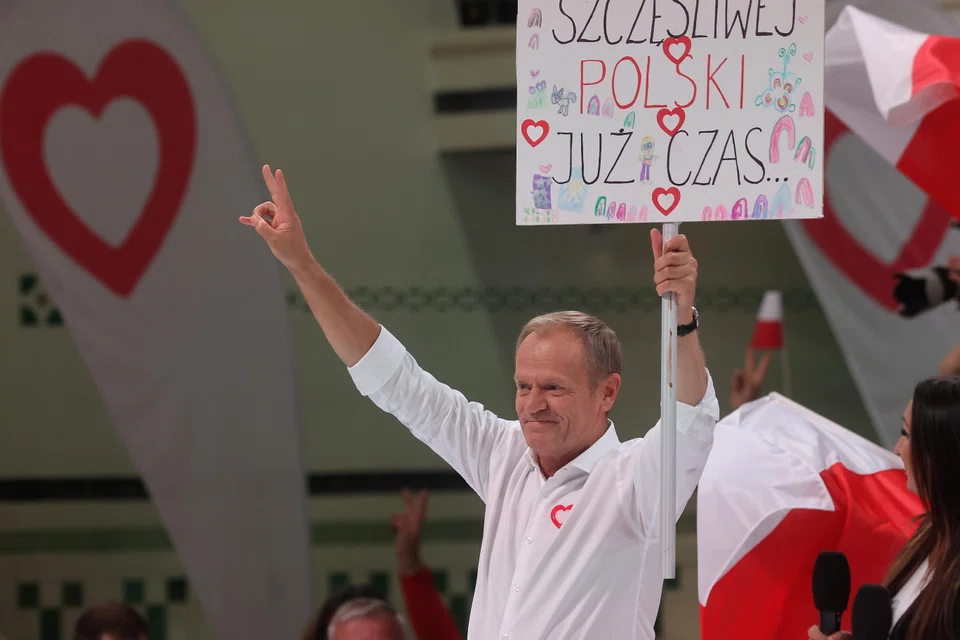
East Europe’s era-defining election
POLITICIANS often describe upcoming ballots as the most important in a generation, if not ever, but that tagging could be accurate in the European Union’s (EU) fifth most populous nation Poland this weekend.
In what may prove an era-defining election – which opposition leader Donald Tusk has billed as their “most important since 1989 and the fall of communism” – a populist, right-wing United Right coalition, led by the Law and Justice Party (PiS), is seeking a third term in office, unprecedented in Poland in the post-Cold War era. PiS is being challenged by an opposition coalition led by Tusk, a former prime minister of Poland from 2007 to 2014, who later became president of the European Council, one of the top two EU jobs in Brussels.
Poland is the most powerful nation in East and Central Europe, a bloc of countries which has become more influential in recent years. The strategic importance of Poland and neighbouring nations has grown as they are at the “front line” of the Ukraine crisis with EU and Nato partners pumping in money and military support. This has accentuated a two-decade long process whereby Eastern states have become more important in Europe, for reasons including their economic convergence with the West.
Sunday’s election is also being closely watched around the world as it will provide the latest indication of the “political weather” in the continent. There are growing signals that the right is gaining strength as illustrated by Slovakian populist Robert Fico’s victory in last week’s election, and the far-right Alternative for Germany Party’s spike in the German polls.
The Polish ballot is also being viewed closely for another reason. The result will influence pan-EU debates in coming weeks on issues from a potential European migration pact to the reform of EU institutions ahead of any future expansion of membership to Ukraine, the Balkan countries and possibly Turkey too.
Opinion polls have consistently shown PiS will probably win the most votes, albeit potentially by a small margin. Indeed, after an intensely bitter campaign, the gap between the right and centre appears to have narrowed for the Sejm (lower house of parliament) and the Senate.
One indication of the bitterness of the campaign are the personal attacks. Polish Deputy Prime Minister and leader of PiS Jaroslaw Kaczynski, plus Prime Minister Mateusz Morawiecki have accused Tusk of following orders from Brussels and Berlin, particularly on Poland taking in migrants.
So the ballot outcome is likely to rest on the performance and preferences of several smaller parties who will help influence who forms a coalition. Tusk’s centrist Civic Coalition has so far been unable to unite with two other moderate parties, the Third Way and The Left, making his pathway to power challenging.
Meanwhile, although the PiS is ahead in the polls, it may struggle to secure coalition partners to win an outright majority given the controversies surrounding it. The party has been accused of diluting democratic norms during its eight years in power, curtailing reproductive health rights, plus bringing public media under political control.
If there is a pathway back to power for PiS, the far-right Confederation party – Konfederacja in Polish – could play a crucial role in getting it enough seats. However, this may come with a significant price: Konfederacja is, for instance, the only Polish party to oppose Ukrainian immigration, and has criticised the government’s decision to award refugees benefits.
In this context, many EU officials would welcome the PiS losing power, not least as when Tusk was prime minister there was much warmth with the EU and key nations like Germany which fuelled his pathway to becoming president of the European Council. Under a new Tusk prime ministership, it is likely that Brussels would probably move quickly to release 36 billion euros (S$52 billion) in loans and grants from the bloc’s pandemic recovery fund which has been frozen over concerns about PiS’ judicial reforms.
However, even if Tusk can pull off a surprise win, there has been no opinion poll to date predicting a combined opposition victory so big that it would gain a three-fifths majority of MPs needed to overturn presidential vetoes. The country’s leading courts are also filled with judges appointed by PiS, meaning some key legislation may also be caught up in long-running litigation.
So this will limit the scope of policy change that a Tusk government would bring. Nonetheless, there are clear political dividing lines between the two blocs.
Migration has perhaps become the most contentious issue in the campaign. PiS has ratcheted up anti-migrant rhetoric, warning that the EU and Tusk want to force Muslim migrants into an overwhelmingly Roman Catholic country. Morawiecki has said “we are not afraid of diktats... from Berlin and Brussels”, and PiS has refused to take in asylum seekers who enter the EU via other countries.
Just as Tusk is likely to have a less strident position on this issue, there are also clear dividing lines over issues like abortion and the rule of law. PiS has faced rising concern over the 2020 tightening of abortion laws.
Moreover, PiS has also moved towards politicising the judiciary by, in effect, capturing the body that nominates judges in Poland, staffing the Constitutional Tribunal and Supreme Court with PiS-friendly judges, plus bringing in rules to punish judges who criticised government reforms. This has put Poland and the European Commission at odds. PiS asserts its reforms are intended to expedite lengthy trial proceedings and reduce corruption, but Brussels has withheld pandemic recovery funds until the changes are reversed.
The bitter campaign has also seen Poland’s previously staunch support for Ukraine undercut. Warsaw had been a staunch supporter of Ukraine since Moscow’s invasion, providing Kyiv with more than three billion euros in arms. More than a million Ukrainian refugees now living in Poland were also initially welcomed.
However, tensions have grown over Ukraine’s grain exports which are undercutting Polish home produce and alienating farmers, a key voting group. Morawiecki said last month his government would supply no more weapons, and was focusing on rebuilding its own depleted stocks. President Andrzej Duda even compared Ukraine to a drowning person dragging a rescuer (Poland) down.
Taken together, Poland is therefore at a pivotal moment in its post-Communist history. A PiS victory will intensify the nation’s discord with Brussels; however, an opposition victory may also disappoint Tusk supporters given that the coalition will not get the three-fifths majority needed to overturn presidential vetoes, and will also face challenges from judicial politicisation.
The writer is an associate at LSE IDEAS at the London School of Economics