EU enhances economic security, with eye on China
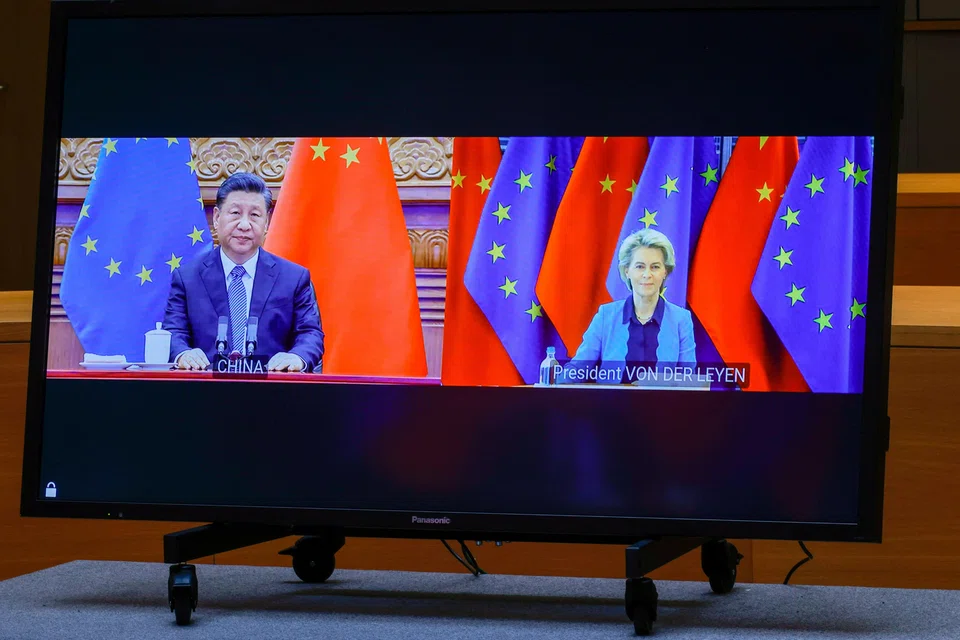
WHILE economic security has long been a key narrative in the US government, its centrality in European politics is of a much more recent vintage. The latest signal of this new political emphasis in the European Union came last Wednesday (Jan 24) with the release of five new initiatives which will deepen the bloc’s more sceptical policy towards China.
The package, aligned with the June 2023 European Economic Security Strategy, doubles down on the potentially significant shift in the EU’s political economy in recent years. The continent has long had a reputation for openness of trade, investment and research, and a key question going forward is to what degree that will now be eroded in a new geopolitical landscape.
The five initiatives are, specifically, a legislative proposal to strengthen foreign investment screening; more effective EU control of dual-use goods exports; options to support research and development in technologies with dual-use potential; enhancing research security across the EU; and better monitoring and assessment of outbound investment risks. The fifth issue of outbound investment is now being consulted on in a new three-month-long review.
While no countries are specifically cited as the targets of this new economic security package, China is the main source of concern in Europe, especially after its economic blockade of Lithuania over the Baltic member country’s deepening ties with Taiwan. When Lithuania allowed Taiwan to open a representative office in the capital Vilnius in 2021, the East European nation was subjected to a Chinese ban on exports.
So the wider context to Wednesday’s announcements includes the broader chill in relations with China that dates back at least to the onset of the Covid pandemic in 2020; plus Russia’s invasion of Ukraine. Since then, European Commission President Ursula von der Leyen has made significant moves towards this new economic security policy paradigm.
In recent months, she and EU foreign policy chief Josep Borrell have cited the huge trade imbalance between the bloc and China – around 400 billion euros (S$581 billion) – as one of the central challenges to tackle this agenda. In a hard-hitting speech last November, von der Leyen said that this huge deficit is “the calculated and declared result of China’s trade and security policy”. China’s declared strategy, she noted, is to “reduce its dependence on the world and at the same time increase the world’s dependence on China”.
It is in this context that Borrell has urged it is “in our mutual (China-EU) interest to find common ground, to redress the imbalance in our economic and trade relations. Otherwise, de-risking may indeed accelerate far more than is good, as the (European) public opinion will increase its pressure on political leaders to disengage more from China”.
The release of the five new initiatives is significant as one of the key criticisms of Europe’s policy shift is that it lacks the tools to make this a reality. Prior to last week’s announcement, the biggest single measure showcased by Brussels is an anti-coercion measure released late last year.
That tool is intended as a deterrent, but will enable the EU to impose countermeasures on any country that exercises economic coercion over any member states. Such countermeasures include increased customs duties, intellectual property restrictions or export controls, under a time-bound procedure lasting no more than a year.
The instrument can be triggered by a wide range of coercive economic practices where a country applies or threatens to apply a measure affecting trade or investment in order to prevent or stop, modify or adopt a particular act by the EU or a member state. Input from external stakeholders will be taken into account when considering activation of the instrument, and businesses are encouraged to give relevant information.
The broader European Economic Security Strategy, released last year, is a potentially major milestone in the EU’s huge new shift of stance in its political economy. The strategy proposes to carry out a thorough assessment of risks in four areas: resilience of supply chains, including energy security; physical and cyber security of critical infrastructure; technology security and technology leakage; and weaponisation of economic dependencies or economic coercion.
Building from this, last Wednesday’s package aims to further strengthen the protection of EU economic security by proposing improved screening of foreign investment into the EU; enhancing European coordination in the area of export controls, in alignment with existing multilateral regimes; identifying potential risks from outbound investments in a narrow set of technologies; promoting better support for research and development involving technologies with dual-use potential; and enhancing research security at national and sector level.
The new package is likely to be welcomed by many of the 27 EU member states, especially those in Eastern Europe which tend (with the exception of Hungary) to have the most hawkish disposition to China. However, a key question remains about whether – even with the new measures – this emerging toolkit can truly deliver on the goals set out by von der Leyen.
For instance, a European Council on Foreign Relations study has also proposed that the EU develops a comprehensive resilience architecture, including a strong agenda for improving economic strength and trade links, a Resilience Office, and a reformed blocking statute that can counter secondary sanctions. It is proposed that such a Resilience Office could provide strategic coordination of the EU’s response and evaluate the costs of economic coercion, while the blocking statute could allow for targeted countermeasures against companies based in third countries.
The significant challenges of implementing these types of economic security frameworks are also underlined by the UK’s experience in the last two years. Late last year, UK Deputy Prime Minister Oliver Dowden announced plans to enhance the business-friendliness of the UK’s foreign-direct-investment screening powers.
He has launched a review aimed at “narrowing and refining” the National Security and Investment Act which allows the government to potentially veto takeovers. The legislation was introduced to try to address security concerns related to the acquisition of UK companies by foreign organisations, including from China.
Taken together, while political momentum is growing behind the EU’s ambitious agenda, implementation may turn out to be challenging. This is highlighted by the recent UK experience with its own economic security policy.
The writer is an associate at LSE IDEAS at the London School of Economics