EU puts priority on key trade deal
THE European Union is currently negotiating trade deals with multiple key world powers, including the United States and India. However, perhaps its top international trade priority in 2023 is the Mercosur deal with Brazil, Argentina, Uruguay and Paraguay, which would create a “new” combined market of over 700 million people.
The fate of the negotiations is being watched around the world, including by China, which has in recent decades made a big bid to increase its influence in Latin America. Closer to home in Europe, the outcome is also being closely scrutinised.
Take the example of the United Kingdom which, post-Brexit, is looking to cement ties with Latin America. In May, UK Foreign Secretary James Cleverly gave a speech in the region arguing that the “tectonic plates of world politics are shifting once again”, with “Latin America’s demographic and economic weight… giving more voice and more influence”.
To try to curry favour, he argued that the UK is the region’s “oldest friend” some two centuries after bilateral ties were first established. Moreover, he specifically called for a permanent UN Security Council seat for Brazil as one step to give Latin America more voice in global institutions.
One key reason why the Mercosur trade agreement is so potentially valuable to the EU-27 nations is that Latin America is such a vast new source of raw materials as Europe diversifies its global supply chains, a major imperative since Russia’s invasion of Ukraine. The EU’s foreign policy chief Josep Borrell said a few weeks ago that the emerging-market region has the economic potential of becoming the “new Persian Gulf”, given its critical mineral assets such as lithium.
Yet, it is not just raw minerals that are of such huge attraction to Europe. The vast continent, home to around half a billion people, also boasts the largest share of renewables in the world, and has the largest reserves of arable land producing an estimated 15 per cent of global food production and 45 per cent of net international agri-food trade.
A second reason that the Mercosur deal has moved to the top of the European trade priority list is that the pact has been agreed, in principle, some years ago, though finalisation is not yet complete. So getting the deal a few inches “over the line” is now a top priority.
In this context, Brussels perceives that a window of opportunity has emerged in the second half of 2023 to finally deliver the prize. This is a political priority for Spain, which has long enjoyed strong ties with the Latin America region, which now holds the rotating six-month presidency of the EU from July to December inclusive.
With the EU-Mercosur bloc agreement in the making for over two decades, both sides are pushing for maximum progress in the coming days ahead of the key EU-Latin America summit on July 17 to 18. Coinciding with this meeting, there will be a business conference too on the sidelines of the session, which will help bring the voice of corporates to this discussion.
While there is now strong momentum towards finalising the deal, several irritants have plagued the final passage. These included the tempestuous relationship between the controversial ex-Brazilian president Jair Bolsonaro, whose removal from power has added to the possibility of the deal being finalised. Bolsonaro had a particularly bad relationship with French counterpart Emmanuel Macron, which spilled out into a bitter war of words when the ex-Brazilian president insulted Macron’s wife.
Another challenge has been that, while the agreement was officially concluded in 2019, both sides are still advocating for additional clauses to be inserted. While this may sound straightforward to resolve, in principle, there is a danger that this process could see previous carefully-negotiated economic trade-offs within the wider deal get re-opened, which risks more delay.
To help deliver a breakthrough, the EU has been cementing its broader relationship with Latin America recently, including via the bloc’s new Global Gateway Strategy (GGS). GGS is mobilising up to 300 billion euros of investment globally for sustainable, high-quality projects from 2021 to 2027.
This includes areas such as green and digital transition; transport and energy infrastructure; health; education, skills and research; and sustainable finance. Examples of GGS projects that the EU is embedding in Latin America, specifically, include critical raw materials value chains for lithium and copper; green hydrogen production; and expansion of electricity transmission networks.
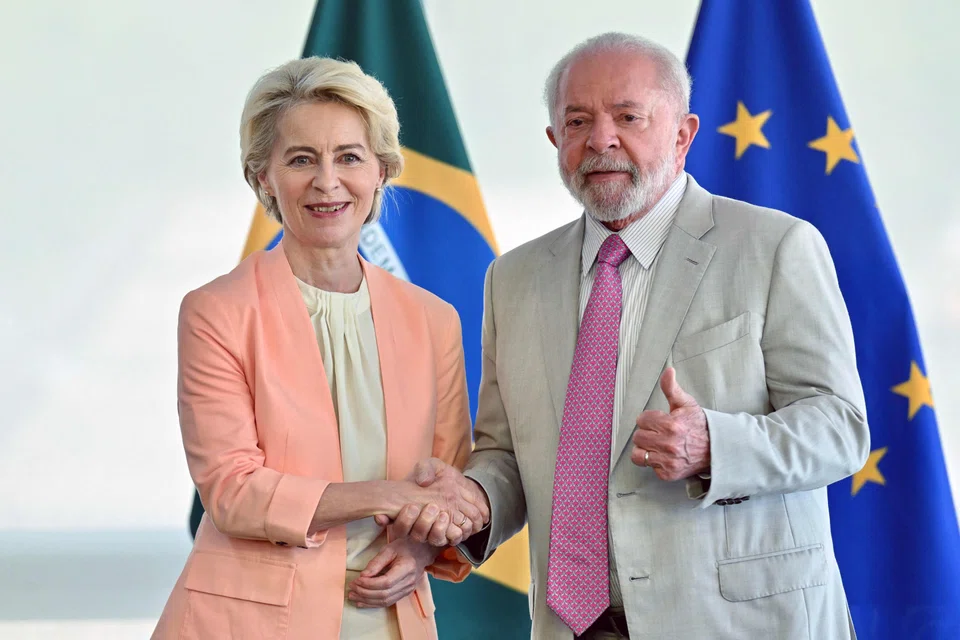
The EU has also been rolling out its biggest political names to the region. In her recent trip to Latin America, European Commission president Ursula von der Leyen pledged with Brazil’s president Luiz Inacio Lula da Silva and Argentinian president Alberto Fernandez that the Mercosur deal will be concluded by the end of 2023. This echoes calls from other senior European politicians, including German Chancellor Olaf Scholz, who said in his trip last year that “the negotiations have now lasted long enough”.
Lula has also said he had faith that the Mercosur agreement could soon be announced, “but with better quality to ensure that Latin American countries can have an industrial policy”. Strengthening Brazilian industry was one of Lula’s main promises during last year’s presidential campaign as the industrial sector’s share of Brazil’s output fell from just under 29 per cent in 2004 to about 19 per cent in 2021, its worst performance in almost two decades.
So Lula wants to reorientate the trade relationship with the EU away from Brazil largely being a giant agricultural powerhouse for European consumers. He favours reopening negotiations to add provisions on reindustrialisation and technology transfer.
Moreover, Fernandez said when he met Scholz last year that he wants to better address “the great asymmetries between the European economy and that of Mercosur… for example in the automotive sector”. Scholz argued that although “there are very specific, individual points from many sides that need to be discussed again”, this must be quickly concluded.
From the European side, concerns centre around agriculture (key for France which is Europe’s largest producer in this sector), and Brazil’s deforestation commitments. On the latter, there are widespread European concerns about the fate of the Amazon rainforest.
Last year, EU trade negotiators presented an extra document to the Mercosur countries on these issues. Brussels hopes this additional instrument will avert the need to reopen the wider agreement.
Taken together, this is why a window of opportunity now exists to get the trade deal over the line before next year’s EU election campaign. However, if an agreement cannot be concluded soon, it may get pushed out to 2025 or beyond, given the next European Commission that comes into power in the second half of 2024 will need time to deliver on priorities.
Andrew Hammond is an associate at LSE IDEAS at the London School of Economics