

Europe calms Trump-Zelensky storm
FRIDAY’S (Feb 28) extraordinary White House meeting between US President Donald Trump and Ukrainian counterpart Volodymyr Zelensky has provoked much global shock. Yet, it may have, unexpectedly, unlocked for Europe a crucial window of opportunity to become more involved in any settlement deal with Russia.
In February, the Trump administration indicated that it saw a purely bilateral process between Washington and Moscow to try to end the war. However, Friday’s remarkable diplomatic bust-up between Trump and Zelensky has helped foster a new Franco-UK-led initiative to try to end the conflict.
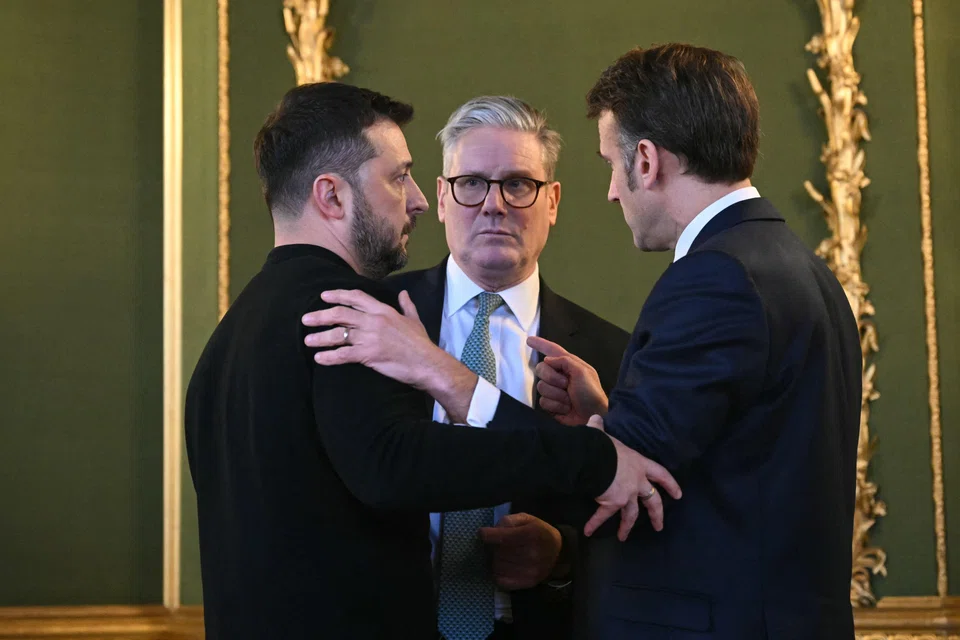
This plan, which Poland Prime Minister Donald Tusk said showed that Europe has “finally woken up”, was the centrepiece of discussion at Sunday’s summit in London convened by UK Prime Minister Keir Starmer. In attendance were more than a dozen European national leaders – from Ukraine, France, Germany, Denmark, Italy, the Netherlands, Norway, Poland, Spain, Finland, Sweden, the Czech Republic and Romania.
Also present were Canadian Prime Minister Justin Trudeau, Nato secretary general Mark Rutte, European Commission President Ursula von der Leyen, European Council President Antonio Costa and Turkish Foreign Minister Hakan Fidan.
Starmer said on Sunday that “three years on from Russia’s brutal invasion of Ukraine, we are at a turning point. Today, I reaffirmed unwavering support for Ukraine, and double down on my commitment to provide capacity, training and aid to Ukraine.”
Yet, beneath this grand language, much uncertainty remains – not least about how the White House will receive the eventual Franco-UK-led initiative, despite assurances that Trump appeared earlier to have given Starmer and French President Emmanuel Macron.
Discussions at the summit focused on three main points that will be further defined at forthcoming meetings, including Thursday’s European Union emergency summit. This is all centred around bolstering Ukraine’s position ahead of any settlement endgame.
First, the Western allies sought to strengthen Ukraine’s immediate position, including with military support. For instance, London signed a £2.3 billion (S$3.9 billion) loan to Kyiv for defence finance. The loan will be repaid from frozen Russian assets with Zelensky, who also met King Charles on Sunday, remarking: “This is true justice – the one who started the war must be the one to pay.”
The second focus is around securing a strong, sustainable deal with Russia. This includes ensuring Kyiv can credibly deter and defend against future Moscow attacks.
To this end, Starmer announced on Sunday £1.6 billion in export funding contracts for Ukraine, which will see the manufacture of more than 5,000 lightweight multirole missiles. In total, the new export financing contact will enable Ukraine to draw on £3.5 billion of export finance to acquire military equipment from UK companies.
At Sunday’s summit, Starmer urged other European nations to follow the UK’s new commitment of boosting defence spending to at least 2.5 per cent of gross domestic product. He made clear that Europe now needs to step up for the good of collective security. This message was also echoed by Tusk, who noted the irony that “500 million Europeans are asking 300 million Americans to protect them from 130 million Russians”.
The third focal point is planning for post-war security guarantees, from both Europe and the US. On the European dimension, Starmer on Sunday threw his weight behind the idea of a “coalition of the willing” of like-minded countries providing such guarantees, including the UK and France, Western Europe’s two nuclear weapons powers.
Such a coalition is, in tight time frames, the best way forward, given the unanimity requirement within the 27-member EU, which could hold up discussions. For instance, Hungary and Slovakia are currently declining proposals to increase support to Ukraine in the EU emergency summit this Thursday.
The US dimension is potentially an even more challenging part of this policy puzzle. Last Thursday, Trump told Starmer in Washington that he “would not make any security guarantees beyond very much – we’re going to have Europe do that”.
While European allies are not expecting America to commit to sending troops on the ground, they are seeking US military cover, including in the air. On Sunday, Starmer reiterated that such US backing would be essential, saying: “I’ve always been clear that that is going to need a US backstop, because I don’t think it would be a guarantee without it, I don’t think it would be a deterrent without it, so the two have to go together.”
More than three years after Russia’s invasion, Sunday’s meeting is the latest signal that, while the Ukraine conflict sometimes seems never-ending, the ground now appears to be shifting towards the beginnings of a potentially difficult, protracted negotiated settlement. The big shift has come with the election of Trump for a second presidential term.
Trump’s disruptive diplomacy, for all of its many shortcomings, is forcing Europe to take a clearer, coordinated approach if it is to have significant influence in the coming weeks. Europe’s leaders know they now must step up to the plate, and broadly agree that any outcome in Ukraine that is perceived as a potentially big Russian victory may only embolden President Vladimir Putin and his allies across the world.
While Europe is hoping to keep the Trump team on board, it is also preparing for the worst. This includes that the US might stop, at some point in 2025 or beyond, any support for Ukraine, including intelligence sharing that would leave critical gaps that only Europe and allies, including Canada, Japan and Australia, can try to – at least partially – fill.
This also intensifies the need for Europe to have a clearer, multi-year grand strategy, too. This includes the potential political integration of Ukraine into the West, which would require Brussels moving forward with accession talks for Ukraine to potentially join the EU.
Amid all this uncertainty, many European leaders hope that while Moscow’s forces have gained ground in Ukraine over the last year, the impact of the war remains overall negative for Russia. Not only have there been massive military casualties for Moscow, the strains on Russia’s economy are also showing. Even if Putin remains in power, his political position may be weakened if a settlement is eventually agreed that does not strongly favour Moscow, after the loss of so much human and financial resources.
Taken together, the European-led initiative is a belated attempt by the region to influence the Ukraine endgame. As much as it is a welcome development, it remains highly uncertain how seriously it will be treated by Trump, who may ultimately prefer to secure a quick, rather than fair, sustainable agreement.
The writer is an associate at LSE IDEAS at the London School of Economics
TRENDING NOW
Singapore identifies 7 firms responsible for haze fires, notices issued urging action: Grace Fu

Could stablecoins be the future of money?

Singapore should prepare for prolonged haze until November, says Grace Fu

High Court rules against Julius Baer’s Singapore trust arm in US$50 million family trust dispute

