

Europe debates ‘de-risking’ challenge with China
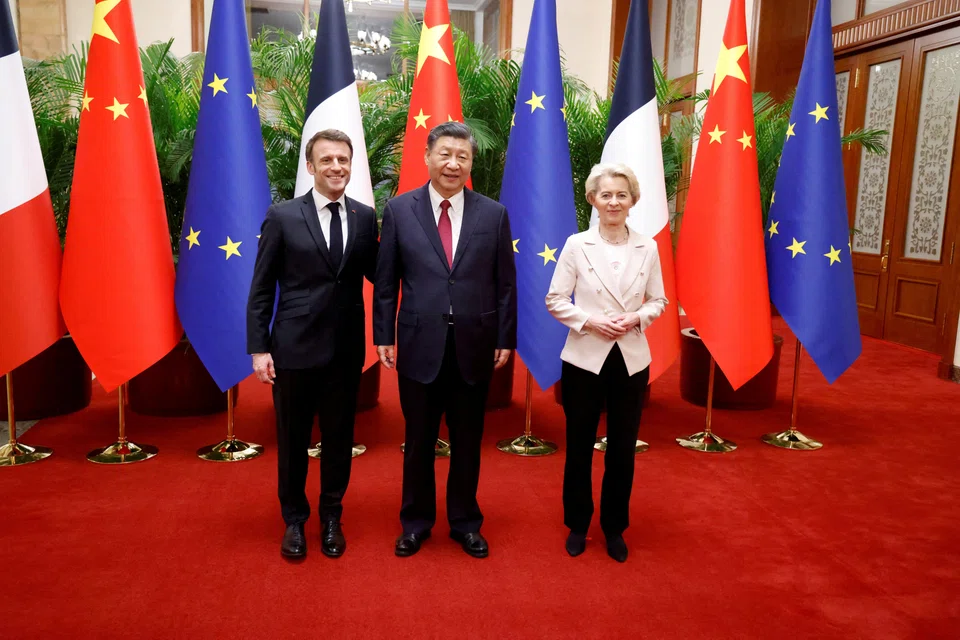
EUROPEAN policy towards China is increasingly being framed by senior politicians as one of “de-risking” rather than “decoupling”. However, there is little conceptual clarity on what this means with the increasing possibility of European Union (EU) policy failure, rather than success.
The debate over “de-risking” versus “decoupling” has been turbocharged by recent interventions by key political leaders such as European Commission President Ursula von der Leyen. Ahead of her recent trip to Beijing, she rightly reiterated that “it is neither viable nor in Europe’s interest to decouple from China” in a manner that she has sometimes characterised as being the policy of the United States.
Von der Leyen, instead, advocates a more modest form of cautious engagement with Beijing, which she calls “de-risking”. While this may be a politically viable distinction, it still lacks conceptual clarity in a debate that will have enormous implications in the months to come for Europe.
Firstly, there are significant disagreements within the EU 27 on these issues, so it will not be straightforward to secure policy consensus. So “de-risking” looks less extensive to policymakers in Germany, given its deep economic ties with China, than it would for key Eastern European nations such as Poland and Lithuania (which allowed Taiwan to open a representative office in the capital Vilnius in 2021).
Germany is, by far, China’s biggest trading partner in the EU, with the nation’s companies also holding sizeable investments in the country. In the first two months of 2023, Germany accounted for 27 per cent of all trade between the EU and China.
Meanwhile, Poland tends to be more sceptical about ties with Beijing, and has long been one of the EU states’ most reluctant for Brussels to ratify the currently stalled Comprehensive Agreement on Investment. Poland also reacted strongly to recent comments from French President Emmanuel Macron that the EU should reduce its dependence on the United States and aim to become a “third pole” in world affairs alongside Washington and Beijing. Both President Andrzej Duda and Prime Minister Mateusz Morawiecki have stressed in recent days that the alliance with the United States is essential for European security, cautioning against any idea of Macron-style “strategic autonomy” for the continent.
A second challenge is that Europe is trying to make policy in a fast-changing geopolitical landscape. This dynamic dimension of “de-risking” makes it a moving (and harder) target to hit.
That is, the amount of “de-risking” Europe collectively feels it will need to take may change significantly over time, depending on China’s posture. If Beijing is perceived to behave “badly” in the coming months or years (for example, by invading Taiwan), there may be much more consensus in Europe towards more comprehensive “de-risking” (which may see political rhetoric move towards “decoupling”). Conversely, if Beijing is perceived to behave “well” (for instance, possibly playing a key role in ending the Ukraine war in 2023 or 2024 by helping bring Russia to the negotiation table), the policy debate may flip.
Within this policy vortex, there are some clues to what “de-risking” could look like, based on what von der Leyen asserts is the need for “having a clear-eyed picture of what the risks are”. This builds on tools such as the proposed Net Zero Industrial Act, for example, which the EU has introduced to disadvantage Chinese producers of renewable energy technologies participating in European public procurement. Plus the new Critical Raw Materials Act, with which the EU aims to become less reliant on Chinese refining capacities.
A good starting point will be to make better use of the existing export control, foreign direct investment (FDI) screening and foreign subsidy instruments. Take the example of FDI screenings, where not all EU countries had FDI screenings in place as late as 2021, and even where these existed, Brussels had no legal power to block investments.
Building on this, the new framework is likely to become clearer when the EU introduces a new Economic Security Strategy later this year to address what von der Leyen has called a still “unbalanced” economic relationship. This includes reducing dependency and diversifying supply chains away from Beijing, especially areas where the EU needs to build its green and digital economy.
So anticipate greater European interest in mineral-endowed Africa, Latin America and South-east Asian countries. This might see new initiatives such as the Global Gateway being increasingly brought to prominence.
Key elements of the new framework are likely to comprise what von der Leyen asserts is a need for “bolder and faster use” of new economic tools against China. This includes screening of foreign subsidies and a new policy against economic coercion, with an anti-coercion instrument to help the bloc fight off attempts from third countries, recently agreed on by the European Parliament and member states.
The EU is also planning to roll out a Foreign Subsidies regulation, giving it extra muscle to fight distorting subsidies that businesses get in third countries. The ambition is giving Brussels greater powers to prevent state-subsidised companies from China – or other nations – producing in Europe.
Another tool that Europe looks set to develop is what von der Leyen calls “a targeted instrument on outbound investment”, especially for sensitive technologies which can lead to the development of military capabilities that pose national security risks. In her own words, “we need to ensure that our companies’ capital, expertise and knowledge are not used to enhance the military and intelligence capabilities of those who are also systemic rivals”.
Beyond that, von der Leyen has added that the bloc needs to “define its future relationship with China” in sensitive high-tech areas. These include microelectronics, quantum computing, robotics, artificial intelligence and biotech.
Moving from the European Commission president’s prescriptions, wider policies being debated across the bloc include strategic stockpiles of critical minerals. For example, at current interest rates, the EU could store a year’s worth of rare earth minerals for less than five million euros (S$7.3 million) annually, given that total imports in 2021 amounted to 120 million euros.
Where possible, this framework will also be strengthened by close cooperation with international partners, including the Group of Seven (G7) and Group of 20. For instance, next month’s G7 agenda in Japan may include a discussion of measures to counteract economic coercion.
A key question now, however, is how much this emerging tool kit can truly deliver on von der Leyen’s “de-risking” goal. Seeking to differentiate the EU position from US-style “decoupling” may be clever positioning, but implementation may turn out to be very difficult, both politically and economically.
The writer is an associate at LSE IDEAS at the London School of Economics.
TRENDING NOW

From legacy to launch: Francis Yeoh and Yeoh Pei Xien on family unity and YTL’s next‑gen ventures

Things to know about DBS’ incoming chairman Anthony Lim

Wealthy Indonesians snap up government bonds as yields near 8%: OCBC
From local AI partnerships to global opportunities: How MNCs help Singapore firms scale

