Europe rocked by far-right gains
THE far right had long been expected to do well in last week’s European Parliament election. However, the results released on Sunday (Jun 9) have shown even more striking gains than many expected.
The gains were so strong in France for the far-right Rassemblement National party – which won 31.4 per cent of the vote, more than double the vote share of Emmanuel Macron’s centrist alliance – that the president called a snap election for the domestic National Assembly.
This extraordinary gamble will see a first round of the parliamentary elections held in just three weeks on Jun 30, with a run-off on Jul 7. It is plausible the far right could also make big gains in that ballot, with the outside possibility that Macron’s chief political opponent, Marine Le Pen, could become prime minister.
Overall, far-right groups in the European Parliament elections are projected to have secured around one quarter of the seats compared to a fifth the last time.
Both the far-right Identity and Democracy (ID) and the European Conservatives and Reformists (ECR) have made gains. Given this success, Hungary’s ruling Fidesz party could now opt to join the ECR, and/or the ECR may even merge with parts of ID to form a larger right-wing group.
This shift replicates a trend in European national politics in recent elections. In nations from Greece and Italy in the south, to Finland and Sweden in the north, politics has moved in a right-wing direction.
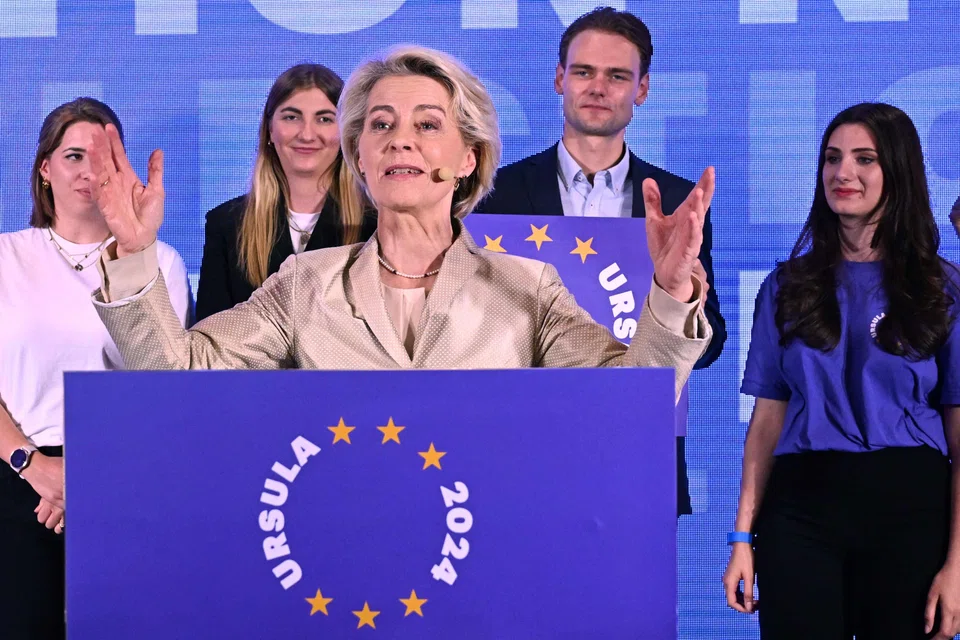
However, the European People’s Party (EPP), the centre-right political group of current European Commission President Ursula von der Leyen, won the most seats (projected to be around 184 of the 720 European Parliament seats).
This ensures a continued moderate majority alongside the centre-left Progressive Alliance of Socialists and Democrats (S&D), which is projected to have taken 139 seats, and also Renew Europe, the centrist/liberal party, with close to 80 seats.
Having secured the most votes, the EPP will nominate von der Leyen for a second term as European Commission president. To win out, however, she will need endorsement from at least 361 of the 720 MEPs and the 27 national political leaders, to confirm her position.
In 2019, von der Leyen secured her presidential position by just nine votes, and there are no guarantees she will win in 2024, given internal EPP divisions over her candidacy and opposition from some socialists and liberals, plus the diminished influence of the Greens. So, she may need to make significant concessions to right-wing parties to secure support.
The formation of a cohesive, sustainable majority in Parliament from 2024 to 2029 will require careful balancing of priorities. MEPs are most influential at the beginning of their mandate when they wield power to elect or block the entire College of 27 European Commissioners.
The conservative EPP is poised to remain the largest political group represented in the Commission, given its dominance in national governments. However, Socialist Teresa Ribera, Spain’s minister of ecological transition, has expressed her intent to become the next green policy commissioner, but her chances are harmed by her strong criticism of von der Leyen’s environmental credentials.
The rightward shift in the Parliament means traditional coalitions may no longer dominate policy, leading to more ad hoc alliances, particularly in economic policy, environmental regulation and migration. Eurosceptic parties on the right will push for greater national autonomy over fiscal and regulatory matters, challenging the enforcement of common EU rules.
Economic competitiveness may become the No 1 issue for the next Commission, especially against the backdrop of massive US and Chinese subsidies. The recent Single Market Report by former Italian prime minister Enrico Letta highlights the need for strengthening key European industries, and overcoming market fragmentation to integrate capital markets.
There may be more encouragement of formation of larger companies, potentially creating more “European champions”. These ideas will be further complemented by a major report on competitiveness that former European Central Bank chief Mario Draghi will soon deliver.
The growing influence of conservative and far-right, populist factions, generally opposed to ambitious environmental policies, presents significant challenges to the future of climate policy. New legislative efforts in this area, in particular, will likely face substantial pushback.
Nonetheless, especially if von der Leyen gets a second term, there will be significant continuity in climate policy. However, her mandate will focus much more on implementing already passed Green Deal legislation. It is also possible that existing measures may come under new attack, including the ban on combustion engines by 2035, which is due for a review in 2026.
Increasingly, MEPs are also likely to favour farmer support over environmental objectives such as biodiversity. Europe has seen widespread farmer protests driven by discontent over low food prices and environmental regulations, including pesticide bans, nitrogen emission restrictions, and limitations on water and land usage.
Facing this backlash, the EU has retreated from incorporating farming emissions targets into its 2040 climate roadmap, stopped adopting the “Sustainable Use of Plant Protection Products Regulation” aiming to reduce pesticide use, and delayed requiring farmers to leave some land fallow to boost biodiversity.
In February, EU lawmakers watered down the Nature Restoration Law, which aims to rehabilitate 20 per cent of European nature by scaling back agricultural land targets.
Green measures have also been rolled back in the Common Agricultural Policy, to which the EU allocates 386.6 billion euros (S$562.7 billion) in its current budget. Other areas that may be impacted include laws promoting sustainable food systems and measures to reduce agricultural emissions.
The next Commission will have a difficult job of balancing cost management with expanding clean energy. The European cleantech industry, facing stiff competition from China and the US, has seen solar power particularly impacted, lacking major bailout support from the EU.
Yet, the European Parliament election is not just important for the future of European policy. It will also impact the rest of the world as the EU remains an economic superpower, with its collective gross domestic product paralleling that of the US.
In this respect, one impact of a surge in support for the far right is the possibility of a more protectionist EU. This would have global implications as the Brussels-based club is the world’s biggest exporter, with scores of nations for which Europe is the leading trade partner ranging from key emerging markets like China in Asia to Brazil in Latin America.
Taken together, this is why the election matters not just for Europe, but also the wider world. Despite the EU’s historical support for economic liberalism and free trade, there could now be a change in its parliament’s political centre of gravity towards a more protectionist bloc.
The writer is an associate at LSE IDEAS at the London School of Economics