

Europe’s red Letta day to consider major reforms
A report by former Italian prime minister Enrico Letta could lead to significant change in the EU
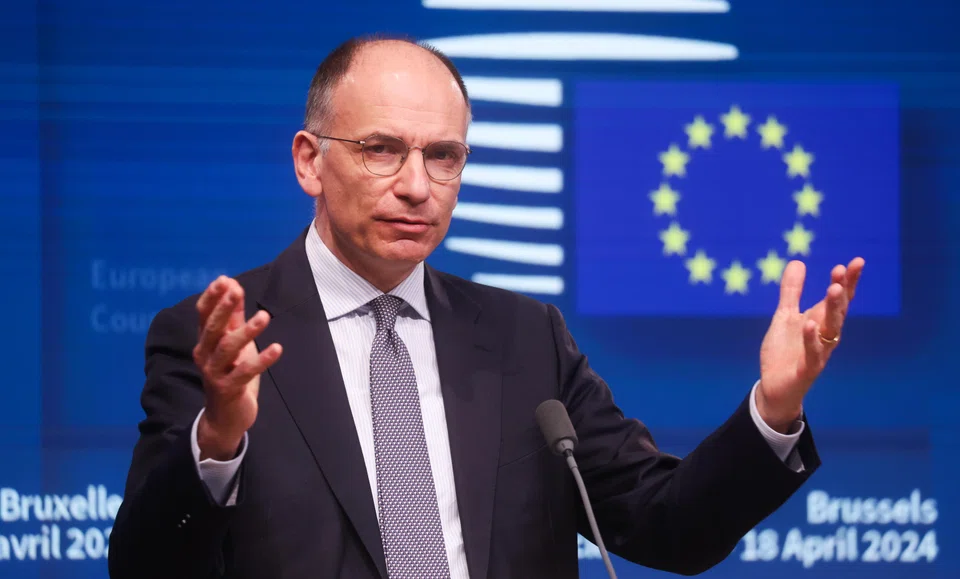
A RED letter day is one of special significance, with the phrase originating from ancient Rome’s practice of marking major occasions in red on calendars. Some two millennia later, the European Union faces such a day on Apr 18, as former Italian prime minister Enrico Letta formally presents a potentially landmark report on the future of the single market.
While the topic is intrinsically economic in origin, geopolitics also drives this sweeping set of recommendations. Change is needed, wrote Letta, as the EU faces a vastly changed international political context, even where its longstanding allies are concerned.
Referring to the possibility of Donald Trump being elected again as US president, Letta warned in a recent interview with the Financial Times that “Trump Two will be different from Trump One”.
“The single market of the beginning was for a small world, now we need a single market with teeth for a big world,” Letta said then.
In his report, Letta highlighted how much the world has changed since 1993, when the European single market was created to allow for free movement of goods, services, people and capital within the EU.
The initiative is seen as one of the bloc’s biggest achievements, but there are growing concerns that it needs a reboot to reflect today’s dramatically different world.
Thirty years ago, the EU accounted for around 20 per cent of global gross domestic product (GDP).
Its share has fallen to just over 13 per cent today, and is declining still.
One constant is that the US remains an economic peer. But the massive Asian emerging markets of China and India are two ‘‘new kids on the block”, providing major new challenges and opportunities.
A continental scale
Letta is clear, in his nearly-150-page report, that the single market is under threat like never before, as the EU recovers from the economic aftermath of Covid-19, faces the continued war in Ukraine, and confronts wider factors such as growing global protectionism.
As for economic competition, he argues that “no single member state can compete with the United States on gas or oil prices, as they are the world’s largest fossil producer”. “Nor Europe can replicate some advantages that China’s state-controlled economy can deploy,” he notes.
Nonetheless, the EU has a continental-scale energy market “united by a modern, sophisticated regulatory framework unmatched around the world”, he adds.
The bloc increasingly needs to find continental-scale solutions, which includes looking at how subsidies “can become a more European tool and less a national tool”. His conclusion is that “the EU must step up its efforts to develop a competitive industrial strategy capable of counteracting instruments recently adopted by other global powers, such as the US Inflation Reduction Act”.
The report focuses on integrating the EU’s energy, telecommunications, transport and finance sectors, with a road map for progress in the next half-decade.
In energy, one idea is adopting a methodology for cross-border cost-benefit allocation, so that regional offshore wind projects can be rolled out faster.
Others include green bonds to support energy infrastructure projects; revising the EU gas supply security framework; and a mechanism for joint purchasing of critical minerals.
In transport, Letta suggests the planning, funding and implementation of a major high-speed rail network of European capitals.
This will presumably be along the lines of the Eurostar train service, which connects London with key continental cities such as Brussels, Paris and Amsterdam in a way that makes plane travel less attractive.
The overall goal is to advance the EU’s green and digital transitions while boosting its strategic autonomy as well as its industrial, trade, and market competitiveness.
According to various stakeholders – from former European Central Bank chief Mario Draghi to the European Trade Union Confederation – this means plugging an investment funding gap between Europe and economic peers such as the US. This gap may be around half-a-trillion euros (S$725 billion) a year, or more than 3 per cent of the bloc’s GDP.
A fifth freedom
Underpinning all this is Letta’s call for a new “fifth freedom” for the European single market, to go beyond what he perceives as an outdated framework of goods, services, people, and capital.
This fifth area is for the free movement of research, innovation, knowledge and education. This will enable the European economy to shift from one “based on ownership to a new one, based on access and sharing”.
His argument is that the EU economy is flatlining not just because of market fragmentation, but also lack of innovation. The new fifth freedom would tackle this by embedding research and innovation at the heart of the single market, including through boosting the roll-out of the European Research Area and its higher-education equivalent, the European Education Area.
Letta’s report precedes that by another former Italian prime minister, Draghi. The latter is working on a paper on EU competitiveness that he promises will propose “radical change” and is due to land this summer.
The Letta report, meanwhile, is being discussed this week by the EU’s senior leaders, including its 27 presidents and prime ministers.
It will gain an added impact from the synergy it has with the forthcoming report by Draghi. Draghi, too, has clearly indicated that the continent must respond decisively to the huge changes in its external environment.
Like Letta, Draghi argues that massive investments are needed in the green and digital transitions. On the digital transition, Europe risks failing to capitalise upon the next technological revolution of artificial intelligence and quantum, in the same way that it did with the early 2000s’ Internet technology boom.
As for the green transition, the EU is placing much emphasis on this through its Green New Deal. However, this is not always matched by commensurate resources. In contrast, the US$369 billion in incentives under the Inflation Reduction Act is widely seen as a game changer, while China continues to offer significant state support to its firms.
Taken together, the Letta and Draghi reports reflect a major moment in Europe’s political economy. A key question is whether, in the midst of a big election year and ongoing crises, Brussels and national governments can act decisively to cultivate a bloc-wide consensus around a major package to reboot the EU.
The writer is an associate at LSE IDEAS at the London School of Economics
TRENDING NOW

Three ex-employees of Envy group join Ng Yu Zhi in bankruptcy

He built the Vingroup empire. Now South-east Asia’s richest man is handing some key roles to his sons

Grab CEO’s wife Chloe Tong on life with Anthony Tan and finding her purpose

Incidence of civil servants buying property near unannounced MRT stations ‘a concern’, but may not establish misconduct: PSD

