Europe seeks to shake up AI landscape
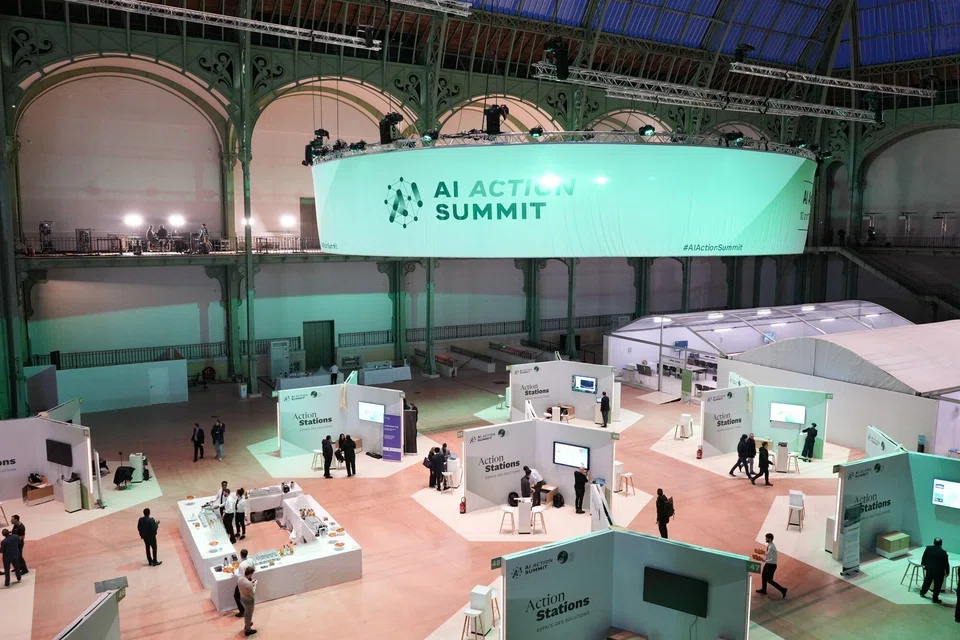
EX-EUROPEAN Central Bank (ECB) chief Mario Draghi’s competitiveness report, published last September, pointed to how far the European Union has fallen behind in the global technological race. Yet, this week the region will seek to highlight how it can become a key artificial intelligence (AI) power at a key summit in France.
Attendees at the big event, co-hosted by French President Emmanuel Macron and Indian Prime Minister Narendra Modi, include European Commission President Ursula von der Leyen, German Chancellor Olaf Scholz, US Vice-President JD Vance and Chinese Vice-Premier Ding Xuexiang.
Tech leaders will also be in full force, including OpenAI chief executive officer Sam Altman and Google CEO Sundar Pichai. The involvement of industry is key as, unlike some previous era-defining technological advances – such as space or nuclear – AI is mostly being developed by private companies, disproportionately located in the United States.
Since the release of Draghi’s report, the uphill battle that Europe faces in becoming a global tech leader has become clearer. Only in the last month, two separate AI developments have shaken the landscape.
First, US President Donald Trump announced his new Stargate plan, a massive proposed US$500 billion investment in AI infrastructure. Second, Chinese startup DeepSeek reported that its cutting-edge chatbot had been built at a tiny fraction of the cost of competitors like OpenAI’s ChatGPT – a development that stunned financial markets.
DeepSeek was founded by 40-year-old AI entrepreneur Liang Wenfeng who was behind the launch of High-Flyer in 2015, a quantitative hedge fund. DeepSeek’s app is free to download, and the model itself is accessible on the developer platform GitHub, although there are some restrictions on how it can be reused and DeepSeek collects so-called keystroke patterns, which raise privacy concerns. By contrast, the American OpenAI’s rival model is reserved for paid subscribers.
Trump called the DeepSeek news a “wake-up call” for the US tech sector. However, it also has potential implications for Europe, given the previous wide-ranging assumption that high-quality efficient AI models may be the preserve of US tech giants with huge hardware resources.
The DeepSeek news indicates that leading EU firms like France’s Mistral AI and Germany’s Aleph Alpha might also be able to gain ground. On Jan 30, Paris-based startup Mistral AI unveiled a new open-source language model called Mistral Small 3, which the firm claims rivals the performance of models several times its size while significantly cutting costs.
Moreover, an alliance of 20 European research institutions has announced OpenEuroLLM. This AI initiative is aimed at developing a European version of DeepSeek. Backed by the European Commission, the project has a budget of over 50 million euros, with a goal of boosting the EU’s competitiveness and digital sovereignty.
Yet, potentially positive as these developments might be, they currently pale in comparison to those in the US and China. So, some perceive that Europe’s best bet is to focus on specialised AI as opposed to core generative AI, the technology behind the chatbots.
The challenge Europe faces on the technology front was outlined in a speech by Draghi’s successor as ECB chief, Christine Lagarde, last November. She highlighted how the region was falling behind in innovation and productivity, noting how only four of the world’s top 50 tech firms were European. She also specified how the lack of unified digital market and venture capital investment hinders the bloc’s technological progress.
It is in this context that Macron is under pressure to show progress. He initially billed this week’s summit as an opportunity to push for more accessible AI technology. However, he is under increasing pressure now to more aggressively showcase the unique selling points of Europe in this new world of AI.
Upon taking office in 2017, the French president promised to create “a startup nation”, and soon ordered an AI action plan. He has claimed European civilisation and its language, values and democratic traditions are at stake if the region cannot harness the power of AI, cleantech and other new technologies.
Key summit outcomes are likely to include a new foundation that will aim to ensure AI’s benefits are more widely distributed, including developing scientific databases. Key successes to emulate include AlphaFold, Google DeepMind’s AI model that predicts protein structures, fast forwarding research and drug discovery.
A second priority is creating new AI coalitions, including the revival of the Global Partnership on Artificial Intelligence. Launched by France and Canada, this is backed by the Organisation for Economic Co-operation and Development, and aims to encourage the “responsible” development of AI.
France also hopes to launch a “Coalition for Sustainable AI”, including the need to develop more efficient hardware and software. This comes in the context of the growing appetite for energy that AI is fostering, increasing the need for data centres. Indeed, France has just announced a big 30 billion euro investment from the United Arab Emirates to build a 1 gigawatt data centre.
The French event is the third in a series of international AI summits, following one in the United Kingdom in 2023 and South Korea in 2024. One of the big differences with this event is that France is broadening the agenda beyond existential AI risks to try to keep opportunities centre stage. This is despite the fact that AI is advancing at an unprecedented pace, exceeding most expectations, amid growing warnings about its safety agenda.
In this context, many hope that the French summit can still play a valuable role in helping to foster a stronger international consensus on bringing AI into more inclusive global governance structures, to help harness the technology to better humanity’s welfare. At present, there is a significant risk of private-sector tech firms having an outsized influence in this debate, not least in a context of US-China geopolitical rivalry.
As AI continues its fast-paced evolution, it is becoming harder to develop consistent, coherent international regulatory frameworks, and prevent a patchwork quilt of policies. For instance, the EU has developed the world’s first comprehensive AI legislation, the strictest set of measures for the emerging technology.
Yet, Trump last month rescinded ex-US president Joe Biden’s executive order that requires AI system developers that pose risks to national security, the economy or public health to share the results of safety tests with the US government, before releasing AI models to the public.
The contrasting approaches of the EU and the US under Trump show the potential for significant regulatory divergence in years to come, even within the West. This may have big implications for global business, and the French summit could therefore play a key role in seeking to bring better equilibrium to this global AI rules landscape.
The writer is an associate at LSE IDEAS at the London School of Economics