

As Europe shifts towards India, controversies take a back seat
IN THE six decades since India accredited its first ambassador to the European Economic Community (EEC), perceptions of the world’s most populous democracy have changed dramatically across much of the bloc.
Back then, India was aligned with the then-Soviet Union, and was a protectionist economy moving away from the colonial era. The EEC – the precursor to today’s European Union, consisting of six Western European countries – therefore had a remote relationship with the emerging market giant.
Fast forward to 2023, however, and the contrast is striking: India is this year’s G20 chair with a three trillion-euro economy. It is also increasingly aligned with the West, despite disagreements over Ukraine.
From controversy to celebration
The transformation of Western attitudes towards India is replicated in the warmth of relations with Prime Minister Narendra Modi specifically.
When Modi came into office, previous human rights controversies surrounding his political past dogged his reputation.
This includes the treatment of Sikh and Christian minority groups by the Hindu nationalist Bharatiya Janata Party which he heads. Indeed, Modi was once subject to US and UK travel bans over communal violence in 2002 – during his tenure as chief minister of western Gujarat state – that killed around 1,000 people, mostly Muslims.
Since then, his national government has also been accused of stifling independent media, with India falling 21 places to 161 out of 180 countries in the World Press Freedom Index since he took office.
In February, Indian offices of the BBC were raided by the Indian tax department, weeks after the UK broadcaster faced government criticism for airing a documentary questioning Modi’s role in the Gujarat riots.
Modi is currently walking a diplomatic tightrope between India’s historical ally Russia and the West over Ukraine. He has declined to criticise last year’s invasion by Moscow, while India snaps up discounted Russian oil previously consumed by European nations.
Russia continues to be India’s largest arms supplier, even though its share has dropped to about 50 per cent from 70 per cent. This could leave India vulnerable to US sanctions which prohibit any country from signing defence deals with Russia, Iran and North Korea.
Yet despite it all, the Indian prime minister is feted not just in Europe, but the wider West. Australian counterpart Anthony Albanese, for instance, even likened him to rock musician Bruce Springsteen at a rousing Sydney reception earlier this year.
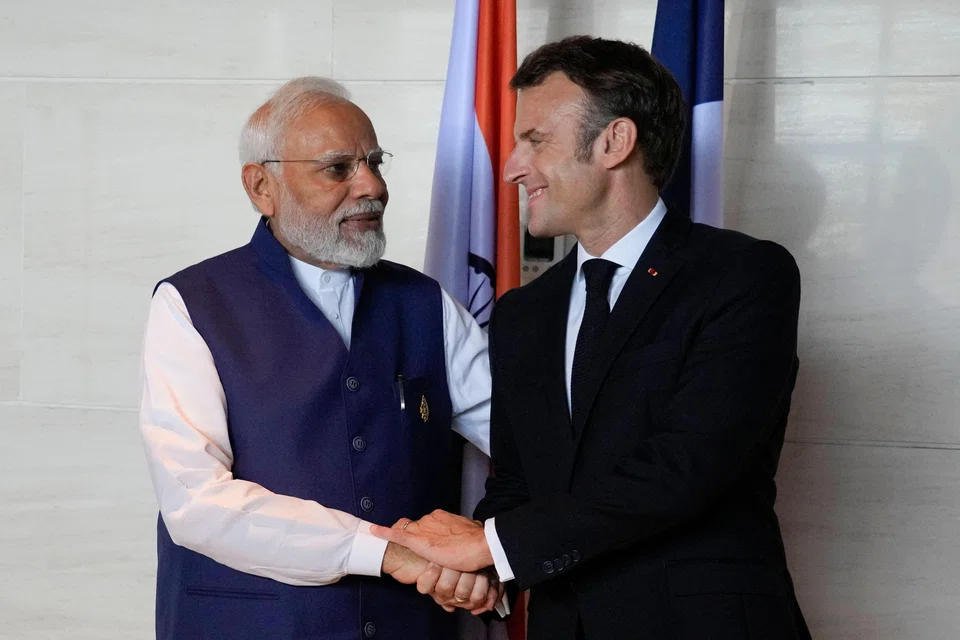
In Europe, France will be the latest EU nation to toast Modi when he becomes the guest of honour at the annual Bastille Day celebrations in Paris this Friday (Jul 14). The prime minister will be joined by Indian troops in the military parade, marking what Macron has called “a new phase in the strategic partnership between France and India”.
Converging interests
The incredible shift in sentiment in Europe and the wider West toward India – which has deepened since the pandemic – comes as New Delhi is increasingly seen as a countervailing military force to China, as tensions have grown with Beijing. The huge emerging market is seen as a key growth driver too.
There are, however, wider key reasons why Europe and India have warming ties. The EU 27 nations (taken as a whole) and India are the world’s two largest democracies. Europe is India’s largest single trade and investment partner – thus why a bilateral trade deal is a key potential prize for both parties.
There are converging interests around shared defence mechanisms, including for maritime security in the Indian Ocean, through which 40 per cent of bilateral trade passes.
The shift is reflected across Europe, not just the EU. For instance, the European Free Trade Association countries of Switzerland, Norway, Iceland, and Liechtenstein are making moves toward New Delhi.
On Jul 10 and 11, Indian Trade Minister Piyush Goyal met counterparts in the four nations for talks on a Trade and Economic Partnership Agreement. The focus was addressing trade barriers, promoting investments, and fostering greater cooperation in areas such as technology, innovation, and intellectual property rights.
The UK is also warming its ties with India. Of course, the two countries have a unique relationship dating back to the British Empire, with an estimated 1.5 million Indian diaspora population in the UK. Strong ties are likely to continue if the Labour Party wins power next year, as Labour leader Keir Starmer wants to turbo-charge the UK-India relationship too.
So there is a bipartisan push for the UK to gain stronger access to the Indian market of around 1.3 billion consumers through a new trade deal. Negotiations are well underway and the UK government hopes it will be concluded before the general elections expected in both nations next year.
In the eleventh and latest round of talks, India’s Goyal was in London this week to meet with UK Business and Trade Secretary Kemi Badenoch. The chief goal of this pact is to bolster bilateral trade, which was around £36 billion in 2022.
There are two key hurdles to overcome. First, New Delhi would like London to allow more employees of Indian firms into the UK, which is politically sensitive at a time of record high immigration. Second, UK negotiators are seeking to get India to open up its highly-protectionist services markets to allow more UK companies to expand there.
Despite these remaining differences, what is striking is how much economics has come to dominate bilateral relations – and how traditional irritants such as human rights have been de-emphasised.
As long as the UK and Europe prioritise ties with India, such controversies will continue to be swept under the carpet. The appetite for greater economic and security collaboration – as Europe seeks to offset cooling relations with Beijing with warmer ties with New Delhi – is trumping all else.
The writer is an associate at LSE IDEAS at the London School of Economics






