

Europe’s economic and political power balance in flux
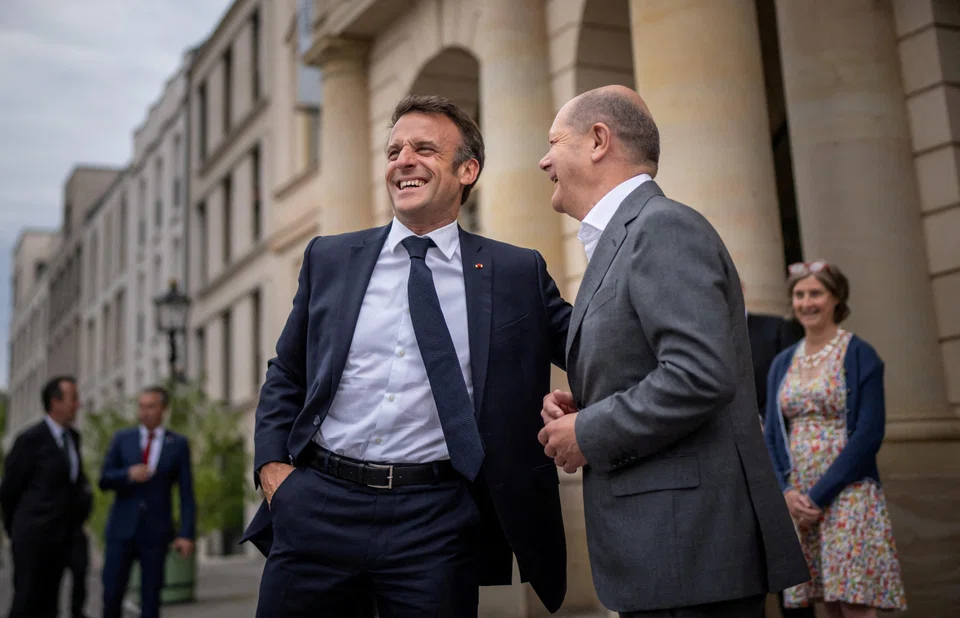
FOR much of the post-war era, close partnership between Germany and France has been a dynamo of ever-closer European integration. Yet, that calculus is changing, potentially significantly.
To be sure, cooperation between the two powers has ebbed and flowed in the past, quite often depending upon the personalities of the office holders in Berlin and Paris. However, there may now also be key structural forces in play too.
The case for the latter is that Europe, post-pandemic and Russia’s invasion of Ukraine, is experiencing significant geostrategic change that may transform the face of the continent.
Part of this is a potential post-war re-awakening of Germany in a “new” European security landscape. This is injecting uncertainty into the relationship with Paris which, in recent decades, has sought to align closely with Berlin to shape the European Union (EU) policies of its more powerful neighbour, to help project its own French vision of European unity.
For now, it is too early to assert conclusively what the impact of this potentially seismic shift might be. But it is already clear that bilateral relations have suffered because of the coolness of relations between President Emmanuel Macron and Chancellor Olaf Scholz. For instance, a joint Franco-German Cabinet meeting last autumn was postponed at short notice amid big differences on energy and defence. A meeting between Macron and Scholz that same month was also overshadowed by tensions.
What is also significant is how, in the face of less cordial bilateral relations, both sides have sought to counterbalance with other European allies. The latest example of this comes on Thursday (Jun 8), with Scholz’s visit to Italy to engage with Italian leader Georgia Meloni.
While left-of-centre Scholz and right-of-centre Meloni may be strange political bedfellows, they have generally been successful in smoothing their disagreements over issues from the EU’s green investments to migration to develop a constructive partnership. At their last meeting, Scholz said the two are working “very intensively” together.
From the prism of Europe’s balance of power, this is a blow for Macron, who had invested much time in cultivating France as the key interlocutor with Italy under Meloni’s predecessor, Mario Draghi. So much so that the two nations signed in late 2021 the so-called Quirinale Treaty, under which both nations committed to greater coordination in security, defence, migration, strategic sectors (including 5G and artificial intelligence), plus macroeconomics. Plus greater coordination before EU leadership summits to try to agree common positions, a process that has long taken place between France and Germany.
However, the intent of Quirinale has withered under Macron and Meloni, whose relationship has sometimes been tempestuous. Last autumn, the Italian prime minister even accused the French government of betrayal as the two battled over who should take migrant boats.
Another example of tension came earlier this year, when Meloni highlighted Macron’s “inappropriate” diplomatic snub to her after she was not invited to a dinner with Ukrainian President Volodomyr Zelensky during the latter’s visit to France. The Italian prime minister asserted that this move by Macron was undermining the EU’s solidarity with Ukraine. She added that it was driven by the French leader’s attempt to distract his public from their domestic issues, particularly the protests caused by his pending pension age increase.
Another example of how Paris is seeking to cement stronger ties with neighbours other than Germany is Spain, where Macron has again taken much time in recent months to build the relationship with Prime Minister Pedro Sanchez. This included signing a significant friendship and cooperation treaty last year. This reinforced ties on issues such as migration, defence and energy, and included plans to build a massive underwater hydrogen pipeline connecting Barcelona and Marseille, which will be key for energy independence.
Yet, amidst all this flux, a core fact remains that France and Germany are still today the most influential states in the Brussels-based club with the largest economies in the eurozone. In the longer term, it therefore remains possible that, even if Scholz and Macron don’t patch up their relationship, future incumbents will see a compelling need to do so.
There is also an outside possibility too of a stronger Macron-Scholz relationship in the final years of the French president’s term of office.
It should be remembered here that, from time to time, Angela Merkel and Macron had a patchy rapport.
Despite not seeing eye-to-eye on multiple issues, Merkel and Macron ultimately became generally a formidable duo plotting the future of Europe and its wider role in the world. Key achievements included persuading squabbling fellow EU members to agree to give the bloc – for the first time in its history – debt-raising powers to finance a 750 billion euro (S$1.1 trillion) post-coronavirus recovery plan, potentially paving the way for greater, future supranational powers of taxation and a more federalised continent.
So some six decades after the Elysee treaty, which established a new foundation for relations, bringing an end to centuries of French-German enmity and wars, what is clear is that Berlin and Paris will have significant bearing on events on EU relations. Both Macron and Scholz know the remainder of their terms could therefore have outsized impact in defining the economic and political character of the bloc potentially beyond the medium-term future.
If Macron and Scholz come together, they still have a window of opportunity to help steer the EU towards a pathway of deepening cooperation in coming years. This ranges from issues from energy to defence, with states sharing more power, and decisions agreed faster and enforced more quickly.
However, this is by no means assured, especially without the longstanding French-German motor of integration, given key challenges including growing Euroscepticism across the continent. For the last few years have seen not just the Brexit referendum, but also a growing backlash to Brussels with openly sceptical governments including Hungary.
This unfolding situation also comes in a context where there still remain a multitude of views across the continent on the future of the Brussels-based club. Alternative scenarios in the next decade therefore include the EU retreating, post-Brexit, to no more than the current economic Single Market, which seeks to guarantee freedom of movement of goods, capital, services and people.
While the direction of the EU is therefore still uncertain, Germany and France will have a huge bearing on its evolution. Despite their cool relationship, Macron and Scholz still have the potential to make an outsized impact in defining the economic and political character of the bloc in the 2020s and beyond.
The writer is an associate at LSE IDEAS at the London School of Economics






