

EU’s China trade policy must toughen to tackle massive deficits
Beijing’s US$412.9 billion trade surplus with the bloc is unsustainable
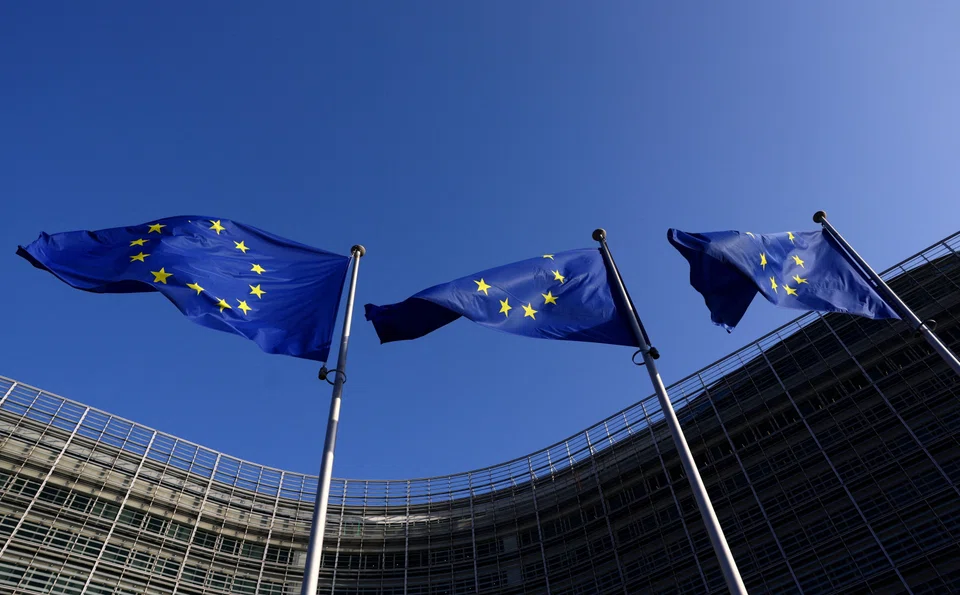
THE Trump era has seen the EU emerge as a major champion of trade liberalisation. The 27-country bloc has stepped up its global trade agenda, recently concluding deals with key partners including Indonesia and India.
However, China is increasingly testing Brussels’ pro-market stance.
Marshalling consensus across its member states is rarely easy. Yet senior politicians in national capitals and Brussels are realising that the bloc’s economy faces an existential challenge without firmer action against Beijing. This is what European Commission president Ursula von der Leyen warns risks becoming a “new China shock”.
On Tuesday (Jul 28), Beijing pushed back against this thesis in a long position paper. China’s Ministry of Commerce rejected European and US claims of “industrial overcapacity” while pointing to the fact that it has remained the world’s second-largest import market for 17 years.
Still, China’s trade surplus with the EU hit 360.6 billion euros (US$412.9 billion) in 2025 – larger than its surplus with the US. That translates to nearly one billion euros a day, a 15 per cent increase from 2024.
On Jul 24, following a trip to Beijing, the European Parliament’s vice-president Javier Lopez highlighted this as an “unsustainable reality”.
European leaders’ concerns over the trade deficit with China are not new, with many citing Beijing’s 2001 entry to the World Trade Organization (WTO) as a turning point.
While US President Donald Trump’s protectionist agenda across both his terms has encouraged a softer European stance towards China (to avoid being at loggerheads with both great powers simultaneously), it is increasingly clear that managed competition is no longer enough.
Rethinking the competition
A tougher trade policy has become necessary.
Strikingly, this view is now shared by a growing number of senior European leaders, including French President Emmanuel Macron and German Chancellor Friedrich Merz. The two have set a September goal to develop a Franco-German “road map” to tackle China trade imbalances.
This shift is crucial: France and Germany are the EU’s largest economies and both were previously among the strongest advocates of open European trade with China.
Macron has made Chinese trade and growing global imbalances a centrepiece of France’s G7 presidency. A recent report by the French Commission for Planning argues that current EU trade-defence tools are not fit for purpose to tackle Beijing’s long-term industrial strategy.
It also asserted that the distance between Chinese and European production costs is frequently “too wide to be closed quickly through innovation or productivity gains alone”.
Leaders such as Macron and Merz appear increasingly adamant that the EU must do more to prevent de-industrialisation as Chinese firms dominate European supply in key sectors such as chemicals, critical minerals and industrial robots.
Other European politicians argue that preserving Europe’s industrial base is essential to safeguarding its democratic model and geopolitical relevance.
Countdown to October
The EU is in a multi-month consultation period with China ahead of an October deadline for action.
On Jun 29, European commissioner for trade Maros Sefcovic and Chinese Commerce Minister Wang Wentao identified four workstreams – trade and investment balancing, export controls, intellectual property rights and WTO reform.
They also agreed to set up a joint trade monitoring mechanism “with a view to improving transparency, enhancing mutual trust and managing trade frictions”.
While this period will see multiple meetings and diplomatic communiques, fundamental challenges are unlikely to be tackled meaningfully in such a tight window – especially given China’s reliance on export-driven growth over domestic demand.
The rhetoric from both sides has been revealing. Wang called on the EU to promote “a rational and objective perception of China... and the adoption of positive and correct policies towards China”.
Meanwhile, Sefcovic was more blunt, stating: “China’s exports to the EU keep rising, while our market share in China keeps shrinking… The status quo is not an option.”
Bernd Lange, the straight-talking chair of the European Parliament’s International Trade Committee, has said that the October timeframe is “not realistic at all” if Brussels wants to secure a binding agreement with China.
A more plausible outcome by this autumn is a broad framework deal, followed by negotiations for a deeper, legally binding agreement to mitigate friction and avoid a full-scale trade war.
Yet, even if this transpires, Brussels still needs a strong hand to gain meaningful, sustainable concessions from China. The answer cannot be more face-saving, non-substantive measures. This will only trap both sides in an endless loop of re-litigation.
This explains why the EU is considering sharper instruments beyond the new Industrial Accelerator Act, which prioritises EU-made goods in public procurement, and the hitherto unused Anti-Coercion Instrument. The latter is widely perceived as too unwieldy.
In June and July, the EU reduced duty-free quotas for imported steel, and a three euro customs charge on small parcels – targeting the nearly six billion such parcels that entered the EU in 2025, with the huge majority coming from China.
Other measures under consideration in Brussels include mechanisms to diversify supply chains, reduce dependencies and build greater EU solidarity against possible Chinese economic retaliation.
The EU has proposed reforming the European Cybersecurity Act – to exclude Chinese firms from critical infrastructure – and discussed plans to require EU firms in sensitive industries to source components from multiple suppliers.
EU-China trade ties are approaching a critical pivot point. While a resolution is unlikely before October, European leaders must step up to the plate with skilful diplomacy, if dialogue is to yield “tangible results”, as Sefcovic put it.
The writer is an associate at LSE Ideas at the London School of Economics






