

EU’s Trump tariff deal breakthrough
The framework agreement may have averted a trade war, but it is fragile and much negotiation remains
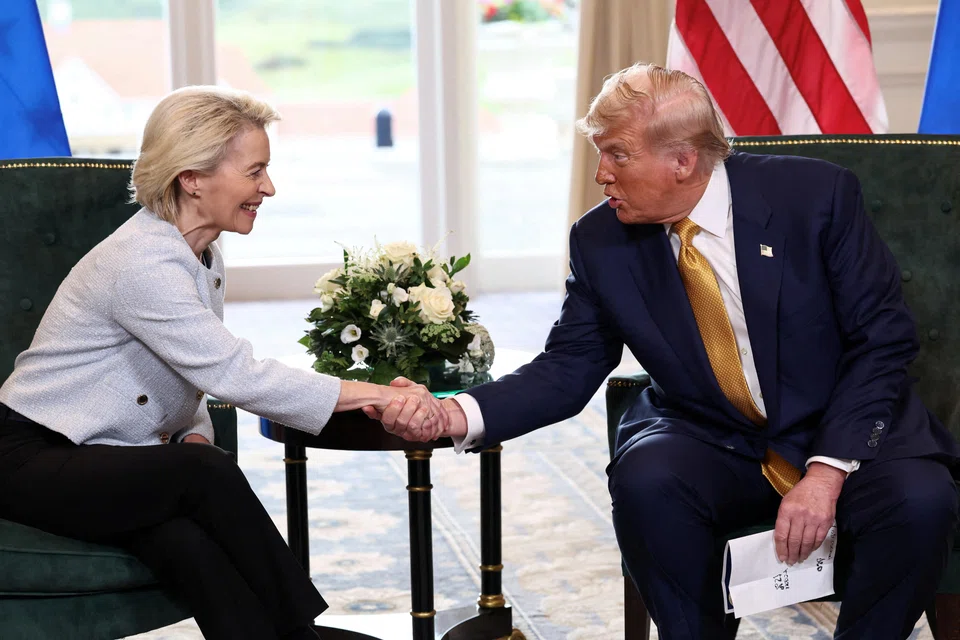
US PRESIDENT Donald Trump’s trip to Scotland last week was never likely to be just a private golfing trip. However, the reciprocal tariff framework deal he struck on Sunday (Jul 27) with the European Union was beyond the expectations of even many longstanding Trump watchers.
It was only Friday, soon after Trump’s arrival in Scotland, that a meeting was confirmed for Sunday with European Commission President Ursula von der Leyen. While the two sides reported they were close to an agreement earlier this month, Trump declared on Friday that there were still more than a dozen sticking points.
On Sunday, Dr von der Leyen referred to the “very difficult” negotiations. She said: “We started far apart from each other... You saw the tension at the beginning... We didn’t know if we would reach a landing zone or if it would crash. But in the end, as we were successful, it’s good and satisfactory.”
The deal agreed on Sunday, while only a framework agreement, is therefore a breakthrough for both sides. Trump even called it the “biggest of all deals”, reflecting the fact that the EU and US trade around US$1.7 trillion per year, and constitute a combined market of around 800 million people and almost 44 per cent of global gross domestic product.
Under the framework, multiple core terms have been agreed. But key details still need to be sorted in the second half of the year in potentially extensive further technical talks.
Significant compromises have been made to get to this point. For the EU, the 15 per cent reciprocal tariff will see a big increase from the baseline of much of the last few decades.
So the deal not only falls well short of the comprehensive liberalisation the European Commission and some previous US administrations have advocated, but it is also higher than the 10 per cent reciprocal tariff that the UK agreed with Trump. This, potentially, gives UK exports to the US a competitive advantage over the EU.
However, the 15 per cent reciprocal rate is the same as that of Japan. It is also less than the 19 per cent agreed by Indonesia and the Philippines with the US, and Vietnam’s 20 per cent rate.
On top of the tariff rate, the EU has agreed to buy around US$750 billion of US energy over the next three years. This is expected to be largely liquefied natural gas (LNG), with some oil and nuclear fuels. Should the deal hold, this energy purchase will be divided over equal US$250 billion tranches. Following Russia’s invasion of Ukraine in 2022, the US is already the EU’s second-largest supplier of LNG.
The energy agenda could be a win-win for both sides. Reiterating the EU’s desire to end its reliance on Russian fossil fuels, Dr von der Leyen said on Sunday: “(There is) too much Russian energy entering the EU through the back door... So it is very welcome to purchase more affordable and better energy from the United States.”
Yet, despite this positivity from the European Commission’s president, the framework deal may be fragile. There is much more negotiation to be done on both the reciprocal and separate sectoral tariffs agenda before potential finalisation.
At the same time, American courts are continuing to look into whether Trump has the presidential authority to initiate across-the-board US reciprocal and sectoral tariffs under the pretext of a national emergency. This coming week, for instance, a US federal appeals court will hear arguments in a closely watched lawsuit on this issue.
On the upside for the EU, the deal secured zero-for-zero tariffs on a number of products, including all aircraft and component parts, certain chemicals, certain generics, semiconductor equipment, certain natural resources and critical raw materials. The goal is to keep adding more products to this list.
However, there are other examples where US sectoral tariffs could end up higher than 15 per cent.
Pharmaceuticals are one such instance, as Trump had previously threatened sectoral tariffs of up to 200 per cent. Dr von der Leyen said: “It is agreed that we have 15 per cent for pharmaceuticals. Whatever the decisions later on is of the president of the United States: how to deal with pharmaceuticals in general? Globally, that’s on a different sheet of paper.”
On Sunday, Trump told reporters: “We have to have them built and made in the United States, and we want them made in the United States. Pharmaceuticals are very special. We can’t be in a position where we’re relying on other countries.”
Steel and aluminium also remain a key point of contention, as Trump intends to exempt them from the reciprocal deal and maintain 50 per cent tariffs. In contrast, Dr von der Leyen has stated that the goal is to return to “historical quota levels, similar to what was agreed with the UK”, which would “help ring-fence our industries and address global overcapacity”.
So the framework agreement is far from perfect, despite the fact that a 15 per cent reciprocal tariff is lower than 30 per cent threatened by Trump. Dr von der Leyen acknowledged the “challenge for some sectors”, but argued it secures crucial access to the US market.
She also highlighted her broader trade diversification agenda, citing recently concluded negotiations with the Mercosur bloc, Mexico and Indonesia as part of a push to expand beyond the EU’s 76 existing trade partnerships.
Nevertheless, for all the deal’s flaws, it avoids – at least temporarily – worst-case scenarios between the EU and US, which could have potentially seen a trade war.
Since last November, Europe had been bracing for a tsunami of troubles from Trump. This January, Trump said: “We have a US$350 billion deficit with the EU. They treat us very, very badly, so they’re going to be in for tariffs.” As tensions mounted recently, the European Commission had prepared several lists of retaliatory measures against US products worth around 93 billion euros.
Moreover, the deal may now help expand cooperation outside of economics, including in consolidating Western support for Ukraine. This could be critical for the future of Kyiv as it faces another difficult period in the war with Moscow.
Taken together, the agreement will avert a trade war, but it remains fragile and much negotiation remains. If the agreement holds in coming years, it is another signal that the long era of expansion of international trade as a share of global GDP is probably now at an end, with Trump’s disruptive tariff agenda reshaping the global political economy.
The writer is an associate at LSE IDEAS at London School of Economics
TRENDING NOW

Once staunchly pro-China, Malaysian Chinese businesses are now distancing themselves from Beijing

Britain’s mansion tax shows the difficulty of targeting wealth

Three hats, one goal: How Ng Kian Swan runs sustainability at NUHS

COE review: The gap between luxury and mass-market cars isn’t the only one worth bridging

