

Ex-G7 chair Meloni faces mission impossible with Team Trump
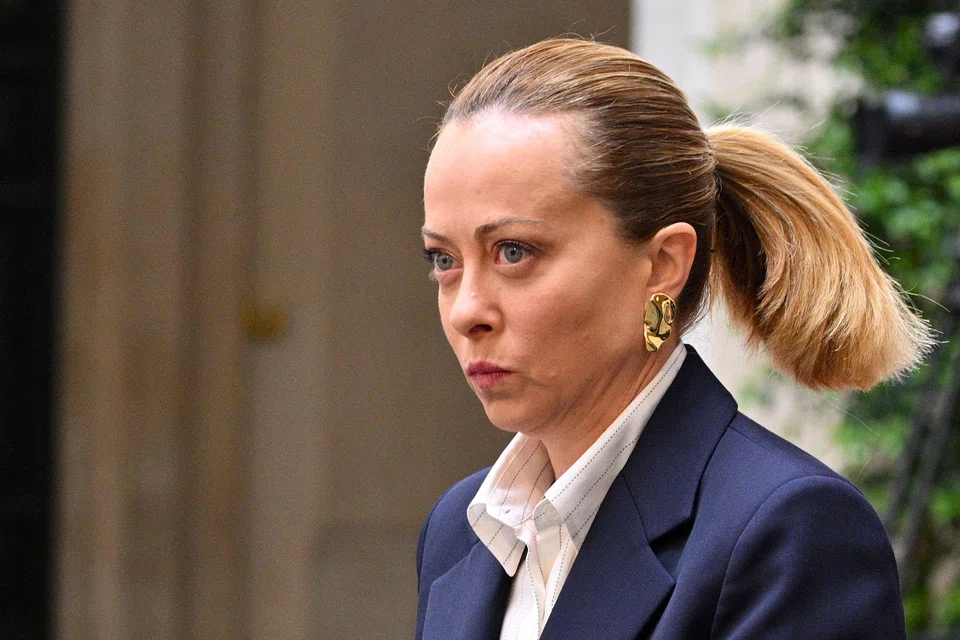
GIORGIA Meloni, who chaired the G7 last year as Italian prime minister, is sometimes called the “Trump whisperer”. But her ability to influence the Trump team faces its toughest test yet this week.
On Thursday (Apr 17), Meloni will visit the White House. Over the weekend, US Vice-President JD Vance will reportedly travel to Italy, from Friday to Sunday.
The agenda will be at least twofold. First, next steps with US President Donald Trump’s trade tariffs, and second, Ukraine.
Meloni was the only European national leader invited to Trump’s second presidential inauguration in January, and the two clearly get along well. However, this may not translate into any significant political or economic gains for Italy this week.
The fact that apparent political closeness does not always deliver dividends with Trump was shown last week, when Israeli Prime Minister Benjamin Netanyahu visited the White House. Netanyahu lobbied for the removal of tariffs on his nation, but this fell flat until the bigger Trump U-turn announced on Wednesday brought reciprocal tariffs down to 10 per cent for all nations, except China.
Meloni’s challenge is even bigger than Netanyahu’s. Italy is deemed as part of the wider 27-member European Union. Trump’s disdain for the Brussels-based club knows few limits, and he regularly repeats the line that the bloc was founded to disadvantage, economically, the US. Within the EU, Italy and Spain, the third and fourth-largest economies in the bloc, respectively, have pushed for a cautious European response to Trump.
So Meloni has few strong economic and political cards to play this week. That said, Italian Foreign Minister Antonio Tajani has already pledged to buy more American gas and invest more in the US, which may help.
A further challenge is that Meloni is boxed in by domestic political constraints. Not only is her governing coalition wobbling at the moment, the main opposition Democratic Party (PD) has also criticised her for political subservience to Trump.
PD leader Elly Schlein asserted that Meloni risks being one of the world leaders that Trump said is “calling us up, kissing my ass... dying to make a deal” on tariffs.
Schlein added: “Trump calls us Italians and Europeans parasites, and the Meloni government turns a deaf ear by lowering its head... as the American president used unrepeatable words to insult those who propose a meeting, to defuse a global financial and economic crisis generated by his tariffs policy... It’s not a good look for Italy.”
In this context, this week’s trip, and her specific proposal for a zero-tariff trade zone between the US and Europe, may well be mission impossible for Meloni.
To be sure, there are some supporters in the Trump team of this idea. These include Tesla chief executive officer Elon Musk, who is informally leading the administration’s Department of Government Efficiency project, and who also favours tariff-free US-EU trade.
While Meloni is unlikely to make much headway on the zero-tariff plan, the economic implications of the US tariffs for Italy means she will make the case to the president for keeping the duties on the EU as low as possible. Such is the political pressure on her that some other EU nations are worried about what she may say to Trump this week.
This concern was highlighted by French Industry Minister Marc Ferracci, when he warned that Meloni’s trip could undercut the bloc’s solidarity. “We need to be united, because Europe is strong if it’s united. If we start having bilateral talks, of course it’ll break this momentum,” he said.
Italy last year had around a 40 billion euro (S$60 billion) trade surplus with the US. This is the third-largest such surplus of any EU nation after Germany and Ireland, with the US market accounting for about 10 per cent of total Italian exports. This economic profile has led to much speculation that Italy is part of what the Trump team calls the “dirty fifteen” of nations with large trade surpluses with the US.
On Ukraine, while Meloni has shown strong support for Kyiv so far, Italian public opinion is more sympathetic to Russia than most of the rest of Europe. Meloni’s political calculus on this issue is also shaped by the sympathy that anti-establishment political parties like The League – part of her Italian coalition – have had for Moscow under President Vladimir Putin.
In recent weeks, Meloni has taken a backstage role on this debate, as France and the UK seek to form a coalition of the willing to help Ukraine. Italy is one of the countries that spends least on defence in Nato – just 1.5 per cent of gross domestic product in 2024. This is well below the 2 per cent threshold that members are urged to spend, and far from the 5 per cent demanded by Trump.
The ultimate bottom line for Meloni is to preserve her fragile coalition. Since she came into office in 2022, she has defied initial low expectations about her prime ministership in a country famed for its political instability and large number of governments – almost 70 – in the post-war era.
On Mar 27, Meloni’s administration became the fifth longest-serving in the almost eight-decade history of the Italian Republic. To be sure, that milestone of 887 days in power is relatively short by the standards of governments in other European nations. However, it is nonetheless a key moment in Italy that puts the Meloni administration ahead of the first Romano Prodi government, which lasted 886 days (from May 1996 to October 1998).
If Meloni keeps her coalition together, she could best the tenure of the fourth longest-serving government, led by ex-prime minister Matteo Renzi (1,024 days), which served from February 2014 to December 2016. She may even top the ranking of Italy’s longest-lived administration, which was former prime minister Silvio Berlusconi’s second government, which served for 1,412 days from June 2001 to April 2005.
While she has already surpassed initial expectations about her prime ministership, there remains an outside possibility of her entering the history books as Italy’s longest serving post-war premier, whether or not she succeeds with her trade agenda.
The writer is an associate at LSE IDEAS at the London School of Economics
TRENDING NOW
Knight Frank’s Tan Tee Khoon leaves firm, Nicholas Keong takes over auction business
Keppel Energy, Sembcorp Utilities and Tuas Power to supply biomethane in pilot project

GovTech retrenches another 38 staff in second round of layoffs
Take-up of new private homes dives 45% in Q3 as prices accelerate with 1.4% rise

