MARK TO MARKET

F1 weekend a bonanza for hospitality plays

Hospitality trusts are riding a strong recovery in international travel, but they have delivered varied returns to investors

Ben Paul
Ben Paul

Published Mon, Sep 11, 2023 · 05:00 AM
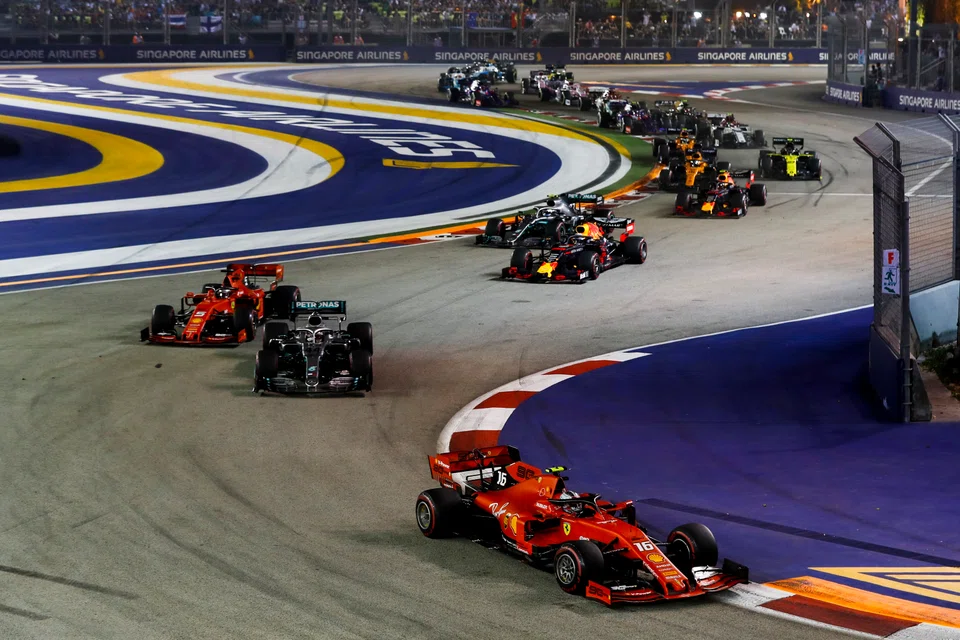
    • The 2023 Singapore Grand Prix is not expected to match last year's record turnout of 302,000 spectators, but it is taking place amid a recovery in international travel that has boosted the profitability of many hotel owners.
    • The 2023 Singapore Grand Prix is not expected to match last year's record turnout of 302,000 spectators, but it is taking place amid a recovery in international travel that has boosted the profitability of many hotel owners. PHOTO: MOTORSPORT IMAGES

    IF YOU have a last-minute urge to immerse yourself in the Singapore Formula 1 (F1) Grand Prix this weekend by checking into a hotel close to the race circuit, the Fairmont Singapore might be able to accommodate you in a 484-square-foot (sq ft) room with a balcony – from upwards of S$1,405 per night.

    Alternatively, the Pan Pacific Singapore is quoting S$1,580 per night for a 495 sq ft room under its “Singapore Night Race Track-facing Offer”.

    If you really have money to burn, you could get a Premier Suite at the Ritz-Carlton Millenia at a “special event rate” of S$4,800 per night.


    For owners of hotel properties in Singapore, the F1 Grand Prix can be a very profitable time of year. In fact, CDL Hospitality Trusts (CDLHT) specifically cited the recurring event as well as major concerts lined up for 2024 as drivers of its business in Singapore in July, when it reported its H1 FY2023 financial numbers.

    While the 2023 F1 season is not expected to match last year’s record turnout of 302,000 spectators, it is taking place against the backdrop of a recovery in international travel that has strongly boosted the profitability of many hotel owners.

    Singapore received nine million visitors during the first eight months of 2023, which is nearly 43 per cent more than the 6.3 million visitors received for the whole of 2022.

    Not surprisingly, some of the more prominent locally-listed hospitality trusts have outperformed their peers in recent months.

    Frasers Hospitality Trust (FHT) was the second best-performing component of the iEdge S-Reit Index this year, with a total return of 7.9 per cent. Far East Hospitality Trust (FEHT) was in ninth place with a total return of 2.4 per cent.

    The iEdge S-Reit Index has delivered a total return of minus 4 per cent since the beginning of this year. The best-performing component of the index was Keppel DC Real Estate Investment Trust (Reit), with a total return of 23.2 per cent. The worst performer was Manulife US Reit, with a total return of minus 81.3 per cent.

    Robust performance

    On the face of it, the relative outperformance of FHT and FEHT was well-deserved.

    FEHT reported a 26.9 per cent rise in revenue for H1 FY2023 to S$52 million, and a 30.7 per cent increase in net property income (NPI) to nearly S$49 million. Revenue per available room (RevPAR) increased 96.9 per cent at its hotels, and 22.8 per cent at its serviced residences.

    Excluding Central Square, which FEHT sold in March 2022, revenue and NPI would have increased by an even steeper 31.3 per cent and 34.7 per cent, respectively.

    Distribution per stapled security (DPS) for the half-year period increased 24.7 per cent to 1.92 Singapore cents.

    FEHT reported aggregate leverage of 32 per cent as at Jun 30, and net asset value (NAV) of S$0.9058 per stapled security.

    At its closing price on Friday (Sep 8) of S$0.635, FEHT was trading at an annualised H1 FY2023 DPS yield of just over 6 per cent and a 29.9 per cent discount to NAV.

    FHT has a more geographically diversified portfolio than FEHT, but it reported a similarly robust financial performance for the six-month period ended Mar 30.

    Revenue rose 41.1 per cent to S$62.2 million, while NPI increased 42.9 per cent to S$45.2 million. Excluding contributions from the Sofitel Sydney Wentworth, which was divested in April 2022, revenue and NPI would have increased by 68.1 per cent and 77.3 per cent, respectively.

    RevPAR at FHT’s Singapore properties – which contributed 29 per cent of its revenue and 35 per cent of its NPI during the period – more than doubled.

    DPS for the six-month period increased 79.7 per cent to 1.2649 Singapore cents.

    FHT reported continued recovery across its key markets for the quarter ended Jun 30. Its gearing stood at 35.3 per cent at the end of the quarter, while its NAV stood at S$0.64 per stapled security.

    At its closing price on Friday of S$0.48, FHT was trading at an annualised H1 FY2023 DPS yield of 5.3 per cent and a discount to NAV of 25 per cent.

    Opportunity in laggards?

    CapitaLand Ascott Trust (Clas) reported a similarly strong underlying recovery in H1 FY2023. Revenue was up 30 per cent to S$346.9 million, while DPS increased 19 per cent to 2.78 Singapore cents.

    But Clas has delivered a relatively weak total return of minus 5.2 per cent since the beginning of the year – thanks to a sell-off last month.

    On Aug 2, Clas unveiled plans to raise S$300 million through a placement and a preferential offering of new stapled securities at a significant discount to their market price.

    The following day, Clas said a placement of nearly 191.8 million new stapled securities had been priced at S$1.043 each, while a preferential offering of 100.5 million stapled securities had been priced at S$1.025 apiece. In both instances, the pricing was at the bottom end of the indicated ranges.

    The market price of Clas subsequently plumbed below the S$1.025 level, which killed demand for the preferential offering. On Aug 28, Clas said that valid acceptances and excess applications were received for only 65.1 million stapled securities under the preferential offering – a take-up rate of just 64.7 per cent.

    This bungled equity-raising exercise could be a buying opportunity for investors, though.

    Clas said the funds raised will be put towards its S$530.8 million purchase of new assets in London, Dublin and Jakarta, as well as asset-enhancement initiatives at its properties in London and Sydney – which are all expected to be accretive to its DPS.

    Clas closed Friday at S$0.995.

    Another laggard in the sector is CDLHT. Since the beginning of this year, it has delivered a total return of minus 16 per cent – despite exhibiting strong recovery momentum in its operations.

    CDLHT reported a 20.9 per cent rise in revenue to S$119.2 million for H1 FY2023, and a 23.3 per cent increase in NPI to S$62.9 million. DPS for the six-month period rose 23 per cent to 2.51 Singapore cents.

    CDLHT’s properties in its home market of Singapore achieved a 42.7 per cent improvement in NPI, as RevPAR increased 45.8 per cent. This was despite the closure of conference facilities at the Grand Copthorne Waterfront Hotel for renovation from April to July 2023, and the removal of some 34,000 room nights from inventory for bedroom-refurbishment works.

    CDLHT’s gearing stood at 37.9 per cent as at Jun 30, while its NAV stood at S$1.41 per stapled security. At its closing price on Friday of S$1.05, CDLHT was trading at an annualised H1 FY2023 DPS yield of 4.8 per cent and a 25.5 per cent discount to NAV.

    While these valuations do not seem particularly compelling, the ongoing recovery in international tourism as well as marquee events such as F1 in Singapore should keep CDLHT and other hospitality plays on the radars of investors.

    The writer owns stapled securities in CapitaLand Ascott Trust