

The Accidental CEO
Linda Jackson fell into the car industry by chance, but her unconventional view of the business has propelled her to the top job at Citroën.
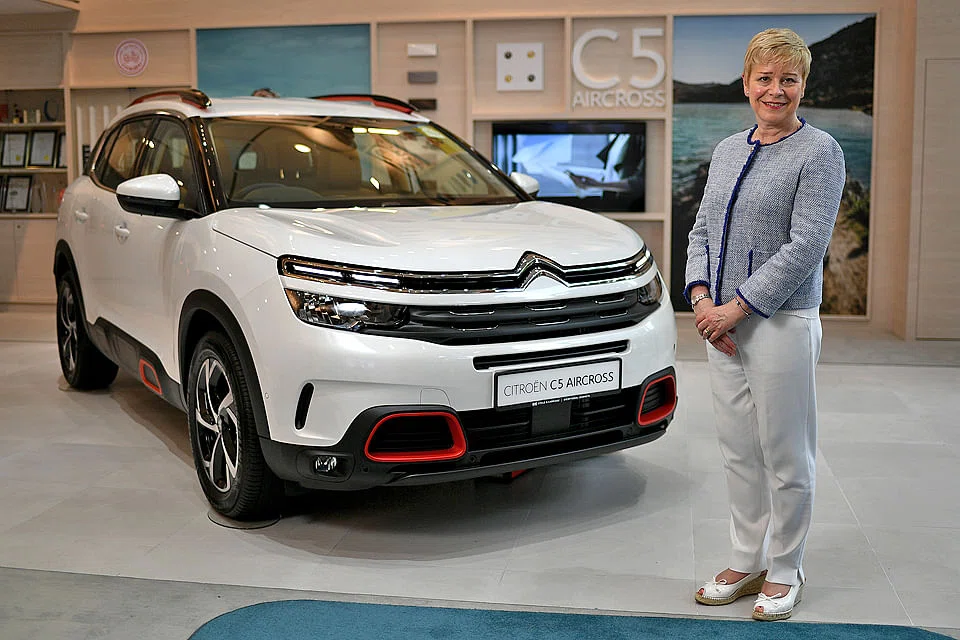
LINDA Jackson should be zonked. After stepping off a red-eye flight, the chief executive officer of Citroën makes a quick stop at her hotel before heading straight to Cycle & Carriage France on Leng Kee Road for a morning-long huddle with the importer's senior management.
This being her first visit to Singapore, she has just hours to make sense of our acronym-laden car market's vagaries - try getting your head around COEs (certificates of entitlement), OMV (open market value), ARF (additional registration fees), the VES (vehicular emissions scheme) and more when you've had adequate sleep, let alone after a night on a plane.
C&C will no doubt use the time to bend her ear relentlessly about getting Citroën to build cars better suited to Singapore's rules, and give the brand a fighting chance to climb above its 0.4 per cent share of the market here.
Then come the ceremonial obligations that plague the working life of any CEO: cutting the ribbon on C&C's new La Maison Citroën showroom at its opening in June, delivering a speech about the brand and then helping to launch the 100-year-old car maker's flagship for Singapore, the C5 Aircross.
Remarkably, even after what would count as a full day for any executive, Ms Jackson has the energy and patience for what must seem like the most dreary of all CEO duties: sitting down with the press, including The Business Times.
But then Linda Jackson is not your ordinary car company boss.
In her own words, the 60-year-old says she "fell into" the car industry "completely by mistake". Not bad for someone who is the first Englishwoman, and only the third woman, to lead a global car company.
Those who can, do
Before starting university, where Ms Jackson was planning to study to become a teacher, she had time to kill and cast about for a holiday job. "I decided that I wanted to earn some money," she says. An uncle who worked at Jaguar, then part of British Leyland, which eventually morphed into the doomed Rover Group, scored her a temporary gig at the famed car company.
"So I got a job there for two months, and I wasn't doing anything particularly complicated, it was very, very basic," she says. But the uncle pulled strings and introduced his wide-eyed niece to the various departments within the company, from design to production to marketing. "I had a great time, didn't do any work!" she says, with a healthy sense of self-deprecation. "But I spent two months understanding how varied this car business was." Captivated by the industry's complexity, she decided she would stay and university could wait.
Ms Jackson says she realised that a global car company could offer an enormous variety of career opportunities, and that she was attracted to the cars themselves. "I think 99 per cent of us, when we buy a car, we buy it with a little bit of emotion. We're buying it because it says something about us," she says. "I don't think I would've had so much interest if it was a company that made nuts and bolts. I mean, maybe people love nuts and bolts, I don't know. But for me, it's not quite the same."
The summer gig turned into a full-time job as an accounting clerk for Jaguar at British Leyland, where Ms Jackson stayed as the group lurched from one financial crisis to another, eventually climbing the ranks to become the finance director of Rover in France. She obtained an executive MBA from Warwick University along the way, and was headhunted by Citroën in 2003 to head the finance departments in France and the UK, before leading the French brand's UK and Ireland operations in 2010. Market share, profitability and customer satisfaction all rose under her watch, and the strong results propelled her to the top job in June 2014.
In the five years that she's led Citroën, Ms Jackson has seen the brand achieve record sales. "In 2018 we sold just over 1 million cars worldwide. Particularly in Europe, we had an extremely good result, we sold 825,000 vehicles," she says. That is up 28 per cent from 2013, a year before she moved into the corner office at Citroën's Paris HQ.
It's the customer, stupid
Ms Jackson was brought in to lead Citroën when its parent company Groupe Peugeot Société Anonyme (PSA) was itself being retooled. Mounting losses meant PSA faced bankruptcy in 2013, and the group poached Renault's number two man Carlos Tavares to turn it around. He sharpened the group's individual brands' identities, streamlined their product lineup and delivered remarkable results in short order. The group's auto business recorded 2.66 billion euros (S$4.03 billion) in operating income in the first half of 2019, up 12.6 per cent from a year ago. Astonishingly, at 8.7 per cent its operating margin is at a level that even premium car makers such as Mercedes-Benz or BMW now struggle to achieve.
You would think that encouraging people to drink Starbucks coffee would rile the French, but making the C5 Aircross compatible with the Seattle-based coffee chain is one example of Ms Jackson's methods.
She rejigged Citroën by focusing on two key areas. "We start with what we call the signature, which is, 'Inspired by you'. Whichever market we go into, we're inspired by those customers, and we want to try to make our products and our services relevant to those customers," she says. "And then we have what we call the promise, and that is to be different or challenge the rules."
It might sound like a cliche to put the customer first, but the business is usually hyper-focused on products. Car company CEOs talk with almost maniacal zeal about their companies' shiny new set of wheels, relentlessly on-script about how their latest machine is also their greatest. Ms Jackson's approach is to put the customer on a pedestal instead of placing her own cars up there. In the fanatical world of cars, that counts as radical thinking.
Indeed, when testing a new car at Citroën's private circuits, she focuses on what the everyday driver looks for instead of trying to burn rubber like a car enthusiast might do.
"I know that I sometimes get in the car and I'm more interested in where the storage spaces are than the fact that it can do a remarkable speed around the track," she says. "I think I'm probably slightly unpopular with some of the engineers."
Ms Jackson says she is simply not the sort to spend a weekend "tinkering in the garage" even though she professes a love for driving and a love for cars. "That's not me, I'm afraid," she says.
That being so, her early tinkering with Citroën drew its share of internal scepticism. "I remember presenting the strategy and I think people were looking at us a little bit strange because we were talking about the customer, as opposed to, 'This is the product we're going to launch'," she says. She explained the "customer journey", talked about digital services and the new La Maison showrooms, and ended up befuddling engineers who were more used to thinking about how much horsepower their next car should have.
It took two years for them to click with her vision. Citroën rolled out some of Ms Jackson's ideas along with a new C3, a compact hatchback that isn't sold in Singapore, and the car became a bestseller.
The new customer-focused thinking also means the company can introduce things that the more blinkered approach of the past would miss. "I like it, because sometimes it gives us ideas. So somebody would come back and say 'Wouldn't it be great if you could actually put a Starbucks coffee cup in your cupholder?' And in the C5 Aircross, you can," Ms Jackson says. "Actually, there are (cars from) some manufacturers, you won't fit it in."
But more broadly, she figured out that Citroën could differentiate itself by simply aiming to make the most comfortable cars. Car makers usually shout about power and performance or design instead. "I don't think there's any other manufacturer that wants to be the benchmark in comfort. Of course, they all want to have comfortable cars, I'm not saying they don't. But many talk about performance, engines, or they talk about the drive. But I can't think of many manufacturers that actually say, 'OK, a key element for us is comfort'," she says.
Fans and flak
That's the reason the C5 Aircross, her company car and current favourite, has seats padded with multiple foams with different densities, and why it has a new kind of shock absorber that uses hydraulic fluid for a cushioning effect. To most people, those things are much more useful than a top speed of 250km/h.
For all that, Citroën is a century-old car company with plenty of heritage, and thus, plenty of die-hard followers. That means that for someone in Ms Jackson's role, there is no shortage of noses to put out of joint, Gallic or otherwise.
Citroën fans once touted hydropneumatic suspension (a spring system that uses compressed air and pressurised fluid in place of steel) as a defining feature; Rolls-Royce licensed the technology from Citroën for its comfort, and French president Charles De Gaulle once escaped an attempt on his life because the advanced suspension allowed his limo to be driven away on tyres that had been shot out by assassins.
Ms Jackson decided to axe it when she reckoned that it had become outdated, now that the brand's cars use progressive hydraulic cushions, a new kind of suspension damper that is cheaper and lighter. Naturally, she drew plenty of flak for consigning a much-loved technology to history.
"People only heard one message. They only heard the message about, 'The old technology's dying and Linda Jackson's killed it'," she says. "But they didn't hear the second message, which was, I've got a great new technology that creates the same effect. Inevitably you get things like that."
She says she's resigned to getting grief for "many, many, many things", but accepts it as an inevitability in the car business. "Everyone has their opinion on cars," she says.
Yet, of all the pitfalls of being a car company boss, perhaps the biggest challenge all of them face is how to figure out a profitable way to manage the disruption of electric drive and driverless technology. She says Citroën is ready for electrification, and is about to launch its first plug-in hybrid petrol-electric cars, and that she is keeping an eye on autonomous driving systems. No one quite knows precisely how to adapt if (or when) consumers want mobility as a service instead of buying cars. "This is why you have to be agile as a company," she says. "It's chaotic, and you have to be agile and able to adapt: the Darwinian approach."
Asked if she would rather have been CEO of a car company 20 years ago when things were more straightforward for the industry, she has a ready answer. "I'm probably stupid, but I'd rather be one now because I think what's been happening in the last five and now the next 10 years is going to perhaps be more exciting than what happened in the last 20 years," she says.
Steering a car company through the upcoming excitement is a taxing challenge, to say the least. It reportedly led Harald Krueger, the former CEO and chairman of BMW Group, to resign just months ago. The car world itself can be especially harsh, with leaders expected to deliver rising sales profitably, while spending heavily to future-proof their products without knowing what future to prepare for.
And for all her successes so far, Ms Jackson is currently the subject of a rumour from one German magazine that she may soon be replaced by Vincent Cobee, a fresh hire working on brand development at Citroën, and the former head of production at Mitsubishi.
Yet, Ms Jackson is no stranger to toughing it out, and says making personal sacrifices is just part of climbing the ladder. Perhaps more so for women. "Maybe as a woman, because you want to stand out, you probably work harder and you probably are more of a perfectionist because you want to show you are doing well. So maybe we work a bit harder than we should do. But I certainly have. But you can't regret it because I love what I'm doing now, so, it's a choice," she muses. "It's a choice."
It's not all toil, of course. Ms Jackson freely admits that she "loves to relax", especially when she leaves Paris for her holiday home. "When I get the chance, I love to go to my house in Normandy. It's got a very, very big garden, and I just potter around, and just sit there reading a book. It's very, very quiet, it's really nice."
Given that Ms Jackson's plans for Citroën involve opening new markets for the brand (she launched it in India early this year), it's hard to imagine how she would find time to unwind in Normandy. As it is, she says 60 per cent of her time is spent travelling around the world.
But that is something she will have prepared herself for. She remembers the HR director of the company cryptically asking her if she liked to travel, right before Carlos Tavares offered her the CEO post at Citroën. Having jumped on the offer, Linda Jackson is right where she wants to be, no matter how zonked she feels.
LINDA JACKSON
Chief Executive Officer Citroën
Born in 1959
Education
1988-1992: MBA, Warwick Business School
Career
1977-1999: Cost analyst and finance roles across the Rover Group for the UK and Europe
2000-2003: Managing Director, MG Rover France
2003-2004: European Sales Finance Controller, MG Rover Group
2005-2009: Finance Director, Citroën UK
2009-2010: Finance Director, Citroën France
2010-14: Managing Director, Citroën UK and Ireland
Since 2014: CEO, Citroën
TRENDING NOW

Easy to rent out, hard to sell: Are buyers losing interest in Singapore’s one-bedroom condos?

GovTech retrenches another 38 staff in second round of layoffs

Stocks to watch: Seatrium, CapitaLand Investment, Keppel DC Reit, Suntec Reit, CLCT, TSH Resources

World’s largest offshore wind platform by Seatrium consortium on track to be completed by 2028

