

AI-Aided Elixir
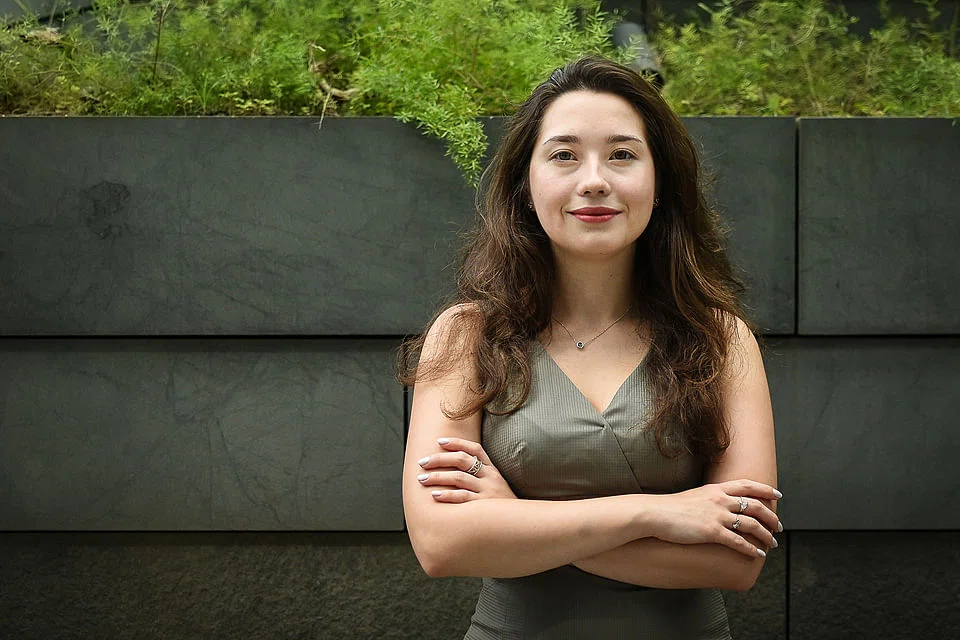
Anastasia Georgievskaya is co-founder of a company that is using artificial intelligence and machine vision to tackle skin ageing. She has organised the first beauty contest judged by robots, and developed an app that tracks age-related facial changes - and she's just turned 24.
MENTION artificial intelligence (AI) and images of self-driving cars, flying drones and robot companions usually come to mind.
But to Russian bio-engineer and entrepreneur Anastasia Georgievskaya, AI translates into computerised medical diagnostics and a new generation of "digital health".
The 24-year-old research scientist is a co-founder of Moscow- and Hong Kong-based Youth Laboratories, which has developed machines that are used in European clinics to diagnose several illnesses and skincare issues in seconds.
Its system currently has a bank of about 20 illnesses and diseases that can be matched to biomarkers caught on images, and Ms Georgievskaya hopes to expand its database to include more parameters as well as to eventually produce a platform supporting mobile medical diagnosis in the next two years.
"That is the future," she tells The Business Times in Hong Kong, where Youth Laboratories has an office, and where she was attending The Economist's Innovation Summit 2017 as a speaker.
"With a mobile app, you can just take an image and get an examination according to the parameters you choose. You can send any kind of picture, it can be a picture of face or skin, or upload a medical image ... and the algorithm will annotate and evaluate it."
Such "computer vision-enabled medicine" has the potential to provide easily accessible diagnostics in urgent conditions as well as precautionary scans that could help with early preventive intervention or treatment, she says.
"To make an appointment with a doctor you may need to call, it takes you some time, but sometimes lives can be saved with very simple manipulations ... This sort of basic but widespread healthcare is especially important in developing countries.
"You will also be analysed for biomarkers that you are not even aware of ... so there is preventive use."
Combining her passions
For Ms Georgievskaya, combining healthcare research with computer programming brings together her two first loves - languages and biology. Growing up as an only child in Moscow, she was exposed at an early age to data sets and languages by her father, an informatician, and her mother, an interpreter. Ms Georgievskaya studied languages in school until university, where she pursued a biophysics undergraduate degree at Moscow State University, followed by a bioinformatics master's degree and a PhD in computer science studies at the Russian Academy of Sciences.
When she was not attending classes, Ms Georgievskaya took part in "hackathons" - competitions for programmers and other technology designers to pit their coding skills against each other over multiple days.
At one such event where participants were tasked to create an algorithm that would enable them to beat a computer game, Ms Georgievskaya met research scientist Alex Zhavoronkov, whose work focused on ageing.
The two would go on to found Youth Laboratories together in November 2015, alongside company CEO Alexey Shevtsov and Konstantin Kiselev, with US$200,000 in funding from a private investor.
"As I was studying biology, I learned a lot about new technologies that took my breath away ... It's very interesting, this feeling that you can also contribute to the basic knowledge of humans and improve technologies that can save humanity or allow us to live longer," says Ms Georgievskaya. "It's like participating in an adventure story."
With Mr Zhavoronkov's background in biogerontology, Youth Laboratories' initial research centred on tracking ageing biomarkers, driven by a desire to provide digital healthcare solutions.
"We need to extend the health longevity of people, and if any research can speed up this process we should definitely take advantage, especially using deep learning and machine learning technology," says Ms Georgievskaya.
"I personally think that AI is like a new stage of human knowledge. So we now try to examine big data and try to extract new dependencies, a new way to investigate what's wrong with us. This is why I think these methods are so powerful."
Youth Laboratories turned to images to collect information on biomarkers that are then linked to neural network algorithms.
"Photos are very good sources of data. They are cheap, easily available, show many features, and can help describe ageing. We started investigating if you can extract any markers of ageing from images and ... while developing ageing biomarkers, we made progress in tracking some skin imperfections," adds Ms Georgievskaya.
"Then we realised that it would be a very cool idea to put everything into a cloud, where you have all the algorithms to annotate different skin conditions, and then you just make requests, upload images and find conditions."
To help attract collaborators and test out their algorithms enabling machines to recognise and evaluate features such as wrinkles and dark spots, the company organised an international beauty contest judged entirely by AI.
Held in August 2016 and supported by Nvidia and Microsoft, the Beauty.AI competition drew 6,000 entrants from over 100 countries, all of whom participated by submitting selfies through an app to be judged by computers trained to evaluate wrinkles, face symmetry, skin colour and several other parameters.
The event drew widespread media coverage and controversy for its novel take on a beauty pageant, as well as the apparent data biases and limitations that resulted in predominantly white winners, even though none of the algorithms treated light skin as a sign of beauty.
Ms Georgievskaya says that the competition was more of a publicity stunt to raise awareness of the company's growing technologies and to iron out kinks in its systems, than a revelation on new standards of human beauty. "The idea was to show that this technology is emerging, you can analyse faces with different algorithms."
Since the event, Youth Laboratories has developed new algorithms that can track skin redness, allergies, varying tones and sagging, which can serve as health markers. The company has grown from its original four members to 15 staffers, with an estimated valuation of US$50 million, according to Ms Georgievskaya.
Beyond skincare and ageing, diseases with visible symptoms such as skin cancer and glaucoma have been added to its database and made available in the company's diagnostics services.
For each condition entered into its database, visuals and medical datasets are first collected through collaborations with research units and clinics.
As the "robot tutor" on her team, Ms Georgievskaya takes the lead in "teaching" its machines to recognise and evaluate different biomarkers, a process that she says takes about two months of tinkering with code to annotate images and datasets as well as test and validate accuracy in detection for each illness or disease.
Addressing potential privacy concerns, Ms Georgievskaya says images used are not stored or saved, only annotated and analysed.
Since July this year, these AI-run diagnostics have been used in 12 clinics in Russia on a pilot programme, enabling anyone to get quick tests with diagnoses provided in seconds for any of the 20 illnesses and diseases in the system.
On top of providing systems and infrastructural installations, Youth Laboratories charges about US$50 per 1,000 requests made to its server, with each request defined as an analysis run by one algorithm, and more than 10,000 requests have been received since the launch of the pilot programme.
Digital health generation
One of the biggest challenges has been in makin accommodations for varied lighting conditions in images, which could affect colour detection and diagnoses, says Ms Georgievskaya, but with rounds of testing and tweaking, diagnostic accuracy is "more than 80 per cent" on average.
"We made the algorithms first from high-resolution images, but have trained the machines to feed additional data so we can also work from mobile phone pictures. You can just take a picture of some skin area, and the algorithms will process it."
One of the system's first users was Ms Georgievskaya herself, who found out she was at risk of certain kidney diseases. She has since sought second opinions and changed her diet to improve her health.
"It is good to know about your health risks at an earlier age, so you have more time to do something about them," she says. "I'm planning to live to 100 years old, so I would rather get tested now. Kids today all have phones, and we are helping to raise a new generation who would be constantly tested with different algorithms, and have improved attitudes and attention to healthcare - a digital health generation."
Working with skin biomarkers has also led the company into a related field - real-time AI-run facial and emotional recognition, which Ms Georgievskaya thinks could be especially useful in retail, at events, and within the services industry.
"We really think that health is not only about what is in your skin, but also what is on your mind. So we keep to this idea and decided to make an engine for emotion recognition and also combine it with biomarkers ... to also understand how you feel, are you stressed, whether you're adjusted to some stress, do you feel relaxed, what are the dynamics of your reaction to particular products," she says.
The emotion recognition system is able to establish emotional baselines for each unique individual appearing on regular security camera footage, enabling users to track and analyse changes in a customer's expressions with reduced bias.
"For example, one day someone leaves a store happier than before. Why? If you see neutral or annoyed reactions, maybe you should change the music, or store concept. With this system, you can get real-time honest feedback from people ... rather than asking them to fill in surveys, which could make them annoyed or have them feel too polite to be truthful," says Ms Georgievskaya.
The emotion recognition system is being rolled out in some department stores and banks in Europe, she adds.
"Just like how everything is already being filmed for security reasons, I really think emotion recognition profiling will be a new common standard of quality control," she says.
"I think that profiling is the future and we should think about what good it would bring to our lives. It brings personalisation and better services."
Underscoring both the medical diagnostics and emotion recognition branches of research is a goal to provide easily accessible customised lifestyle analytics and healthcare recommendations, says Miss Georgievskaya.
"Lifestyle recommendations are to be included in our app in the future, on top of diagnosing illnesses. The future is in helping people to make lifestyle changes via computer vision analysis. The trend of customisation works in synergy with digitisation.
"Now you have everything digital, it is much easier to upload information as we have more and more data, and it's becoming easier to investigate more out of that ... That's why everything is becoming personalised. Our treatments and lifestyles should also be personalised."
ANASTASIA GEORGIEVSKAYA
General manager and co-founder, Youth Laboratories
Born
November 1993 in Moscow, Russia
Education
2014: Graduated with bachelor's degree in biophysics from Moscow State University
2016: Graduated with master's degree in bioinformatics from Moscow State University
Present: PhD candidate in computer science at the Russian Academy of Sciences
Career
2014-2015: Bioinformatician at Insilico Medicine
Since 2015: General manager and co-founder of Youth Laboratories
Accolades
2015: Genehack Hackathon prize winner
2017: MouseAge Project Lead, in collaboration with Harvard Medical School
TRENDING NOW

Malaysian king buys stake in Singapore-listed mining firm expanding into rare earths

Grab CEO’s wife Chloe Tong on life with Anthony Tan and finding her purpose

Once staunchly pro-China, Malaysian Chinese businesses are now distancing themselves from Beijing

Longer wait times expected as S’pore healthcare institutions report system disruptions

