The brainy communicator
Christopher Graves, chairman of Ogilvy Public Relations, is turning to subjects such as neuroscience and behavioural economics to craft a better narrative.
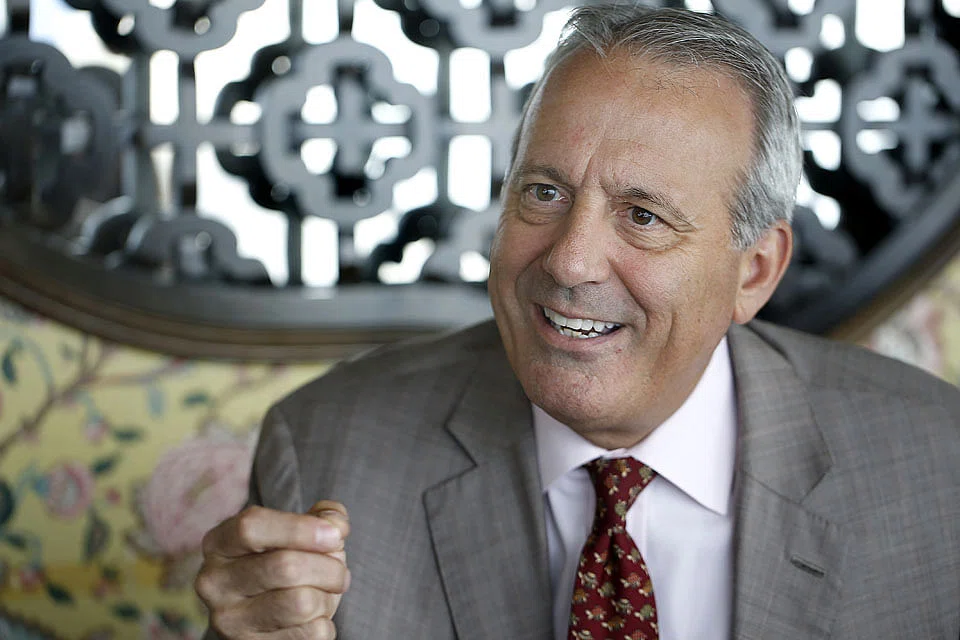
IT is an indication of how far the public relations industry has travelled, or perhaps, where it is headed, when the chairman of one of the world's biggest PR companies gets an international award for a research paper titled Brain Behaviour Story.
Christopher Graves, chairman of Ogilvy Public Relations, won the WPP Atticus Award which honours original thinking in communications last year. Over a six-year period, Mr Graves delved into primary research to understand emerging findings in behavioural economics and neuroscience to craft a new point of view on the effectiveness of narrative in communications. His findings overturn much of what communications professionals believe about what works and what doesn't in their field.
Mr Graves feels recent technological advances have turned traditional approaches on their heads in a slew of industries and PR is no exception. Five forces are reshaping the PR industry, he says.
The first one is hacktivism or brandjacking - or the taking over of a company's message or image and making a satire out of it. With new tools at hand, hacktivists can now make a multi-media parody about a company or a brand that looks professional and authentic - indeed, Hollywood standard, as Mr Graves says. Recently, a major oil company's video campaign was picked up by a satire group which did a parody clip of the campaign that got lots of traction - perhaps more than the original campaign itself. That was possible because many felt that the oil company's campaign was laced with cynicism and there were gaps in credibility.
Giving a counter example, Mr Graves recalls how beauty brand Dove did a campaign called Beauty Sketches which highlighted how media, advertising and public relations have pummelled the self-esteem of women. The campaign was the epiphany of low self-esteem among women. A parody was done with men which was the exact opposite - all the men described themselves as the next George Clooney. "It was a hysterically funny satire, but the Dove brand survived because it was the men that were the butt of the joke and not the brand.
"So it's an interesting test of brand integrity. Can it withstand satire? Do they love the brand enough to ignore the satire or does a spoof point to some structural integrity problem with the brand?" These are questions that need to be tackled.
The next big trend is what is being called SoMoClo or the confluence of social media, location-based marketing coupled with mobile technology, cloud computing and big data analytics. This is forcing brands to have a re-look at how they connect with their stakeholders. For example, say in a retail environment, big data can now be used to address specific customer needs, as opposed to the needs of a particular demographic group, and this can result in a whole new business model.
This leads to the third trend, which he calls the rise of the sharing economy in which communities, and not corporations, rent out spare capacity to customers. The popularity of the car-sharing service Uber and room renting service Airbnb are good examples of new services springing up in a new sharing economy.
"Communication and brands are trying to figure out what is a brand in a sharing economy. In a situation where many of us can share a car instead of buying one, what does that mean for branding? Is it the product, service or community that I'm branding? Is it me as a community enabler and facilitator as a brand?"
The next profound change is being brought about by the increasing use of behavioural science in the industry, says Mr Graves. He explains that much of what is done in communications today is through intuition and creativity. "But there is a huge body of emerging research in areas such as neuroscience, behavioural economics, social psychology and narrative theory that can be used.
"And when you pull these together you can find much more effective ways of crafting narratives than we have done. While intuition or creative exploration is fine, we actually need to use more science in the planning stages of narrative development and about what changes minds and what moves people because it turns out that there really is a science to that." This dovetails into Mr Graves' fifth force which is content creation and marketing. By content he does not mean advertorials masquerading as editorial content. Rather, this is deep research and credible content which can be offered for free in order to build relationships.
He gives an example: "If you went to IBM and asked them if they have scientists working on interesting things, they would probably point out to hundreds of interesting projects and scientists. But they do not have TV shows or newspaper columns in which they can show what they are doing. If they had to just depend on the media, most of the interesting things they do would never see the light of the day. But if I could write it in a not self-promoting way then this content would work."
He emphasises that clients and agencies need to understand the reciprocity issue of influence. "If I'm truly helping you by sharing something fascinating and informative and not every line is saying that I make that so come and buy it... (and) if this is really helpful then you'd say that IBM is pretty savvy on this topic.
"It's a move from explicit to implicit. This is a sort of thought leadership but much more informal and frequent. Content is more like news. It can be short form or medium form, not all of it has to be long form. It has to be very articulated without the explicit hook to get me to buy something today."
But he adds a note of caution. Content marketing has to be done just right, otherwise it can strip a great piece of writing of its meaning. "I don't think anybody would go up to William Shakespeare and say: 'I read that sonnet of yours, great content! Could I do some content marketing for that sonnet?'.
"However, that said, I do believe in content and content marketing when it's effective," he says. "You don't do it for vanity publishing but you do it to build relationships. If I do that for you (that is provide you with good and relevant content) then you will begin to trust me and then we can talk about other things after that. This is different from advertising or direct marketing. We are trying to build a relationship using content."
Mr Graves joined Ogilvy PR after 23 years in business news reporting including 18 years with Dow Jones, The Wall Street Journal and CNBC. He was promoted to his current position last year. During his stint in Ogilvy, Mr Graves held the position of president and CEO of Asia Pacific before going on to be the global CEO prior to his current position.
The Ogilvy PR chairman believes that really good public relations practitioners never try to paper over or spin a problem brought to them by their clients. Instead, they advise on full disclosure and help clients build narratives that can pass the test of social media and keep the integrity of the brand intact.
"If you take an antiquated approach today it's not going to work because humans abhor a vacuum in everything, especially in narrative, and in the absence of your narrative, they are going to create one. This means stonewalling will not work because an alternative narrative will be created, amplified and accelerated even though it's not your narrative and not even the correct one."
There is no question that social media amplifies and accelerates everything, especially a crisis. "During such times companies have to ask themselves whether they are the cause of the crisis or is it a spurious allegation that needs to be overcome?"
It's for this reason that brand reputation is so vital. "A company that already has a very strong reputation while going into a social media crisis, has a much bigger advantage and chance of getting through the crisis with some transparency and speed than a company that goes into it with a poor brand reputation." An example of how good reputation and strong brand loyalty can help a company to recover from a crisis is Apple's recent problems with so-called "bending" of the iPhone 6. For a number of days it was a trending topic on social media, dubbed Apple's "Bendgate", and KitKat, among others, did a spoof saying: "We don't bend, we break".
"You will always be the subject of scrutiny but look at the difference between Apple under attack and other companies under attack. The love and emotional empathy for Apple is greater than the analytical view of the issue. And emotion always triumphs over the analytical, especially in a negative. If you don't have the emotional bonding you cannot move people's opinion in an analytical way," says Mr Graves. Apple survived the Bendgate social media crisis with its reputation and sales intact.
Mr Graves believes that good communications is not only about helping companies get over their Bendgates. It also has a larger purpose of social good. He firmly believes, for example, that good communications can be an important tool to combat outbreaks such as Ebola in West Africa.
"Much is being made of Ebola and the use of social media like Twitter but I think in order to combat Ebola at Ground Zero you will have to use ancient arts rather than 21st century social media," he says.
"You are looking at illiteracy, suspicion and a 1,000-year tradition of eating bush meat, which is the source of Ebola, in the villages where it all started. Imagine it from their perspective. You don't believe in germs or immunology and viruses as it has not been part of your education and you feel that the reason people are getting sick is because of curses. In this mental state if you see somebody come in a bizarre suit and take your relative away and then your relative dies, then it's a very scary thing."
There is anecdotal evidence from similar incidents in the past on how to combat such crises. Campaigns to fight HIV, leprosy, and diarrhoea were undertaken with the use of ancient arts of personal and personalised local folk media.
"It's puppetry, it's songs, it's theatre and storytelling. If you pull these together and you incorporate it through their own people doing the puppetry, the songs and the theatre it can be enormously effective. And that's what needs to happen at Ground Zero for Ebola. People from their own area are able to convince and convey the narrative in a story format." He feels that this can be a vital medium in spreading education among the villagers on things such as hygiene and the ills of eating bush meat.
To a question about what appears to be very sophisticated use of social media by the Islamic State (IS) to propagate its message and attract new recruits, Mr Graves observes that the rise and relatively high profile of IS is not something that can be just pinned on their social media profile.
"It's about human longing and narratives. If you look at IS within the social media context and you look at the measure of success it has had in luring young people from the UK (among other countries), my question would be, what is the narrative that has made them (these young people) so vulnerable to this alternate IS-driven narrative? What is the longing or anger that makes them susceptible to the IS narrative?"
Mr Graves feels the soul searching that has to be done must be framed thus: "Why on earth should somebody go and join IS? What is the narrative of their current situation (as citizens of the UK) that would make them vulnerable to this alternative narrative?"
"I don't think there is a government narrative out there that would combat the IS narrative," he says, adding : "What I think would (work) and what I think you are seeing more of, is disappointed and disaffected youth that tried it (the IS narrative) and found that the narrative did not match reality. You are starting to see that feeling come back through mainstream media via stories of youths who were persuaded to join IS and who then either have a friend they lost or they themselves were maimed or treated in a different fashion than to what they expected. They are getting into this cognitive dissonance between the narrative they bought into and the real life experience."
The technique of developing a counter narrative depends on something called the "identifiable victim" phenomenon, says Mr Graves. The identifiable victim effect is the story telling of one individual as opposed to a theory or a grand pronouncement. It needs to be bottoms-up grassroot stories.
"You cannot use a negative of IS to lure those who have already been lured by the 'romance' of IS. I would say we have to fashion the alternative narrative through individuals and it has to be much more positive and believable - there is an alternate reality and alternate outcome that they are pursuing that is getting them in danger's way.
"Is anybody crafting that narrative now? I have not seen that yet. I also think it cannot come from the government. It needs to come from people who have no official ties (to the government) and are not paid to do it but do it because it is the truth."
At the end of it all, Mr Graves is looking to make sense of what's happening in the world and human society in relation to the tectonic shift that is occurring due to technological advances. As his research and publications show, he is looking to understand how people's minds work, that is, get to know how their brain functions and he wants to use a range of tools from various scientific disciplines to do that.
And all this in order to craft a better narrative, tell a good story and create great content. He also believes that at some point of time there will be no clearly delineated line separating advertising and PR. "It's not going to be those clearly defined silos," he says, adding that this is where Ogilvy PR has a huge advantage in being part of the Ogilvy & Mather group.
CHRISTOPHER GRAVES
Chairman, Ogilvy Public Relations
1958 Born in Norfolk, Virginia, USA
1981 Graduated from Wesleyan University with a BA in English
1987 Executive producer, Wall Street Journal TV Division at Dow Jones
1993 Vice President/Managing Editor of Asia Business News (Dow Jones)
1997 Vice President, CNBC Asia
1998 Vice President, CNBC Europe
2000 Managing Director (Europe & Asia), Dow Jones Consumer Electronic Publishing
2002 Managing Director, Far Eastern Economic Review (Dow Jones)
2005 President & CEO, Asia Pacific, Ogilvy Public Relations
2010 Global CEO, Ogilvy Public Relations
2014 Global Chairman, Ogilvy Public Relations