

Building Scale
Loh Boon Chye, CEO of the Singapore Exchange, addresses concerns about the stocktrading industry and the issues that keep him up at night.
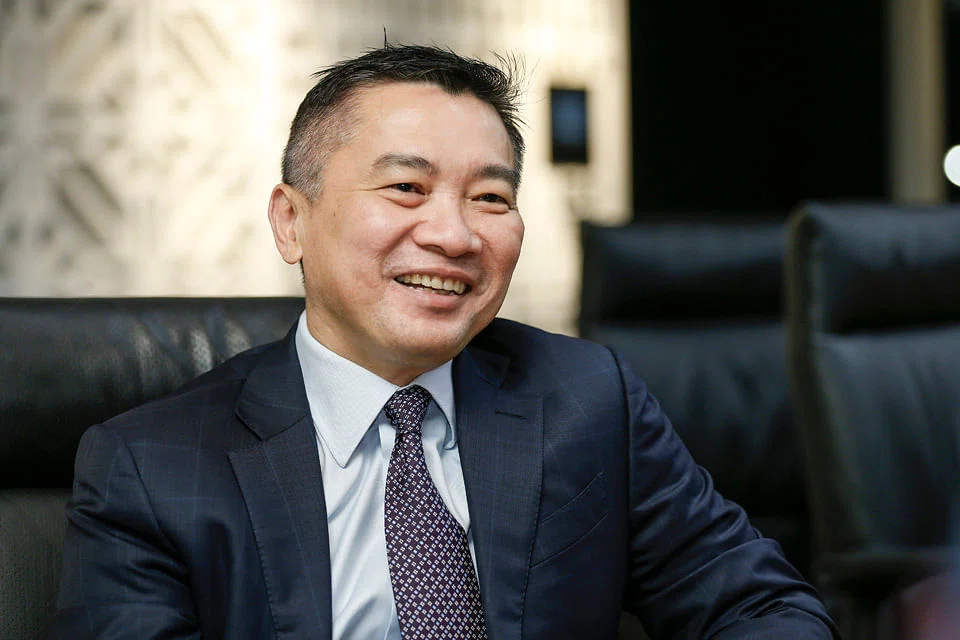
TO SINGAPORE EXCHANGE (SGX) chief executive Loh Boon Chye, the strength of the Singapore passport - which now ranks as the world's most "powerful'' since it requires the least number of visas for travel - illustrates well the "scale" that the bourse seeks to achieve.
"We're a small country but we have the number one passport - that's the scale I've been talking about!'' he says enthusiastically. "Scale means we can reach more countries than any other. And it's important to understand scale does not mean size; in fact, scale can be more meaningful than size.''
This idea of scale as opposed to just size surfaced earlier when The Business Times asked if the equity market is, as some have described it, a mere "sideshow'' to SGX's real money-spinner, its derivative contracts.
"If you want scale, you have to have breadth in the services, products and tools you offer and the platforms you operate. Clearly, derivatives is more global for us and yes, derivatives is where we transcend Singapore's boundaries'' says Mr Loh.
"And it's true that without derivatives we would not have been in the position where a participant could come to SGX and gain access to 95 per cent of the Asia-Pacific's GDP. No other exchange can offer that. But at the same time the equities market is important and cannot be ignored. We know that one of our primary purposes is to help companies raise capital and it's not just through the IPO market - we recently took a stake in CapBridge and also partnered Nasdaq which allows for greater global reach.''
Not by size alone
Further expanding on the idea of scale, he adds that scale means reaching and surpassing boundaries that could never have been reached purely by size.
"Our Nasdaq alliance is one example of extending scale; also opening an office in Chicago and the acquisition of the Baltic Exchange in London. We are also in discussion with others on alliances and partnerships, looking at expansion into other asset classes which would make us a lot more relevant and have better scale in terms of offerings and creating a lot more 'stickiness' for participants to come to the exchange''.
Mr Loh is SGX's fourth CEO since the exchange was formed and listed in 2000. He describes himself as being "very much a family man'' whose leadership style is founded on "mutual accountability'' - "it's not just what I expect from my colleagues but what they should expect from me''.
He took on the role after stints at the Monetary Authority of Singapore and then JP Morgan which he joined in 1992 to expand its Asian business. "But my career was really built upon my 17 years at Deutsche Bank (after JP Morgan) and I'm very proud of my time there when Deutsche became the bank for Asian business,'' he says.
It was also in Deutsche that the genial, keen-eyed, 53-year-old earned the nickname "Flow Monster'': "I believe to be really effective and dominant in Asian business you need to have flow, so the Deutsche bank business was really built around flows. Flow begets flow, like the equity market where volume begets volume. If I recall correctly it was Euromoney magazine that coined the name and I think they used it on the cover of one of their issues,'' he says, chuckling.
Having served on SGX's Board from 2003-2012, he assumed the CEO role in mid-2015 knowing full well that it is a "hot seat''.
"I like challenges and it was a challenging period - volume was down, markets were volatile and there were issues to deal with. My experience on the Board gave me a preview of what to expect, though of course serving on the Board and actually being the CEO is very different! But I took it on because I really wanted to contribute to the financial markets landscape. Whether in shaping it for the future, I simply wanted to contribute because my whole career has been in finance, even though I studied engineering.''
Speaking of flows and low volume, BT asks about the letter to the Finance Minister that the remisier community wrote in early 2015, which was a complaint about the state of the stock market and said urgent measures were needed to restore confidence. "I wouldn't say it was just confidence. Clearly, the level of activity and volumes were not the best and with any market, whether equities, derivatives, etc, you need volume, and that's what we set out to improve. Year to date, if you look at just the equity market, SDAV (securities daily average volume) is up 11 per cent and we have done many things - the market makers programme, investor education, corporate profiling.
"As a market operator, we have to be aware that what is good for one segment may not be good for another. So we are always trying to calibrate and strike a balance, frankly between at times very diverse interests. Different stakeholders have different views and each will - quite rightfully, I might add - argue from their vantage point but as the operator, we have to assess their inputs and act in the manner which we think is the best for the market.''
The stakeholders who penned that letter were remisiers or trading representatives (TRs), a group which has grown increasingly disillusioned with their lot in life and of late are worried about the advent of robo-advisers. So, is the original TR model still valid in this age of disruption? "Yes it is,'' Mr Loh replies firmly. "But as with any other industry or profession, changes abound and there is a need for them to adapt and recalibrate. I start on the premise that relationships in any business, and in particular in finance, are important and even with the advent of machines and AI, robo-advisers, the human brain is still needed.
Market insights
"After all, it's humans that design trading algorithms - yes, thereafter the machine takes over but the process started with humans, the interaction among various players about what makes sense given certain market conditions and what potentially winning strategies might be. TRs are very important because they provide market insights and context having experienced many cycles.
"As for robo-advisers, they should be seen as complementing the existing TR model. Robo-advisers will allow TRs or dealers the opportunity to offer scale in their business because before one inputs answers to the questions that robo-advisers ask, what goes into the inputs for the questions to be asked? TRs with their years of experience, interacting with their investors, they understand what is important. TRs could then use robo-advisers to offer customers greater scale. Also, their constant interaction with clients allows them to re-input and recreate better algorithms to ask better questions which in turn hopefully leads to better asset allocation advice.''
Another commonly heard complaint is that other than the 30 Straits Times Index components and perhaps a handful of other mid- and small caps, interest in the broader market is poor. In Mr Loh's view though, this is seeing the glass as half empty.
"We could talk about trading being largely concentrated in the big stocks or the STI but that's only one measure of performance. For example, I could also judge performance by returns and here, if one had bought the best performing sector every month this year, you'd be up close to 80 per cent,'' he argues. "Likewise, if you had been in the worst performing sector every month, you'd be down 30 per cent. Our index is up in dollar terms close to 25 per cent versus regional peers of around 18 per cent. So it all depends on which way you want to look at it.''
On the subject of balancing roles, yet another gripe often levelled at SGX is that it functions as a listed regulator with potentially conflicting interests. Is that arrangement still valid today?
"There is no one-size-fits-all. I still believe in the model but we have to constantly rethink the fundamentals. So now, having the regulation unit under a new subsidiary, RegCo, is one way of recalibrating the model.
"Rule changes can be effected quicker than legislative changes and because legal action takes longer to process than disciplinary action, there are clearly benefits in having a listed regulator. Also, being in the frontline, you're interacting all the time with market participants, so you're always hearing recommendations about how to make the market a better place. One of the comments we've heard is whether we are taking too many small steps but I think small steps that get big wins is not a bad outcome!''
Granted, RegCo has an independent board of directors but this hasn't appeased critics who point out that SGX still calls the shots because RegCo is a wholly-owned subsidiary of the exchange.
"It's very important that RegCo has an independent board. But will the day come when it's totally independent? It's not cast in stone. Different circumstances may merit a different model so one has to be open to rethinking the fundamentals and recalibrating if need be.''
In the months ahead, the exchange will clarify its position on two "hot button'' issues - quarterly reporting (QR) and the introduction of dual class shares (DCS). On QR, Mr Loh speaks animatedly about his role as the boss of a listed company.
"We practise disclosure that's better than any dictated by the rules because it's important that we share our long-term vision with our investors,'' he says. "So what's important is that companies have to recognise that once you're listed, you owe your shareholders a duty to keep them informed, the frequency of which should not be determined by a set reporting period. I wish that resources and time permitting, this could happen daily!''
DCS is a controversial subject as governance advocates have warned against tampering with the one-share, one-vote arrangement that has served markets well for decades. However, Mr Loh believes a rethink is justified.
Going forward
"There is a subtle, nuanced difference between a company led by a founder versus a company led by a hired professional and this might call for different capital structures. It might be DCS or something else but the point is that we cannot have 'one size fits everyone' because the founder-CEO looks at businesses differently. We've finished our consultation and we're thinking it through and we need to figure out, taking into account all the inputs, what is the best way forward for the market.''
Juggling the interests of diverse stakeholders takes up much of Mr Loh's waking hours, and this extends into the wee hours of the morning. He's often awake at 2am, thinking of how to keep SGX relevant. " I think a lot about scale and again, I want to emphasise that scale is different from size. It's easy to think of Singapore as a small country and seeing the glass as being half empty. This isn't the right way to approach things - let's look at it as half full and take the attitude that we can build scale despite our small size."
LOH BOON CHYE Chief Executive Officer, Singapore Exchange
Age: 53
Education: Bachelor's Degree in Engineering, NUS
1989: Started career as Investment Officer, MAS
1992: Joined S'pore branch of Morgan Guaranty Trust Co of New York, managing South-east Asia fixed-income and derivatives business
1995 to 2012: Held various leadership roles in Deutsche Bank AG, including Head of Corporate & Investment Banking for Asia Pacific, Head of Global Markets for Asia, and CEO of Global Markets at Deutsche Bank AG in Singapore
December 2012 to May 2015: Deputy President and Head of Asia Pacific Global Markets at Bank of America-Merrill Lynch; Country Executive for Singapore and South-east Asia and a member of its Asia Pacific Executive Committee
July 14, 2015: Joined SGX as CEO, and Executive and Non-Independent Director on the SGX Board
Other Directorships: SGX Board (October 2003 to September 2012; since July 2015), GIC Board (since November 2012), EDB Board (since 1 February 2017), Board of the World Federation of Exchanges (since Sept 2017)
TRENDING NOW

Inside Jensen Huang’s last hours as Nvidia CEO

Higher rates, weaker spending: Is the Philippines entering stagflation?

‘I’ll be buying more’: Singapore investors pour into Nvidia shares on Jensen Huang’s exit

Demand, tech capabilities position Apac and AI as Skyscanner’s next growth frontiers: CEO Bryan Batista

