

Building smart solutions
Post-pandemic, buildings have to be flexible, resilient and overall more cognitive, says Visal Leng, Asia-Pacific president of Johnson Controls, the 135-year-old company whose founder invented the thermostat.
Tay Suan Chiang
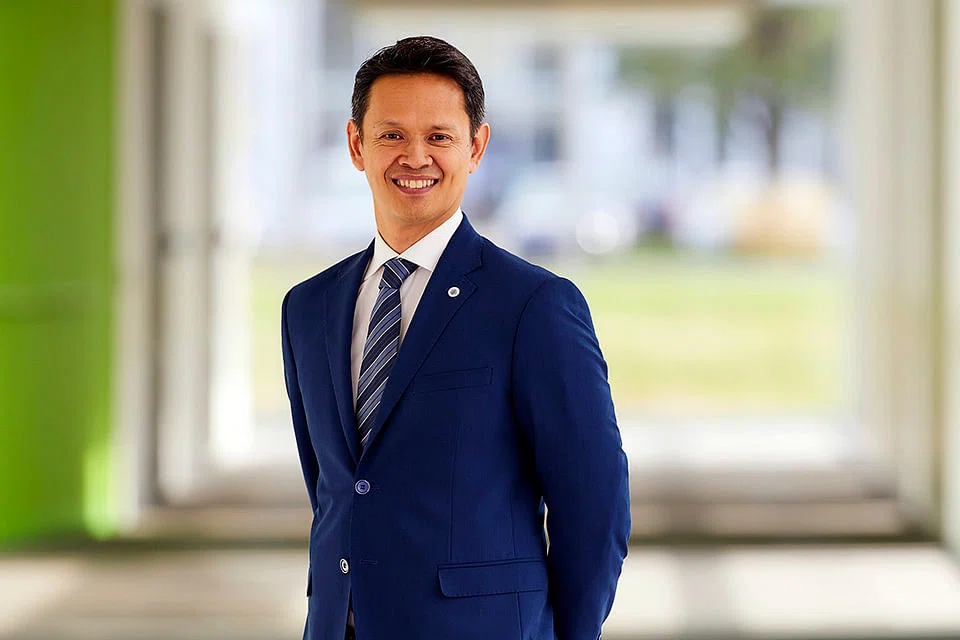
Like most people around the world, Visal Leng, Johnson Controls' president for Asia-Pacific, has been working from home. Or in his case, for the past few months, in a serviced apartment in Singapore.
Based in Shanghai, Mr Leng and his family came to Singapore in late January for Chinese New Year, and found themselves unable to return when travel between the two countries was suspended.
After working from his serviced residence for six months, Mr Leng has adjusted well to it. But during the earlier months, he too faced teething issues that many of us experienced.
"I had to help my daughter adjust to long-distance learning, and with some of her homework. I have calls at night, so there are also privacy issues to deal with," he says, during a virtual interview with The Business Times over Microsoft Teams, at his sparsely occupied office at International Business Park because the connection there is better than in his home.
Mr Leng and his family have since returned to Shanghai.
So does he miss being in the office? "I don't miss the physical space of the office but I miss the interaction with my colleagues, you know, the camaraderie," he says. "Sure, we have found solutions such as Zoom sessions, but it is not quite the same as having face-to-face contact."
The pandemic has however, brought a silver lining to the company culture. "We've had to step up as one team. Even though we have offices around the world, Covid-19 brought us all together," he says.
He adds that the company had already been thinking about allowing employees to work from home even before the Covid-19 pandemic, as the concept isn't a totally new one.
"Covid-19 accelerated our plans about working from home," says Mr Leng.
"Going forward, what we are thinking about is really how we can leverage working from home but at the same time being in the office as well. This will be pretty much the future of work."
Ensuring offices are safe
Johnson Controls' offices around the world took cues from its branches in China, which were the first to reopen, when getting ready to welcome back employees.
"The first was to ensure that the spaces and the air are clean. Then we had to consider how the new operations would be? How many people will be in the office, how many will be working from home, and how are we going to allow customers to come to the office," says Mr Leng. "We also had to consider cost, making sure that the cost of our offices is optimised, not only in the immediate future, but also in the long term. These are issues that we also help our clients deal with."
With the pandemic not sparing any industry, this will mean that how buildings are designed and run in the future will have to change.
"Offices and buildings in the healthcare sector will see the immediate changes. Schools will be impacted too. Airports are not very much used now, but in the future, they and train stations will require a higher level of safety and security," says Mr Leng.
Johnson Controls provides building solutions for four million customers worldwide, of which roughly 300,000 are in Asia-Pacific. Its solutions span across all industries, from data centres, hospitals, airports, office buildings, shopping malls to oil and gas, and food and beverage industries.
Mr Leng credits the company's wide reach, a comprehensive portfolio of solutions and a constant focus on innovation for standing out among its competitors.
It works with architects and engineers at the start of a project, but also with owners throughout the building's life cycle. "We are not about just one transaction," he says. "It is important for us to be with owners from the beginning and also later on, when there are maintenance and retrofitting issues to consider."
Before Covid-19 struck, architects and engineers were driven to make buildings more sustainable, such as using energy-efficient glass for the facades, installing solar panels to harness the sun's energy or putting in features that have good water efficiency.
A people-centric approach to building
But being green is about the building. And now Covid-19 has thrown in an extra factor into the equation. "On top of being sustainable, we now have to take a more people-centric approach," says Mr Leng. "And this revolves around safety, security, social distancing and wellness. The person in the building needs to feel safe and feel that their environment is catered for."
Already, many buildings' owners have put in place new features in terms of safety and security.
Think the deployment of thermal cameras, touchless entries into buildings, and contact tracing.
"Next, we need to think about the health and wellness of the building users, so this would be about air quality. You want the air to be clean and germ- and virus-free, and there are many technologies that offer that, such as filtration and ionisation," he says.
Dealing with air - be it its temperature or cleanliness - is the 135-year-old company's forte, which began when founder Warren Johnson invented the thermostat. Since then, the company has a long tradition in air-conditioning and air-purification.
Some of the company's products include air handling units that sit on top of buildings which filter the air, using ions, UV light, and negative pressure, which can filter air up to 99.98 per cent.
"The third thing, we need to start putting into consideration is that buildings need to be flexible and resilient," says Mr Leng. "Buildings need to be able to be able to cater for a lot of people, such as a hospital when it is experiencing a surge in patient numbers during a pandemic, or in the case of office buildings, when there is a sudden drop in the number of occupants."
He cites an example of how in Wuhan, Johnson Controls was called upon to build a makeshift hospital for 900 beds in eight days. It sounds straightforward on paper, but there had to be considerations on how to build safely, speedily and cost-effectively.
And in the case of offices, with more companies considering allowing employees to do a mix of working from home and at the office, companies may start to think about whether or not they should reduce the size of the offices, no longer catering to 100 per cent of their workforce, but rather down to 70 or 80 per cent.
"But of course, this will still be industry-dependent," says Mr Leng. "But being able to cater for large and small groups of people is what I mean when I say buildings have to be flexible and resilient."
The future of the office
But even if more people are working from home, it is unlikely that offices will disappear. After all, people around the world have been working remotely for years and yet offices still exist. Instead, Mr Leng says, the question that companies need to ask themselves is, what is the function of the office now?
"We see a strong trend for the office to be a place where you congregate and collaborate, because working remotely has its limitations," he says. He explains that studies have shown that creative thinking doesn't come from sitting in front of a screen, but from face-to-face interactions and brainstorming together.
"With that in mind, I'd say offices will be designed for collaborations, and they will have much more technology in them, such as quality video conferencing capabilities."
He predicts that offices in the future may have fewer work stations, but more conference rooms or private rooms for discussions.
Creating cognitive buildings
Mr Leng also believes that buildings will not only become smarter, such as offering contactless entry, but be more cognitive. For example, he foresees that buildings will have AI technology that will not only be able to capture the temperature of its occupants, but also track foot traffic.
"The building will be able to self-regulate with the data that it collects. For example, if it senses there are a lot of people in this room, the air-conditioning will increase. Or if there are fewer people in the office, it will send data to order less food for the canteen. Buildings will be able to recognise what the needs are and self regulate," he says.
But will it be a costly affair? Mr Leng says it all depends on the vision of the clients and how much technology they want to have. Contact tracing, which can be done using a mobile app is inexpensive, but more capital will be needed for features that require higher technology. "It is a question of the return on investment," he says.
Since the pandemic started, Johnson Controls has seen a lot more interest from companies in the solutions around safety, security and wellness.
Mr Leng shares an example of how Johnson Controls worked with a hospital in South-east Asia on developing a system where there are sensors in the wards that monitor the condition of the patients. Blinds are automatically lowered when necessary, and should there be a code blue emergency, the medical staff are alerted and operating theatres are mobilised.
As a result of such monitoring, the hospital has seen a significant drop in response time, and also a 30 per cent increase in lives saved. "In this case, the deployment of technology is priceless," says Mr Leng.
In terms of new technology, Mr Leng says Johnson Controls is focusing on digital solutions, such as being able to operate the air handling units remotely, followed by connecting one smart building to another, and eventually to creating a smart city, via an ecosystem of smart buildings.
Home monitoring
While Mr Leng's business unit is focused on non-residential buildings, he says digital solutions will affect homes too.
Home automation that already exists will become even more popular. The other area Mr Leng feels will matter more, in time to come, is home monitoring.
"This will be crucial in homes with elderly folk, where there can be a surveillance system that can detect anomalies in patterns. For example, if uncle is supposed to be making breakfast, but he isn't, then an alert will be sent to his caregiver," says Mr Leng.
The civil engineer started his career "thinking about bridges" and then spent a number of years with GE. "It is exciting to be coming back into the building industry," he says, of his current role.
What he likes about his job is Johnson Controls' mission - "we are in the business of advancing safety, security and comfort of people", he says.
Over half the world's population live in cities, and with people spending long hours in buildings, they have to be comfortable and safe. "Often people take the building's conditions for granted, but I like that I'm in the business of putting people in a space that allows them to do their best, whether it is an office, hospital, school, or even in a yoga class. We touch every activity that people are in, so that is really exciting," he says.
Maybe it is an occupational hazard, but Mr Leng is picky about building interiors. "I don't like it when the temperature is too cold, and the lighting is dim. The ambient temperature should be cool enough, and the space bright, since that is good for creativity and optimism," he says.
VISAL LENG
President, Asia Pacific Johnson Controls
1970: Born in France
EDUCATION
Master's degree in civil engineering from Ecole Speciale des Travaux Publics (ESTP) in France
CAREER HIGHLIGHTS
1994: Technical Sales, Dow Chemical
1996: Marketing Manager, GE Plastics
1999: Auditor, GE Audit Staff
2002: Finance Manager Asia, GE Plastics
2003: Quality Leader Asia Pacific, GE Power
2006: General Manager Southeast Asia, GE Water and Process Technologies
2008: General Manager Services Asia Pacific, GE Oil & Gas - Global Services
2011: General Manager, Asia Pacific, GE Oil & Gas
2017: President Asia Pacific, Baker Hughes
Since 2018: President, Asia Pacific, Johnson Controls
TRENDING NOW

World’s largest offshore wind platform by Seatrium consortium on track to be completed by 2028

Is stamp collecting enjoying an analogue revival or are its best days over?

GovTech retrenches another 38 staff in second round of layoffs

MBS adjusted property Ebitda falls 20.6% in Q3 with fewer high-roller visits, weaker hold

