

A client-driven approach
Changing expectations mean that EY has to build beyond its assurance and tax expertise to meet clients' demands for holistic solutions, says Asean regional managing partner Liew Nam Soon.

Janice Heng
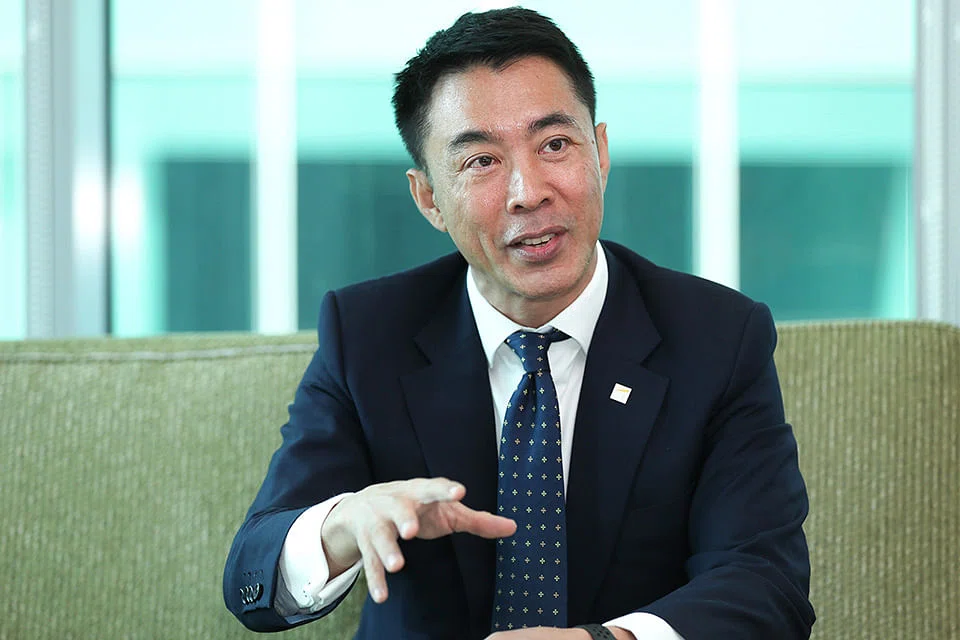
FROM an undergraduate engineering degree to a Masters of Business Administration, from consulting to industry and back again, Ernst & Young (EY) Asean regional managing partner Liew Nam Soon's curriculum vitae perhaps captures the current direction of professional services, with its increasing focus on the use of technology and industry experience.
"We're really responding to a business change whereby clients are expecting us to provide them with a broad suite of perspectives, insights, and services," he says. This is what clients are saying to professional services firms, he adds: "We really expect you to understand our business. We really expect you to put yourselves in our shoes."
EY has been making an effort to hire people with experience in both industry and professional services. Though Mr Liew pre-dates this shift, he would certainly fit the bill.
He joined the workforce after gaining an undergraduate degree in engineering from Nanyang Technological University - and after more than a decade of experience, completed an MBA at Imperial College, London in 2006.
"Life has a way of taking you to places that you didn't anticipate," he says. Graduating in 1992 in the midst of a recession, and facing a choice between Andersen Consulting or a sales-focused role at IBM, he opted for the former.
There, he had expected to handle manufacturing-related projects given his engineering background, but it turned out that there were none available. Instead, he handled financial services - "And then I loved it."
While Andersen Consulting gave him a strong technology grounding, Mr Liew wanted to broaden his scope. He thus joined PwC, making partner in 2001. Then PwC's consulting business was acquired by IBM in 2002.
"As fate would have it, I came back into more of a technology-type environment," he says. After some time at IBM, a client convinced him to join his company instead. Thus, in 2006, he took up the role of chief transformation officer at Prudential.
Spending almost three years there gave him the perspective from the other side. As a consultant, one handles individual projects. In industry, however, work does not come in such discrete blocks: "When you're running a line, those problems never go away and you have to deal with it."
At Prudential, on the receiving end of proposals from consultants, he was better able to assess what worked and what didn't, "looking at how businesses really operate".
"So that experience which I took when I came back into consulting or professional services really helped. Because now I had added credibility." Industry experience allows one to truly see things from the client's perspective and understand their concerns, down to why they are asking certain questions, and what obstacles they have to navigate internally.
Great expectations
"I had not anticipated when I left consulting to join a client, that I would come back," says Mr Liew. In fact, in 2008, he had been about to further his experience in industry by joining a bank to run their regional IT operations. But the Global Financial Crisis was not exactly the best time for such a move. When EY came to him, he accepted.
"Obviously I still prefer coming back to professional services," he says. "It's a fresh challenge almost every other day."
Mr Liew was not the only one making a change. As he explains, the Big Four firms at the time were still known more for their assurance and tax expertise, but EY was looking to build up beyond this. "It was an opportunity to kind of come back to a partnership, but also ride with EY in terms of their ambition and intent to rebuild the advisory or consulting business."
This evolution was in line with clients' changing expectations. Audit and tax expertise alone would no longer suffice: "When they look to a professional services provider, they're saying: 'We don't just want the technical experience. We want really deep domain skills and capability.' "
Even within the traditional audit practice, for instance, demands have risen. "Gone are the days when the CFO (chief financial officer) or the management team is looking for an opinion on just the financial statement analysis." While that of course remains an expectation, clients are further asking: "What does this mean for us in the competitive space we're in? What should we do as a business?"
"They are looking for more strategic insights. When you do an audit, you look at bringing other value-added advice. ... It's no longer just about the integrity of your numbers. It's about, what do these numbers really mean?"
Technology is playing a growing role. "Even in our traditional businesses like audit and tax... (what) we deliver now is digital in nature," says Mr Liew. In tax, clients are seeking not just tax advice and help with compliance, but asking if EY can "value-add", such as by running tax for them as a managed service. EY uses technology to deliver better value, with digital tax platforms and analytics.
"I think there's an expectation that all professional services providers, EY included, provide a broader, more holistic set of advice and insights," he adds. Clients do not simply want to hear about their control failures, say - they also want to know what to do about them, and whether there are technologies that can be used in this.
Other examples of technology use include a blockchain project linking shippers with insurers; the use of artificial intelligence to provide insights for optimising port crane operations; and e-citizen services. To be able to deliver such solutions, EY both works with software vendors and builds capabilities in-house.
The current Covid-19 outbreak, too, has had clients calling for tech solutions. EY is helping one government to build a digital platform to enable remote worker access and management in critical services, with an eye on governance and cybersecurity. With another government, EY has worked on how to match donations with recipients, while addressing audit and governance issues.
Meanwhile, a multinational client has been redesigning its supply chain, relying on EY's insights on this reconfiguration, including the local regulations in each market.
"When we look at a particular problem, we don't just look at it from a strategy perspective, or operations, or a technology perspective," Mr Liew sums up. "We layer in, oftentimes - because we're whole-of-firm - tax considerations, we layer in regulatory considerations."
He wouldn't use the term "one-stop shop", however. "Clients are sophisticated, they don't really want a one-stop shop," he explains. Certain professional services firms are seen as being better in certain areas, and clients may prefer to mix and match across services.
That being said, EY does offer the full range of services from strategy to implementation. Some other players focus on one end or the other, he notes: "We've seen the strategy firms try to move downstream (and vice versa)." EY, in contrast, can go in both directions: "We are actually in a sweeter spot to expand."
The regional future
In 2013, Mr Liew became the financial services leader for Asean, a role that has traditionally gone to an audit or tax role instead. "That allowed me to move out of just looking at consulting," he says, with new areas coming under his purview, such as tax, and mergers and acquisitions.
Then, last July, he was made regional managing partner - looking at all parts of EY's business in Asean.
In what directions is EY looking for the future? Mr Liew rattles off a few. There's the economy-wide data and tech transformation, as earlier mentioned, with EY having to build up internal capabilities, make acquisitions, and work with third parties.
Then there's "getting deeper into client-centricity" - which seems something of a truism, perhaps, but is about having "everything driven from the client's perspective". To that end, EY continues "to invest in domain knowledge", bringing in people with industry experience.
This is crucial as clients themselves gain more expertise, compared to a decade or two ago, he notes. Now, organisations have hired ex-consultants or built in-house research teams: "Their level of competency and knowledge is actually a lot higher. ... I joke with some of our clients, 'We're competing with you.'"
What isn't a joke, though, is EY's commitment to talent development - a third focus for the future, which includes training employees across different service lines. "We don't expect our people to be experts in everything. We do expect them to be in a position to have a broad conversation, broad enough to then bring in the tax expert or the regulatory expert or the technology expert."
In a nod to the future of work, EY has also been running its GigNow platform for gig workers for about two years. This responds to trends in both demand and supply of talent: some projects have short or medium-term requirements for staffing, and there is a growing pool of talent who prefer to work on a contract basis.
A fourth focus: simplification and integration. "We believe that when we engage our clients, (we are) not just talking about a controls issue," he says by way of example. "We are solving a business problem." Said business problem could involve control issues, broader strategy, and so on - but the big picture view remains.
Then there is Asean. Traditionally, the Big Four firms tend to invest locally within Asean, with each individual market not receiving support from the global or regional office, says Mr Liew. But he would like EY to invest on a regional basis instead.
Consider pockets of high growth, such as startup unicorns emerging from Indonesia. It would make sense to invest in Indonesia as a group, rather than only locally.
Then there is the aim of bringing the best capabilities to clients, regardless of where these capabilities usually reside. Clients, after all, operate on a regional basis too. So if a client needs support in Indonesia, and capabilities have to be brought in from elsewhere in the region, then how can this be done without Indonesia alone having to pay for it? Mr Liew's answer: "Collectively, as an Asean bloc, invest in Indonesia."
Being in Asean has a personal benefit for him, too. "One of the things I like about the Asean role is that many of these places can be done as a day trip. Most weekends I don't travel." Instead, he spends time with his wife and their nine-year-old son.
"It was only in my 40s that I had Singapore as a base," he adds. After years of living and working around the world, he felt that "it was time to kind of have a base and spend more time with family".
Granted, even while based here, he is still on the road two or three days out of every week for business reasons - at least before the current virus outbreak all but shut down international travel. Still, he does get to see his family "very often".
But a little anecdote suggests that the younger Liew is aware of what it means to have a busy life. Mr Liew had recently wanted to play some sports with his son over the weekend. His son replied, in all seriousness, that he had to check his schedule.
LIEW NAM SOON
Asean regional managing partner Ernst & Young
Born in Singapore in 1967
EDUCATION
BEng with Honours, Nanyang Technological University
MBA, Imperial College, London
CAREER HIGHLIGHTS
1995: Senior consultant, Andersen Consulting
2000: Director, financial services and venture accelerator, PwC
2001: Partner, financial services, PwC
2002: Partner, financial services and CRM leader, Asean/South Asia, IBM Global Services
2006: Chief transformation officer, Prudential
2008: Partner and Asia-Pacific financial services advisory leader, EY
2013: Partner and Asean financial services leader, EY
2018: Asean markets leader, EY
Since 2019: Asean regional managing partner, EY
READ MORE: EY appoints new country managing partner for Singapore, Brunei
TRENDING NOW

Grab CEO’s wife Chloe Tong on life with Anthony Tan and finding her purpose

Brokers maintain ‘buy’ on CDL despite investor reservations over strategic review

Deal between tycoon friends sparks scrutiny of Philippine power sector

Hwa Seng Builder, two China companies win S$1.2 billion Tuas Road Viaduct phase two contracts

