

Connecting the dots
Jessica Tan overcame her naysaying consultant instincts to build a digitech platform for Ping An Group, and rose to the role of group co-CEO, becoming one of the few Singaporeans at the helm of a Chinese juggernaut.
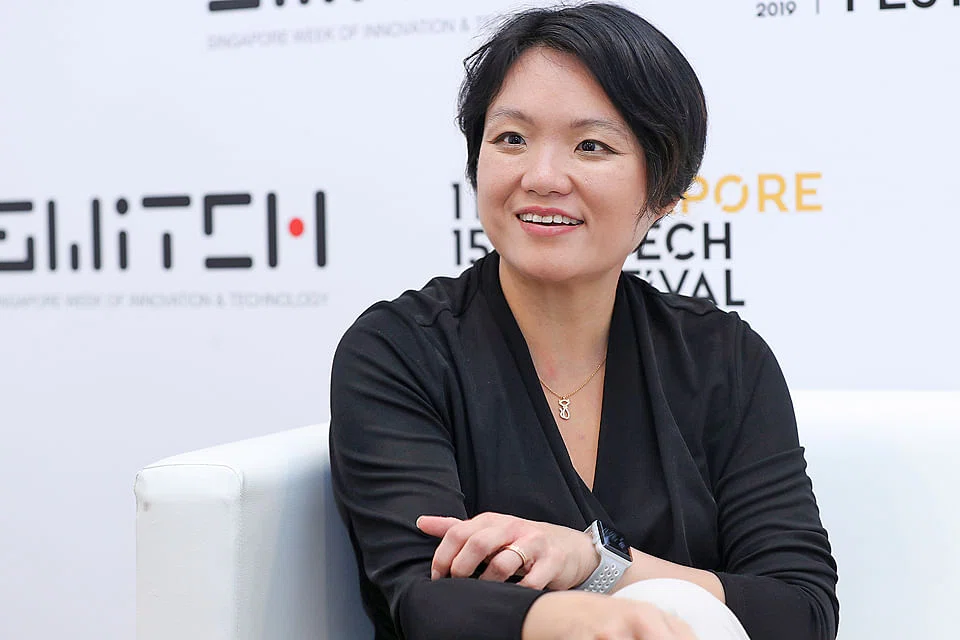
TO HAVE a conversation with group co-CEO of Chinese juggernaut Ping An Group Jessica Tan is to speak in terms of multiples and scale.
Take, for example, the launch of a digital platform by Ping An for small and medium enterprises (SMEs) in Guangdong province in China. That's 11 million SMEs in that province alone.
That platform is meant to eventually link to businesses in the Greater Bay Area - connecting the cities in the Guangdong province to Hong Kong and Macau - with the bay area already contributing more than 10 per cent of China's gross domestic product (GDP). It is projected to be the world's largest bay area in GDP terms by 2030.
The digital platform is fronted by Ping An's unit OneConnect, a technology service that sells its expertise to Chinese banks and, increasingly, financial institutions in the rest of Asia and the Middle East. Recently listed in the US, OneConnect is also a business spinoff that, had Ms Tan insisted on her way, would not have been born.
Some five years ago, when Ms Tan was tasked by Ping An's founder Peter Ma to look into building a technology business that would cater to large financial institutions, the cold, clinical assessment that she brought to the table, thanks to her 13 years at McKinsey, was that this would not fly.
"When he asked me to put (together) OneConnect, I spent three months doing my usual analysis, to tell him that OneConnect would never work. And that people won't use our stuff, and I said, 'Look, we shouldn't do it'," she tells The Business Times.
But Mr Ma, who built the business from scratch into China's largest insurer, insisted, pointing to the megatrend of China's growth, and how the 62,000 financial institutions in China will need digital services. "I'm so glad he overruled me. He said, 'Look, just listen to me, and just do it'," Ms Tan recalls.
"That's why very few consultants are entrepreneurs, we tend to see a lot of problems," she says. "I've really enjoyed working with Peter and learning, because he teaches you to see possibilities, and that's what entrepreneurs have."
Today, OneConnect alone is working with some 600 banks that process about 90 million loan applications every month. OneConnect earns off a transaction-based pricing model.
OneConnect is also expanding into markets beyond its home turf. In the one year of expanding outside of China, OneConnect is now working with more than 30 financial institutions in 10 countries and regions outside of China, with Indonesia being one market of interest. As an example, it now works with the financial services group of Indonesian conglomerate Sinar Mas.
OneConnect allows banks to use data from mobile phone bills to shopping records for credit-scoring purposes, and further layers on digital verification services such as using micro-detection of facial expressions to determine if the person is lying about his identity.
OneConnect's selling point is also in offering banks access to its platform that extracts real-time data such as sales and tax receipts of SMEs, providing a new way of assessing creditworthiness beyond the traditional ways of backing against collateral.
As with most technology companies, OneConnect has yet to turn a profit. It widened its net loss to 1.19 billion yuan (S$233 million) in 2018, compared with a net loss of 607 million yuan in 2017. Full-year revenue in 2018 more than doubled to 1.41 billion yuan, its IPO prospectus showed.
To be sure, Ping An itself is profitable, with nine-month net profit up 63 per cent over the year to 130 billion yuan. It is also big on tech investments, with the group committing to invest 1 per cent of its revenue into research and development (R&D). Over the past five years, Ping An has invested some US$15 billion in R&D.
Great opportunity
In searching for growth beyond China, Southeast Asia presents a "great opportunity", says Ms Tan, a Singaporean who flies back to Singapore over most weekends.
Singapore today is OneConnect's regional base, and through the republic, the firm has already filed technology patents here, contributing to the group's portfolio of some 20,000 patents.
Only 47 per cent of South-east Asian adults have a banking account, 2018 data from CB Insights showed, translating to about 350 million adults in this region who do not yet have any relationship with a bank. Meanwhile, only a third of SMEs in the region have access to bank lending. "Clearly, the opportunity is huge," says Ms Tan.
"If you look at some of the fintech companies in the developing markets right now, there have been very few that can make it scale. I think that really depends on two things. The first is that if you look at SMEs, it's really about getting them digitising first. I think in the past people tried to get the SMEs to digitise themselves, but it's quite difficult to do so. They lack the people and the resources....(and) it's not something that a bank, on its own, can solve."
By working with the Chinese government to build a platform for Chinese SMEs, the impact comes from building a brand-new credit bureau record. Given the added layer of blockchain technology offered on the platform, some 20 per cent of the SMEs would also volunteer further information on the platform that would provide real-time details about their financial data or supply chain.
This is unlike working with traditional banks, Ms Tan suggests, as the lenders typically work with anchor clients, and serve another one to two companies related to the anchor client. "They are not able to do seven tiers," she points out.
OneConnect also decided against applying for a digital banking licence in Singapore. This differs from OneConnect's move in Hong Kong, where it holds a digital banking permit, but is also where Ping An has a distinct foothold in Greater China.
Its decision to bow out of the digital banking race in Singapore leaves the door wide open for it to work with the incoming crush of digital bank aspirants in this region instead. A senior executive from OneConnect had told BT seperately in January that OneConnect now earns about 7 per cent of revenue from outside China, and plans to up this to 15 per cent by around 2022. The Asean operations are also targeted to break even in 2020, OneConnect had told BT.
To be sure, it hasn't been all smooth-sailing. The OneConnect listing in the US late last year, which took place after the interview, came after a big slash in valuations, with the company eventually settling on raising US$312 million on a market valuation of about US$3.7 billion. The Softbank-backed group went ahead with the IPO despite the sabre-rattling between the US and China amid trade tensions. (Ping An declined further comment on the IPO in a follow-up query over valuations.)
That being said, ahead of the IPO, Ms Tan had been asked about increased scepticism over loss-making technology firms that are heading for the public markets, given that the WeWork debacle had cast a big shadow on listings by tech-driven companies.
It would be fair to say Ms Tan is not too daunted by naysayers.
"Institutional investors are very sharp and astute investors. People still look at individual opportunities, there's a whole Wall Street that does that," she says, pointing to the "short-term aberration" likewise inflicted on Ping An's Good Doctor listing. Today, Good Doctor - Ping An's medtech firm - has gone above its listing price set in 2018. "We look for more long-term investors who care more about intrinsic long-term value and less of the short term."
That said, she points out that not many analysts and investors are able to understand Ping An's business. The problem, she says, is that analysts are less keen - or less able - today to measure the potential of the group's staggering four billion users and how Ping An can layer on financing and other services.
Here, the multiples return as part of the conversation.
In the nine-month period ended Sept 30, 2019, Ping An had added close to 30 million new customers, of whom 39 per cent came from the 594 million Internet users derived from the group's five "ecosystems", referring here to financial services, healthcare, auto services, real estate services, and Smart City services.
These "Internet users" include those who use their apps, and eventually become paying customers.
The crux - for a company that, on a group level, is still delivering a growing bottomline - is for investors to understand that the technology business is less about profit contribution as it is about growth opportunity, adds Ms Tan. "I think from a tech valuation, I'm less concerned about whether we are embedding it in our business, because that will eventually get done," she says.
She also points out that many of the Internet companies have seen most of the monetisation coming from advertising, rather than as an extraction of the value behind data.
"That's a very simple conversion of data, which is in fact only the beginning of the value, because most of it still works by clicks and referrals," she says.
"It's about thinking about the economic value behind it...so what if I have all your shopping records, other than using it for shopping? Does it mean that I now know your creditworthiness in your other parts of life? That's not true. It requires domain knowledge for that."
Ping An is one of eight holding a provisional credit bureau licence in China, and joins other tech giants who arguably have "a lot more volumes of data", says Ms Tan. But few of them actually work with financial institutions to use that data for credit decisions, she adds.
Climbing up the ranks
Ms Tan's climb up the ranks of a Chinese giant comes with a sense of purpose and adventure. After studying in the US - and rejecting the scholarship route - Ms Tan, whose parents came from Malaysia, stayed on in America to make up for lost time from having lived mainly in Singapore for most of her life.
Graduating at the time of the dot.com boom, her internships were "cushy jobs", complete with helicopter rides, among the perks. Eventually she landed at McKinsey, where she worked in 15 different countries over 13 years - India, most of South-east Asia, Germany, and London, among others. It's a sense of adventure that she would urge young Singaporeans to follow.
"When you work overseas, you get to understand how people work, how people think. In Vietnam, for example, in actual meetings, people don't really talk much. In Vietnam, everybody has a gazillion jobs. Their job is not just their official job, (they) have many other personal businesses. And then you get to know them. You sing karaoke together.
"Ultimately, (leadership) is about people. How do you align interests, to work together? And I think that's something that you cannot replicate from the books," says Ms Tan, who gets her teenage daughter to follow her to work during year-end school holidays to learn how technology is being used to transform education and healthcare industries.
"These days frankly, if today you ask me to work on a formula, I'm embarrassed to say that even though I have an MIT degree, I can't do it anymore. But it's about the concept and real-world problems. You have to have a passion to (solve) that and you cannot do it sitting at home, sitting in the classroom or just reading case studies. You've got to be there, and want to do something about it."
JESSICA TAN SIN YIN
Co-CEO, Ping An Group
1977: Born in Singapore
EDUCATION
Master of Engineering in Electrical Engineering and Computer Science, Massachusetts Institute of Technology
CAREER HIGHLIGHTS
2000: Consultant, McKinsey & Company
2008: Partner, McKinsey & Company
2013: Joined Ping An Group as its Chief Information Officer/ Chief Operation Officer
2017: Deputy Group CEO, Ping An Group
2018: Co-CEO, Ping An Group
TRENDING NOW

Once staunchly pro-China, Malaysian Chinese businesses are now distancing themselves from Beijing

Looking beyond looming CEO succession, should UOB potentially pursue a transformative merger?

Could stablecoins be the future of money?

Grab CEO’s wife Chloe Tong on life with Anthony Tan and finding her purpose

