

Crusader for fintech rules
Failing to regulate fintech or Big Tech is not unlike ignoring shadow banking activities, says Standard Chartered chairman Jose Vinals - and he's optimistic about the Herculean task of coordinating global regulation.
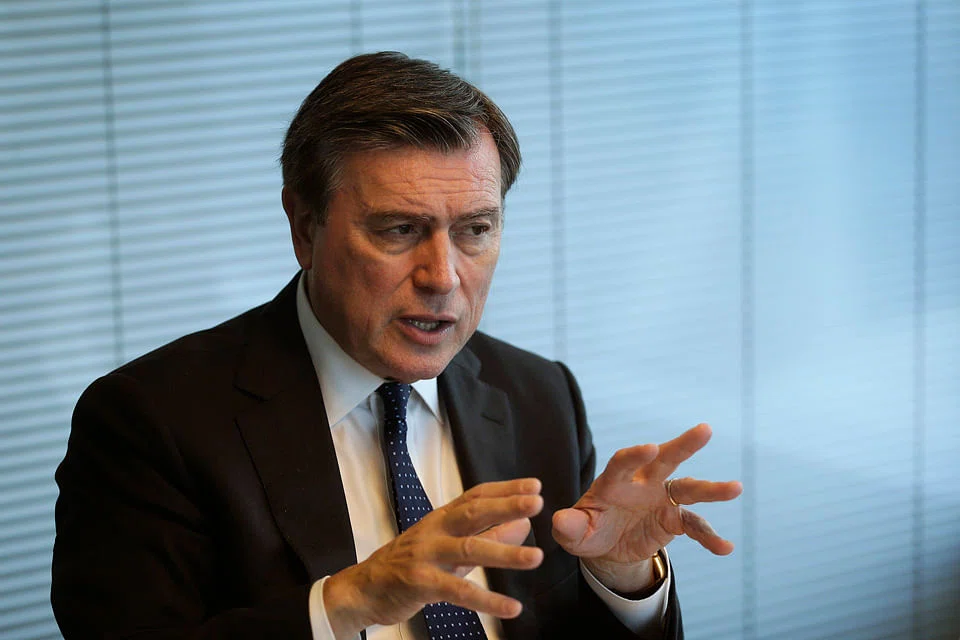
STANDARD Chartered chairman Jose Vinals will have you know that he succumbs to temptation, and his sin of choice today is biscotti. "Leave it here, leave it here," he says, pointing to the plate of almond biscuits, and then unwrapping the cling film over it. "I like sweet a lot. Too much."
Just a little appetiser before the main course - a clear-eyed tour of financial regulation - as the banker-economist taps his years of experience as a director in the International Monetary Fund (IMF), from which he went on to helm StanChart as group chairman in late 2016.
And top of his mind is greater regulation for fintech and other online companies that are growing their line of banking products. Mr Vinals thinks they have gotten a sweeter deal than they should have, and that the treats should have been rolled back some time ago.
"These are companies which are paying, compared to banks, less taxes. These are companies which are less subject to regulatory norms. These are companies which are subject to lower data protection standards. These are companies which are subject to lower competition standards, in terms of antitrust, than banks. So I think it will be very important to restore a level playing field," he says.
Today, Alibaba runs the world's largest money-market fund. Big Tech companies such as Apple, Amazon, Facebook and Google have also advanced into financial services, giving banks a run for their money.
"If you have a bank and non-bank that is carrying out similar activities which entail similar risks, it should be regulated similarly," says Mr Vinals. "I don't think that it's too early to regulate. If anything, it may be too late. Data protection, and being subject to competition laws or arbitration laws - all of those things are very important, and I think (regulation) should happen and I think it should be done thoroughly."
Big Tech and regulations
Mr Vinals further points out that failing to regulate fintech or Big Tech is not unlike ignoring shadow banking activities, as relevant a topic as any particularly when 2018 marks the 10th anniversary of the Global Financial Crisis.
"I don't think there is any value in waiting to put in place regulations which may be relevant to the supply of banking or quasi-banking products, especially when it entails maturity transformation or leverage," says Mr Vinals, who holds a doctorate in economics from Harvard University.
"Those are the two criteria that were applied for shadow banking activities. If you have leverage and maturity transformation, then that's something that banks do, then it should be regulated, because these are activities done by banks. If you're an online company and you build that leverage or that maturity transformation, that is also something that should be regulated like banks, in holding them accountable in terms of consumer protection, like banks are regarding sale of products to consumers."
But the challenge may be unifying global regulations, which gives rise to opportunities for regulatory arbitrage, especially for Big Tech companies that have services ubiquitous across the world.
"Amazon has a global reach. Alibaba has a global reach. Apple has a global reach. No matter where they are located. So I think something which is very important is that we have global regulations, or regulations which are coordinated globally, consistent across countries. Because otherwise, you're going to have the opportunities for arbitrage. And that is something that we know is not good. It distorts competition, and can lead to the accumulation of risk in certain jurisdictions," he says.
"That is the next big thing on the regulatory reform agenda, which is how to deal with the new technological front on the financial system, this new frontier, which I think is so important from the point of view of financial innovation, and which provides so many great products to consumers, but which need to get properly regulated as well."
Despite the Herculean task of coordinating global regulation, Mr Vinals is optimistic that the requisite cross-border cooperation can materialise. "As with everything in life, it's complicated. But in the past 10 years, you have seen a tremendous regulatory reform drive, which has been coordinated by the Financial Stability Board, and the mandate of the G-20. I think the G-20 governments understand that it is important to have certain laws of the land for the new financial tech frontier, and that requires coordination.
" The good thing is there are established regulatory bodies, which have been meeting for many years, which make very professional assessments of the risks, and which come up with very professional recommendations and norms, which are not obligatory for countries, but it constitutes a minimum standard," he says.
"I think it will happen. I cannot tell you at what speed. But I think it will happen because the track record for other regulations is there, and the bodies for coordinating international regulations are there, and there are also the incentives for countries to play ball because I think global challenges require global solutions."
What Mr Vinals is now fairly certain about is that, 10 years after the crisis, the financial sector is overall more resilient than before the crisis. He observes as well that the non-banking part of the financial system is overall safer, with perhaps one exception: the exchanges. "There, they need to have enough loss absorption, but also be subject to recovery and resolution standards, which provide some guarantee that if there are problems, they would not be 'too big to fail'," he says.
"I think there's been a significant change after the crisis, first because banks understood that the way they managed risk before the crisis could not continue; otherwise they would again get them into trouble. And second, because regulations have been put in place or strengthened, so that banks now have to have more capital, more liquidity, and better risk management frameworks. Banks are also more resolvable, so that if they ever get into trouble, they are not 'too big to fail', and they do not cause big, big troubles to the rest of the economy."
Taking up his appointment at StanChart, Mr Vinals was surprised by the lack of surprises for himself as he moved from the public sector to the private sector. "Something that helped me was that at the IMF, I had been dealing a lot with emerging markets, and had helped to develop economies which coincide very much with the footprint of Standard Chartered," he says.
"Perhaps, the only thing (different) is that the markets impose a time pressure. That time pressure is very visible; this is why there is a culture of performance that is very important that we have been strengthening over the last few years, so that the bank delivers on its corporate objectives."
At its heart, StanChart - while operating in 68 markets around the world - is a "plain-vanilla bank" that does things very much rooted in the real economy, he says, noting that the bank finances a healthy 6 per cent of global trade flows.
"The bank has improved dramatically since Bill (Winters; Group CEO) came in 2015. But I would say the bank has improved significantly since I first arrived, not because I arrived, but what I'm saying is that the pace of progress has continued. I have seen the risk management framework of the bank improve very substantially, becoming much more developed, much more mature, and therefore, improving the resilience of the organisation," says Mr Vinals.
"To be resilient is more important, because the more resilient you are, the bigger the ability you have to grow your business. Now we have a more holistic approach to risk management, a more developed and granular risk appetite, and much better capacity to run stress testing."
Given his vast experience in unspooling risks in emerging markets, Mr Vinals points to two risks ahead. The first is to do with normalising monetary policy, particularly in the US. "The central scenario of gradual increases of rates would be favourable for our business in general. But if that pace of increase in interest rates were to happen more rapidly than is now expected, and were to be accompanied also by a stronger dollar, that would be a more challenging environment for many economies, including the emerging markets."
The second, which has gripped markets worldwide, is the escalating trade war between the United States and China, which is leading economies towards a new reality of trade protectionism, says Mr Vinals.
"It is very important that we don't do anything to undermine the multilateral global trade system that has served the world economy so well and has allowed integration of more and more countries into this global trade system, and has allowed countries to benefit, including and particularly emerging markets in Asia," he adds. "We should not undermine that source of strength."
Benefits of globalisation
He adds that China's rise in the global economy and as a key player in the global trading system, has had a very beneficial impact on other countries, particularly in Asia. "I'm a big believer in win-win. Trade is a win-win situation, it's not a zero-sum game. China has gotten bigger and bigger in economic terms, but I think that that's a natural development. And the Chinese growth has been a source of strength, contributing to sustained global demand at a time when advanced economies were not doing quite well during the global financial crisis. Now the US and China, as the two largest economies in the world, need to find a mode to collaborate, to cooperate, so that we can perfect that globalisation, because I think that globalisation, in spite of the critics, has to be perfected but not destroyed," he says.
"Sometimes, globalisation gets blamed for side effects for other things. For example, rapid technological change. Technological change is something that we all know is good, is a factor behind increased productivity. And productivity is behind growth, and growth is key for countries and people. But yes, there are distributional effects, where technology displaces jobs from certain occupations, and displaces jobs from certain countries. That is natural. But that should not lead to the conclusion that you should prohibit technology or invention. Rather, you have to address the negative side effects through appropriate social policies at the national level.
"The same thing happens with globalisation. Globalisation has been, overall, favourable to countries, but not everyone has benefited equally from globalisation. That doesn't mean that globalisation needs to be abandoned. It means that you need to accompany globalisation with policies, which allow for a better distribution of the profits or the benefits of globalisation, so that it filters through society in general, not just certain segments."
Still, there remain concerns that China's mounting debt poses real threats to the stability of the global economy today, he notes. There are also fears that China's One Belt One Road strategy is one-way in terms of investment flow, creating concentration risks.
This, Mr Vinals points out, is precisely where commercial entities should step in, to ensure the soundness of projects along this new Silk Road. These commercial firms naturally include banks. For StanChart, One Belt One Road is a strategic objective; the bank hopes to identify and mitigate risks in projects. It instils governance and discipline into trillions of dollars in projects, he says.
"I think that initiatives that tend to foster connectivity across countries, and that are conductive to more trade and more investment, are good for growth and development. Yes, this is China's initiative, but we would welcome it as much as if it is a Japanese initiative, or if it is an Indian initiative, or a US initiative. It doesn't really matter where good ideas come from, as long as good ideas are put in place.
"Having said that, I think that while the One Belt One Road has important opportunities to be a win-win for all the countries involved - for China and all the countries present on the One Belt One Road - it is very important that the projects that are going to come associated with the One Belt One Road are projects which are planned, signed, and executed according to a logic that ensures and preserves their commercial viability, so that these projects can be really useful for countries' growth. So the issue of good governance of the projects on the One Belt One Road, I think, is very important to yield the private and social benefits that we are all expecting from it," he says.
"These projects along the One Belt One Road are financed to a significant extent by debt, which is incurred by the recipient country. So it is in the best interest also of the recipient country, and of China, that these projects are well-designed, because the recipient country needs to have viable projects, so that these projects can generate the revenue that helps them repay the debt to China, or to whomever has helped to provide the funding."
If done right, StanChart would be tapping into a bright future overall for Asia as a region. "The developed markets have reached a steady stage. But that steady stage is going to be perturbed and disturbed by what we're seeing in Asia. When we come here, what we get is a glimpse of the future. We need to understand that Asia is at the forefront of innovation, of changing the landscape of the global economy, and of finance," says Mr Vinals.
And StanChart is firmly rooted in the region, with Singapore as one of its global hubs. That means, for Mr Vinals, frequent trips to the Lion City - something that he welcomes, not least for its culinary temptations as well.
"The problem when I come to Singapore is that I always leave with excess weight, which is easy to take out because once I go to London, with its carrots and boiled vegetables, I lose it very easily."
JOSE VINALS
Standard Chartered chairman
EDUCATION
PhD, Economics, Harvard, US
MA, Economics, London School of Economics, UK
BA, Economics,
University of Valencia, Spain
CAREER
1981 - 1986 Professor of Economics, Stanford University
1986 - 2006 Bank of Spain; latterly as Deputy Governor
2001 Awarded Premio Rey Jaime I (King James I Prize) in Economics
2009 - 2016 IMF; Financial Counsellor and Director of the Monetary and Capital Markets Department Since 2016 Group Chairman, Standard Chartered
TRENDING NOW
Gas Supply may pursue remedies if contract breached following Indonesia’s export cuts: Tan See Leng

Why the biggest business decision about AI isn’t which model to choose

If Europe goes to war, the fallout will be felt in East Asia
Singapore expects all parties to honour commitments, says PM Wong after Indonesia cuts gas exports

