Extending the last mile: Can logistics players continue to deliver?
Third-party logistics companies have thrived during the e-commerce boom amid Covid-induced lockdowns, but with e-commerce platforms starting their own fleets, delivery companies might have to do something slightly different.


A quick knock, the sound of scurrying footsteps and a package placed at the door - that's the now familiar experience most people associate with logistics companies.
Covid-19 induced lockdowns helped third party logistics (3PL) companies thrive over the past year, bringing deliveries right to your doorstep, allowing you to avoid crowds and social interactions. Their logo-emblazoned vans, riding on the e-commerce boom and unloading parcels daily, are now a familiar sight at every estate.
Still it's not all roses for these last-mile players. Consumers frequently complain on social media about how parcels are mishandled or deliveries missed. Meanwhile, e-commerce marketplaces Shopee and Lazada, that provide the bulk of the delivery business, have set up their own in-house delivery fleets as well.
Online retail giant Amazon led the way in the US, setting up its own fleet, and is now on track to becoming the biggest delivery player Stateside. Yet in Singapore, Amazon has moved away from using freelance drivers and gone on to utilise 3PL providers like Ninja Van, perhaps a sign of how things are slightly different here.
The challenges arising aren't fazing Singapore delivery players, as volumes have gone through the roof. After all, it's not just e-commerce marketplaces that are providing business for them, but also traditional brick and mortar businesses that are shifting sales online.
Ninja Van is processing 2 million parcels a day across the region, 3 times its pre-Covid-19 volume. Another 3PL provider, Pickupp has seen a growth of 2 to 3 times in parcels processed daily from the pre-Covid 19 period.
"They are actually busier than they ever were, largely because the market is that much bigger now for the digital commerce space," said Sudhan Sundaram, managing director, supply chain strategy & consulting lead (products), South-east Asia at Accenture.
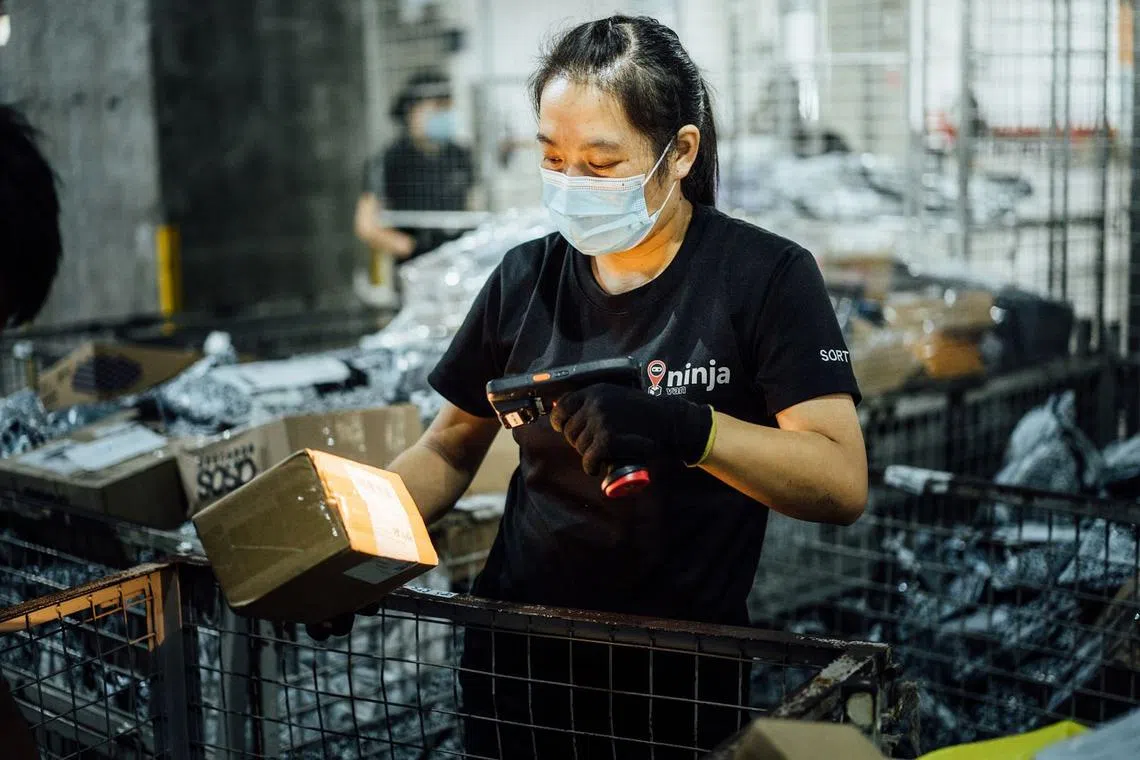
While retail platforms like Lazada and Shopee dominate both volumes and attention, there are other forms of e-commerce activity that continue to need last mile delivery players. These range from sellers in social commerce via Facebook or Instagram channels, to websites that sell directly from brands to consumers.
"There are market segments that we will continue to service, and platforms like Facebook won't service, leaving it to 3PLs like us," says Firas Alsuwaigh, chief of strategy at Ninja Van.
Focusing on the customers, in this case merchants rather than end-consumers, will be key in ensuring that 3PL players remain sticky. That means offering integration and services throughout a merchant's supply chain, going where traditional delivery players haven't gone before.
But while increasing the number of touch points will make switching providers less likely, logistics players still have to get the basics right.
"Because if we don't solve the base ability to deliver at a certain cost level, then the rest won't even matter as much," says Lim Kuo-Yi, co-founder and managing partner, Monk's Hill Ventures, which has invested in Ninja Van.>
Still, e-commerce marketplaces aggregate the most volume for 3PLs to tap onto, and news of an in-house delivery fleet would unsettle their delivery partners. But it seems that the reality is quite different.
Hand in hand
Marketplaces have been ramping up their in-house fleets. Recently, Shopee Express was 1 of 2 courier companies piloting a courier hub scheme at 2 HDB multi-story carparks, as well as buying vehicles for their fleet in the Philippines.
The ramp-up has been largely in response to 3PL players initially struggling to keep up with spiking demand during the lockdowns of the early days of Covid-19.
Monk's Hill's Lim puts it down in part to e-commerce players wanting to secure some control over the customer experience of delivery: "They want to have more control over the entire user experience from the initial buy to the actual delivery, they want to have more predictability in access to capacity."
But rather than competing, it appears that the in-house delivery fleets were built to work in tandem with their 3PL partners, unlike the Amazon model which was to replace the bulk of its delivery partners.
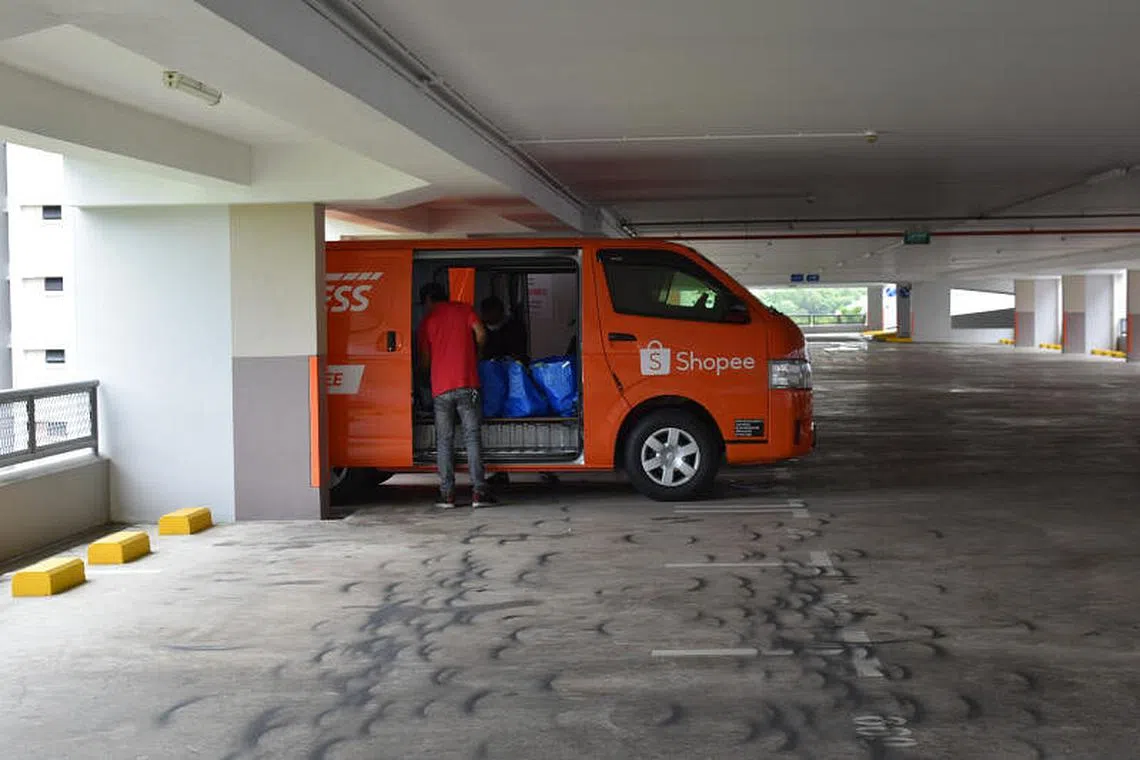
The delivery players for their part seem to be familiar with working hand in hand with these in-house fleets.
"Instead of viewing them as threats, we believe that our technology and services are able to complement as well as support marketplaces' in-house fleet," said Lee Chee Meng, co-chief operations officer, Pickupp.
The Business Times understands that the marketplaces' in-house fleets are meant to fill in the gaps rather than compete with its existing 3PL partners. Furthermore, having started so late in the game, the in-house fleets will struggle to make headway.
"They wouldn't really be able to make a big dent by investing in all of these capabilities by themselves to get 3PL providers out of the way," said Aksh Jyot Singh, principal director, supply chain & operations - 4PL / consulting, South-east Asia at Accenture.
The fleets of dedicated 3PL providers are also massive. Ninja Van employs 67,000 people across South-east Asia, GOGOX has 4.6 million registered driver-partners, and Pickupp has about 20,000 active freelance delivery agents and 20 full-time drivers. A significant hiring spree would have to be undertaken to match their fleet sizes.
Capabilities like a network of drop-off and pick-up points to expertise in handling cross-border shipments are what 3PL players have already built up over the years. In-house fleets that have just started out would lack the same capabilities, a gap that can't be easily covered by throwing more money at it.
"Logistics services from GOGOX complement with the dynamic business model each marketplace has, enabling a more flexible and diversified logistics profile for marketplaces according to the growing demands and seasonal spikes," says a GOGOX spokesperson.
Furthermore, marketplaces aren't in the business of delivering parcels, something 3PL players are, aiding a more natural state of affairs where marketplaces leverage existing expertise rather than build new ones. From warehouse operations to visibility on operations via a digital platform, the investments already made by 3PL players make it unwise for a marketplace to ignore, notes Aksh.
Notably, Alibaba has taken a stake in NinjaVan, and its open delivery platform Cainiao has also entered Singapore, partnering with an NTUC logistics unit. Both of which might point to a new partner for Ninja Van to turn into a revenue stream, as well as bind the ties with Alibaba-owned Lazada tighter.
On the merchant side too, 3PL players offer more than just doorstep delivery, giving them options that an in-house fleet alone might lack.
"While there is a dependency (on marketplaces) for their large volumes, there is a similar dependency on us for capacity," says Ninja Van's Alsuwaigh.
Customer-centred
A common misconception for consumers is that 3PL providers are mainly serving them. However, that's quite far from fact.
Ultimately it is merchants who are channelling their parcels for delivery. Offering merchants more options then is key to the continued longevity of logistics providers, rather than just being a partner on a marketplace.
It's not as if consumers are neglected, with parcel tracking and notifications now standard for the job.

But when volumes are in the millions, 99.99 per cent reliability would still see a significant number of people impacted by the 0.01 per cent failure rate. That's where robust infrastructure is needed for quick customer service recovery.
"If you wait for a week or two to recover, you may have recovered but the war is over," says Monk's Hill's Lim.
Customer service recovery is more complex than just giving it more attention to solve it. It requires internal visibility on processes and communication channels to resolve issues quickly.
"This includes setting up proper communication loops, unlimited delivery attempts to customers at faster service levels, offering refunds where necessary," says Pickupp's Lee.
All this will result in a sticky customer who would be more partial to using the same 3PL provider again.
"We do believe that a customer who has had their issue resolved satisfactorily is more retentive than anyone who has never encountered any problems before. A happy resolution creates a safeness and thereafter loyalty, that's why we invest heavily in that side of things," says Alsuwaigh.
And it might be a cliche but reliability and good service are what will keep customers coming back.
Keeping merchants on board with more than just delivery
Still merchants are the centre of business for logistics companies, and value added services - from integration with their storefront on online marketplaces to handling cross border shipments and the paperwork that comes with it - will be key to ensuring a merchant sticks with its delivery partner.
"More and more demand is in the direction of supply chain management solutions and services," says Accenture's Aksh.
That's how some logistics players have been moving up the value chain over the last year, beefing up capabilities from leasing planes to expanding to China. Others like Pickupp are offering a one-stop logistics platform with options for its customers from warehousing to micro-fulfilment to pick up and drop off services to even cross-border shipping.
All this on top of the last mile delivery service, which has become a crowded space. Pickupp now also offers an express delivery solution.
Pickupp has gone one step further to build its own e-commerce platform, Shop On Pickupp, integrating its delivery service with an ordering platform for merchants.
"Our expertise in delivery services and technology is flexible enough to meet the needs of merchants across varied industries, including your home bakers, restaurants etc," says Pickupp's Lee.
Ninja Van, meanwhile, has gone up and down the supply chain with its Ninja Direct offering, born out of efforts to build cross border infrastructure in China.
The service takes care of the entire supply chain for a merchant, from sourcing and procuring inventory from a supplier in China, to financing the payments, to shipping it across borders into their home country to handling custom clearances and warehousing. Focusing on both up and down stream, Ninja Van believes it is adding value and deepening its relationship with its merchant customers.
"So a bit more dependency and a lot more bandwidth, then the merchant can come to us as a pretty much one-stop logistics supply chain solution where we take care of everything from the top to the bottom," says Alsuwaigh.
Currently Ninja Direct is available in Indonesia, Malaysia and Vietnam, with Thailand and Philippines still in the early stages. Ninja Van is still evaluating if Singapore would be a suitable market for the offering. The service has grown about 5 times over the last one and a half years, with 2,000 active merchants now using the service.
To be fair, this service isn't a new one, with procurement agents and freight forwarders able to do the same for merchants. But the fragmented space allows a 3PL provider like Ninja Van to package it together, and lean on its own branding to gain trust from merchants.
"As a much larger player and offering the credibility and certainty that hey, you can trust us to help you get your shipment all the way in. So generally moving that type of behaviour from existing small procurement agents to us has been quite easy," says Alsuwaigh.
Ninja Van is looking to attract merchants going through wholesalers to aid them in sourcing and procuring directly from China, Thailand or Vietnam. "Pretty much a work in progress but very promising growth and very quick as well," he adds.
As 3PL providers seek to cement their relationships with both merchants and consumers, doing just the basics of delivery is no longer enough. The last mile could be a very long run.