

Flexible workspace operators in Singapore on expansion path again
With the return to office, demand is rising and utilisation rates are as high as 70 to 80 per cent

BUSINESS has been brisk for operators of flexible workspaces here in the past few months after a couple of lean years due to the pandemic. And they are set to resume on the expansion path even with the cost of flexible offices here reported to be the third-highest in the world, after New York and San Francisco. The average cost of private office desk space in Singapore is US$834 a month, according to Workthere, a flexible office leasing agency under property consultancy Savills.
The pick up in demand for co-working space and serviced offices has come on the back of the Singapore government’s relaxation of travel restrictions in and out of the country, facilitating the setting up of offices here by overseas entities. More people being allowed to enter office buildings also boosts footfall at flex space facilities.
“Corporates are also increasingly open to adopting the core-flex model offered by landlords, given the fast-changing operating environment and the limited availability of Grade A office space in the CBD,” said JLL Singapore’s head of research and consultancy, Tay Huey Ying.
One instance of a core-flex model in play would be when an occupier needs more space but cannot get any from the landlord; however, a co-working operator in the building may be able to help.
“Additionally, office redesigning activity is expected to pick up pace as occupiers take steps to ensure employees are returning to sustainable and healthy working workplaces that are fit for purpose in a post-pandemic world... They could turn to flexible workspaces as swing (or temporary) spaces in the interim,” Tay added.
Tricia Song, head of research for South-east Asia at CBRE, said: “On the back of steady demand from end-users and high occupancies across flexible workspace centres in the CBD, driven by a combination of mid to large-sized enterprise deals in the past 6- to 9 months, we are seeing flexible workspace operators resuming expansion plans and expect to see a number of new site acquisitions/signings within the year.”
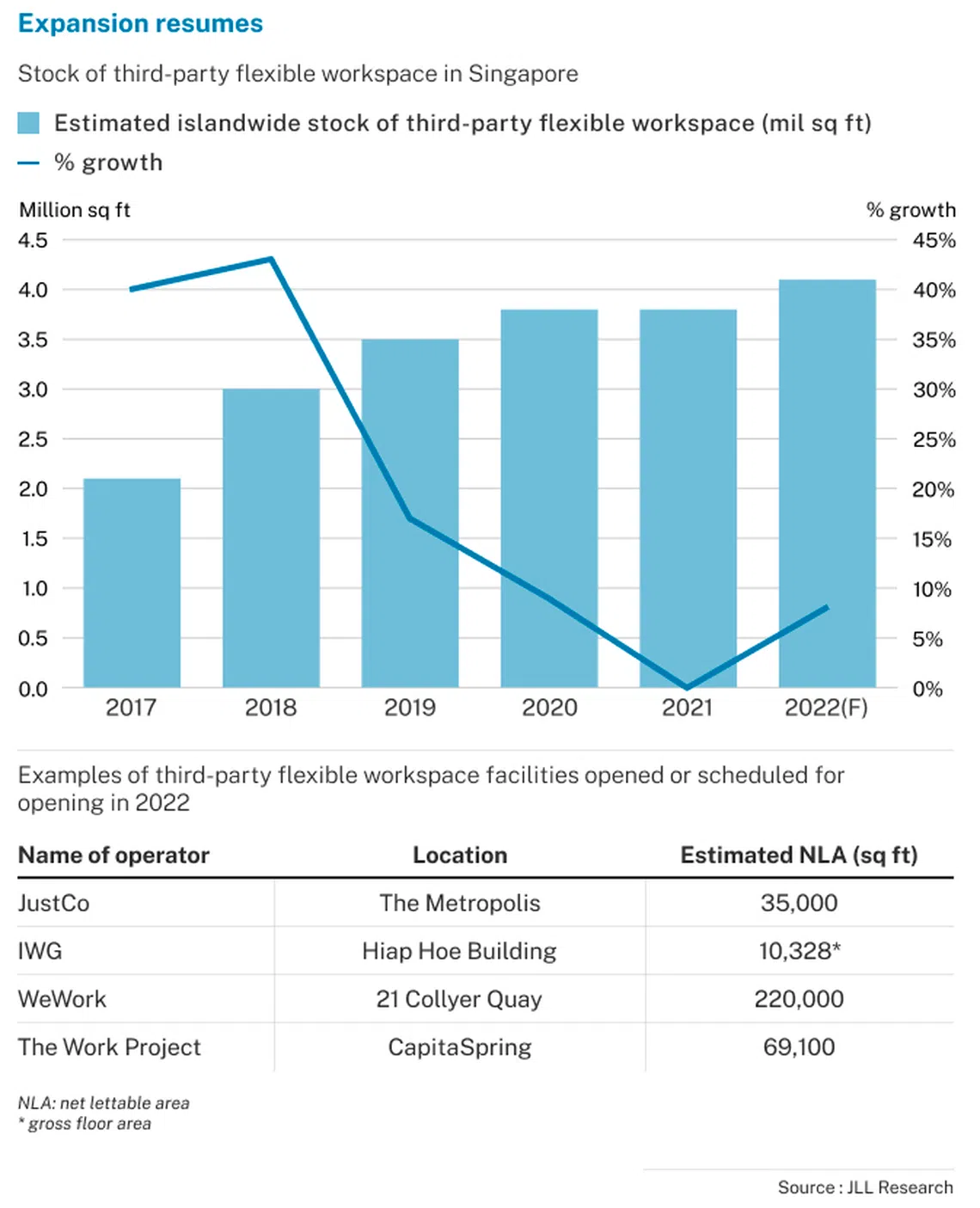
This would be in addition to the roughly 318,000 sq ft of flexible workspace opening this year, based on information as of end-March 2022, said Song.
Footprint growth by flex space operators in Singapore slowed significantly in 2020 and 2021, while their centres’ utilisation rate went down to as low as 30 per cent during the pandemic, said Song. “However, with the return to office, demand has come up and we are hearing of utilisation rates as high as 70 to 80 per cent.”
JustCo said the average new deal size of large enterprises for its flexible space in Singapore in Q1 2022 was 85 workstations, up from about 73 workstations in Q4 2021. New enterprises it signed up in the first 3 months of 2022 include a global bank, fintech and financial services companies, healthcare providers, and an investment management company. Its existing large enterprise clients include Lazada and Tencent.
In similar vein, WeWork ‘s general manager for Australia and South-east Asia, Balder Tol, noted that flexible workspace adoption is no longer driven just by small and medium-sized enterprises and start-ups alone, but led by large enterprises.
“Large enterprises, which make up more than half of our business here, are offering more flexible work to meet the shifting employee preferences and evolving business strategies. Large enterprises like US pharmaceutical group MSD, French group Thales, and Open Government Products are some of WeWork’s members in Singapore,” said Tol.
The flex space operator said large enterprises usually take up dedicated workspaces across large offices and several floors, with the flexibility to customise the space according to their unique needs.
Tol also shared that WeWork has been seeing interest from European, Chinese and American companies to strengthen their presence in Asia, with Singapore as a regional hub and launch pad to expand into the rest of the region. This is especially with the upcoming opening of its biggest centre in the region, at 21 Collyer Quay.
“We have also seen companies restructuring, re-looking business strategies and moving their headquarters from markets like Hong Kong. WeWork Singapore has also tracked a close to 13 per cent increase in sales and inquiries from Hong Kong-based companies from Q3 2021 to Q4 2021, with the intention to locate and scale their operations into Singapore.”
JustCo says that enquiries for its workplace solutions jumped by more than 40 per cent in Q1 this year over Q4 last year, with a spike right after the easing of restrictions announced in March. “The increase is expected to sustain through April,” said Michael Sim, vice-president and head for JustCo Singapore and Korea. The average occupancy at JustCo facilities in Singapore is now 75 per cent, close to pre-Covid levels.
WeWork occupancy in Singapore for March 2022 was up 20 percentage points from the same month last year.
With more co-working operators branching out from the CBD, these facilities provide a third place of work in the hybrid work model – besides the corporate office and home – for staff who need a more professional setting for work and to hold meetings, but closer to their homes.
IWG’s country manager for Singapore, Darren Rogers, said visits to its locations beyond the city centre increased by 37 per cent between February and March this year, outpacing the 32 per cent increase for its CBD locations. IWG locations outside the CBD include Joo Chiat, Paya Lebar, Tampines, one-north and Jurong East.
Observers say that the attraction of co-working facilities to occupiers is that the space comes fully fitted and they can use shared office services and amenities like printing, the pantry and meeting rooms – without paying for a fixed lease to house these facilities as in a conventional office lease.
Moreover, flex offices come with the option of shorter-term leases to suit occupier requirements – instead of being locked into a typical 3-year lease for conventional office space.
TRENDING NOW

First Resources blames El Nino, outside fires for Kalimantan hotspots amid haze scrutiny
High Court rules against Julius Baer’s Singapore trust arm in US$50 million family trust dispute
Singapore key exports jump by higher-than-expected 68.4% in September, led by non-electronics
MSCI proposes standalone status for Indonesia; Jakarta stocks plunge 8%

